Bagua

Tuesday, February 12, 2019
Repost: Qi Breathing Video
Here is a repost, because in light of my previous blog someone had asked me for it, of the video on how to perform Qi Breathing.

Monday, February 4, 2019
Practicing Out of Balance
Some students have asked me regarding how to effectively maintain cultivation practice when they are sick, or very tired, or swept up in emotional turmoil, or deeply distracted by some other activity. This is a very important subject.
With regards to all four points of difficulty, clearly it is easier to Show Up when you are in a state of Balance.
All four of the situations you describe are basically situations of being unbalanced.
And yes, all four can be difficult.
The fact is that when you are challenged, that's when it's easy to lose balance.
It's in those moments that you have to have the level of consciousness to be able to realize that you're out of balance, and then get back to it.
Getting back to Balance can be as simple as remembering to Breathe; but you can't expect to be able to achieve that if you are only trying to remember doing that when the unbalanced situation arises.
So now this is where Discipline comes in.
If you can engage with Qi Breathing on a regular basis, doing it when things are in Balance, that will make it much much easier to remember to Breathe, and restore Balance, when things are difficult.
With regards to all four points of difficulty, clearly it is easier to Show Up when you are in a state of Balance.
All four of the situations you describe are basically situations of being unbalanced.
And yes, all four can be difficult.
The fact is that when you are challenged, that's when it's easy to lose balance.
It's in those moments that you have to have the level of consciousness to be able to realize that you're out of balance, and then get back to it.
Getting back to Balance can be as simple as remembering to Breathe; but you can't expect to be able to achieve that if you are only trying to remember doing that when the unbalanced situation arises.
So now this is where Discipline comes in.
If you can engage with Qi Breathing on a regular basis, doing it when things are in Balance, that will make it much much easier to remember to Breathe, and restore Balance, when things are difficult.
Thursday, January 17, 2019
Video: Freedom is the Basis of All Spiritual Transformation
In this week's video, I talk about freedom, on both the level of the individual and also of society. And I try to explain that freedom is the fundamental requirement for spiritual transformation in an individual; and that a society that values freedom is going to be more open to evolve socially than one who disregards the freedom of the individual.
Saturday, January 5, 2019
Can You Use the I Ching for "Trivial Purposes"?
I have often had students ask me whether it's proper to use the I Ching for 'trivial' questions.
The question usually comes from the defining of certain types of questions as important, and others as unimportant. Sometimes it involves the notion that the I Ching should only be used for questions of Spiritual importance, or deep profound life-decision questions about one's purpose or higher self.
So I am asked, for example, if it is acceptable to ask about lost keys or some problem at work or how things will go at a football game, etc.
So my perspective is that this is absolutely acceptable to do; but I think what we need to define is the difference between something being "mundane" and something being actually "trivial", in the context of the I Ching.
The point isn't that the I Ching can't be used for everyday ordinary things. In fact, the I Ching can be greatly useful for mundane questions. You can use it for everyday subjects, even minor questions or doubts, or nearly-inconsequential problems.
However, where you can't use it is for something that's "trivial" in the sense of being a question you don't really care about.
That's true whether the question is about something very mundane or something of great cosmic, spiritual or life significance.
This is the secret of understanding whether a question is trivial or not: it's not about the subject matter but about whether you have anything actually invested in the subject matter.
If you don't have a sense of the question actually mattering to you, then you should not do an I Ching casting about it.
Note: the idea that "you shouldn't do it" is not in the sense that it would somehow 'dishonor' the I Ching or that it is some kind of spiritual taboo or will cause bad karma or anything along those lines. It's simply that you shouldn't do it because if you don't have some kind of of sense of investment in the question beyond mere curiosity, the casting won't actually work for you.
You need to have some level of caring about the question asked beyond just mere curiosity. It has to matter to you a little more than that, whether it's at the level of something where you just have a strong feeling of wanting an answer even if the casting won't have any real consequence, all the way to "this casting is a matter of life and death". As long as you have investment, as long as there's skin in the game, regardless of the scale or whether the question is incredibly mundane or cosmically profound, the casting will be able to function.
Otherwise, the casting really will be "trivial".
The question usually comes from the defining of certain types of questions as important, and others as unimportant. Sometimes it involves the notion that the I Ching should only be used for questions of Spiritual importance, or deep profound life-decision questions about one's purpose or higher self.
So I am asked, for example, if it is acceptable to ask about lost keys or some problem at work or how things will go at a football game, etc.
So my perspective is that this is absolutely acceptable to do; but I think what we need to define is the difference between something being "mundane" and something being actually "trivial", in the context of the I Ching.
The point isn't that the I Ching can't be used for everyday ordinary things. In fact, the I Ching can be greatly useful for mundane questions. You can use it for everyday subjects, even minor questions or doubts, or nearly-inconsequential problems.
However, where you can't use it is for something that's "trivial" in the sense of being a question you don't really care about.
That's true whether the question is about something very mundane or something of great cosmic, spiritual or life significance.
This is the secret of understanding whether a question is trivial or not: it's not about the subject matter but about whether you have anything actually invested in the subject matter.
If you don't have a sense of the question actually mattering to you, then you should not do an I Ching casting about it.
Note: the idea that "you shouldn't do it" is not in the sense that it would somehow 'dishonor' the I Ching or that it is some kind of spiritual taboo or will cause bad karma or anything along those lines. It's simply that you shouldn't do it because if you don't have some kind of of sense of investment in the question beyond mere curiosity, the casting won't actually work for you.
You need to have some level of caring about the question asked beyond just mere curiosity. It has to matter to you a little more than that, whether it's at the level of something where you just have a strong feeling of wanting an answer even if the casting won't have any real consequence, all the way to "this casting is a matter of life and death". As long as you have investment, as long as there's skin in the game, regardless of the scale or whether the question is incredibly mundane or cosmically profound, the casting will be able to function.
Otherwise, the casting really will be "trivial".
Wednesday, January 2, 2019
Chapter 50 of the Path and the Power (Tao Te Ching )
In this new video, I read chapter 50 from my new book, The Path and the Power, a new interpretation of the Tao Te Ching, with commentary.
You can get a free PDF copy of the Path and the Power if you sign up to the Swami's Newsletter, which will give you one or two updates a month with recent teachings and new material just for subscribers.
You can join the Newsletter by following the link on the video description or by clicking on the "Newsletter Sign Up" link to the right of this blog.
(note that it's an interactive sign-up form so you need to make sure that if you have "noscript" or "adblock" or programs like that on your browser you may have to allow the page's script to see it! When you sign up, the link to the Path and the Power will be found in the Welcome e-mail sent to you on sign up, so be sure to read that)
You can get a free PDF copy of the Path and the Power if you sign up to the Swami's Newsletter, which will give you one or two updates a month with recent teachings and new material just for subscribers.
You can join the Newsletter by following the link on the video description or by clicking on the "Newsletter Sign Up" link to the right of this blog.
(note that it's an interactive sign-up form so you need to make sure that if you have "noscript" or "adblock" or programs like that on your browser you may have to allow the page's script to see it! When you sign up, the link to the Path and the Power will be found in the Welcome e-mail sent to you on sign up, so be sure to read that)
Friday, December 21, 2018
What is the Yi Fa Society?
The Yi Fa Society is a "Secret School" founded on ancient formulas for the teaching of a complete system of inner alchemy. It provides a complete curriculum of training taught over various levels, with both practical and philosophical teaching material. It utilizes a complete system of Qi Gong (Yi Fa Qi Gong) for the cultivation of consciousness, and trains its members in the secrets and symbolic language of the I Ching. Its 8-level curriculum allows students to progress in understanding and self-transformation.
The structure of the Yi Fa Society emerged from a series of revelations which came as a result of a twenty-year study of the I Ching. The I Ching is the foundational text of all Chinese spirituality; a three-thousand year old book that has been in continuous use since its creation, the oldest book of such kind in the world. Used by most as a mere fortune-telling device, sages throughout history have understood it to contain a profound system of metaphysics, and the keys to understanding reality itself. It also contains within it a system for personal transformation through a process of "inner alchemy".
The I Ching provides the symbolic basis of the system of meditation and inner-alchemy known as Qi Gong, but this too has usually been misunderstood by laymen as a mere system of health-exercises. Thus, the Yi Fa Society has designed a new set of Qi Gong practices, known as Yi Fa Qi Gong, which are meant to use the principles of the eight elements (the four celestial and four terrestrial elements) to establish a progressive set of teachings by which its members can develop inner transformation, leading to what the I Ching refers to as the emergence of the "Superior Individual", the higher or true self, through the establishment of the True Will (that is, our fundamental natures).
The Yi Fa Society's system of teachings are done in eight levels, each of which provides a graduated series of secret practices and teachings that build on the former levels. It is not tied to any specific religious teaching, but rather to the perennial philosophy of enlightenment; although it makes use of symbols and concepts that have come into common use in Confucianism, Taoism and Buddhism (as all three were influenced by the symbolism and philosophy of the I Ching).
Where to Begin?
If you are interested in joining the Yi Fa Society, please contact me here, on Facebook, or Google+ to receive an application form. Likewise, please write if you have any questions.
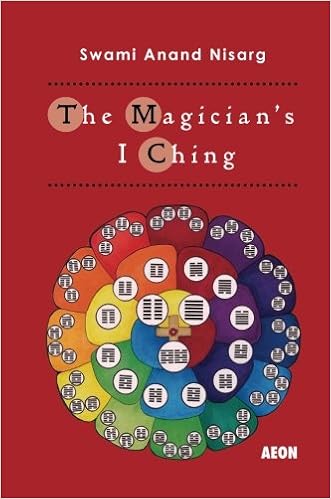
The foundation of the Yi Fa is found in the I Ching. This book provides the foundation for the entire Yi Fa curriculum, and while there are many worthwhile versions of the I Ching in publication today, the specific teachings of the Yi Fa are best expressed in the book "The Magician's I Ching", where the teachings of the I Ching as a system of divination, decision making, and tool for transcendence are explained in straightforward terms specifically designed for western readers, and for those who plan to actually use the I Ching as a system for self-transformation.
(if you are interested in joining the Yi Fa Society and working its curriculum, which is a complete system of esoteric training, please contact me!)
Wednesday, December 5, 2018
On the Nature of Nuclear Hexagrams
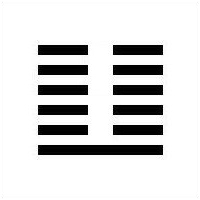
Nuclear Hexagrams are a frequently-misunderstood mystery of the I Ching. In The Magician's I Ching I attempted to give a brief explanation of how to understand them. They can be understood as "nuclear hexagrams" because they are the hexagram the exists inside the "nucleus" of a hexagram: the lower trigram of a nuclear hexagram consists of lines 2, 3 and 4 of the original hexagram, and the upper trigram consists of lines 3, 4 and 5 of the original hexagram.
So for example, Hexagram #19:
 has as its nuclear Hexagram #24:
 I have seen some people mistakenly look at nuclear hexagrams in an I Ching casting as if it was some additional part of the divination process on its own, as if there was some random element to it which contributed to the 'fortune telling' itself. But the nuclear hexagram is static, every hexagram only has a single nuclear (though in the cases of Hexagram #1 and Hexagram #2, they are their own nuclear).
In fact, Nuclear Hexagrams are part of a system of clusters or connections between hexagrams. On the cover of The Magician's I Ching, you can see this pattern depicted artistically:

The nuclears show you groups of common hexagrams which can be understood to interact in special ways. Their main practical use is for the purpose of contemplating the mysteries and deepening one's understanding of the I Ching as a whole and of the individual hexagrams. The relationship of the hexagrams connected by their nuclear provides important insights.
Let's look, for example, at the hexagrams that have Hexagram #23 as their nuclear:

Hexagram #23 is "Shedding".
In this set of four hexagrams with #23 as their nuclear, for example, you can see the pattern that starts first with the effort of beginning, with Hexagram #3, "challenge":

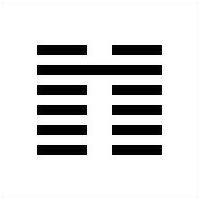
Then as you build up, it leads to bringing things together, with Hexagram #8 "Union":
After this, you move to reaching beyond the level of the foundations to be able to discover the greater mastery that is more than the sum of its parts, with Hexagram #20 "Contemplating":

And finally, to the state of making advance to a new level, with Hexagram #42 "Gaining":

So to put it another way, looking at it (for example) in the context of Cultivation: first the initial enthusiasm in the face of a vast undertaking, then the hard work of mastering the basic forms of the exercise, then when that is mastered of understanding what lies beyond the mere technical practice and exploring the essence, and then the genuine growth.
This needs to begin with Shedding (#23); you can almost imagine the "landslide" of Shedding, and following that landslide the tiny sprout of #3 breaking out of the shifted ground, then the hard work of growth, then the bearing fruit, and finally the harvest.
But it is also true that the nuclear governs at each step; as you move from one step to the next there needs to always be a process of shedding off some of what you are doing to make room for the next stage of growth.
In your own I Ching studies, first you need to study and learn the basic meanings of each hexagram by itself. But once you're ready to go deeper, studying the nuclears and the connections between the hexagrams and their nuclears will be of great use for developing a larger understanding of the greater mysteries of the I Ching.
So for example, Hexagram #19:
In fact, Nuclear Hexagrams are part of a system of clusters or connections between hexagrams. On the cover of The Magician's I Ching, you can see this pattern depicted artistically:

The nuclears show you groups of common hexagrams which can be understood to interact in special ways. Their main practical use is for the purpose of contemplating the mysteries and deepening one's understanding of the I Ching as a whole and of the individual hexagrams. The relationship of the hexagrams connected by their nuclear provides important insights.
Let's look, for example, at the hexagrams that have Hexagram #23 as their nuclear:
Hexagram #23 is "Shedding".
In this set of four hexagrams with #23 as their nuclear, for example, you can see the pattern that starts first with the effort of beginning, with Hexagram #3, "challenge":
Then as you build up, it leads to bringing things together, with Hexagram #8 "Union":
After this, you move to reaching beyond the level of the foundations to be able to discover the greater mastery that is more than the sum of its parts, with Hexagram #20 "Contemplating":
And finally, to the state of making advance to a new level, with Hexagram #42 "Gaining":
So to put it another way, looking at it (for example) in the context of Cultivation: first the initial enthusiasm in the face of a vast undertaking, then the hard work of mastering the basic forms of the exercise, then when that is mastered of understanding what lies beyond the mere technical practice and exploring the essence, and then the genuine growth.
This needs to begin with Shedding (#23); you can almost imagine the "landslide" of Shedding, and following that landslide the tiny sprout of #3 breaking out of the shifted ground, then the hard work of growth, then the bearing fruit, and finally the harvest.
But it is also true that the nuclear governs at each step; as you move from one step to the next there needs to always be a process of shedding off some of what you are doing to make room for the next stage of growth.
In your own I Ching studies, first you need to study and learn the basic meanings of each hexagram by itself. But once you're ready to go deeper, studying the nuclears and the connections between the hexagrams and their nuclears will be of great use for developing a larger understanding of the greater mysteries of the I Ching.
Subscribe to:
Posts (Atom)