Bagua

Bagua
Showing posts with label Bagua. Show all posts

Tuesday, August 14, 2018

An Excerpt From a Level-4 Yi Fa Text: Advanced Commentaries

II. The Vast in the Small

People want to imagine a top-down vision of reality, where there is some "higher" and "greater" true reality, and their everyday ordinary world is just some pale shadow of the real thing.


This perspective on reality will lend itself to escapism. Even many models of creation, like the Qabalistic Tree of Life or the older Taijitu Tree of Life, give one the impression that our material world is at the "lowest" point and everything else is higher (and thus it is suggested, more important).
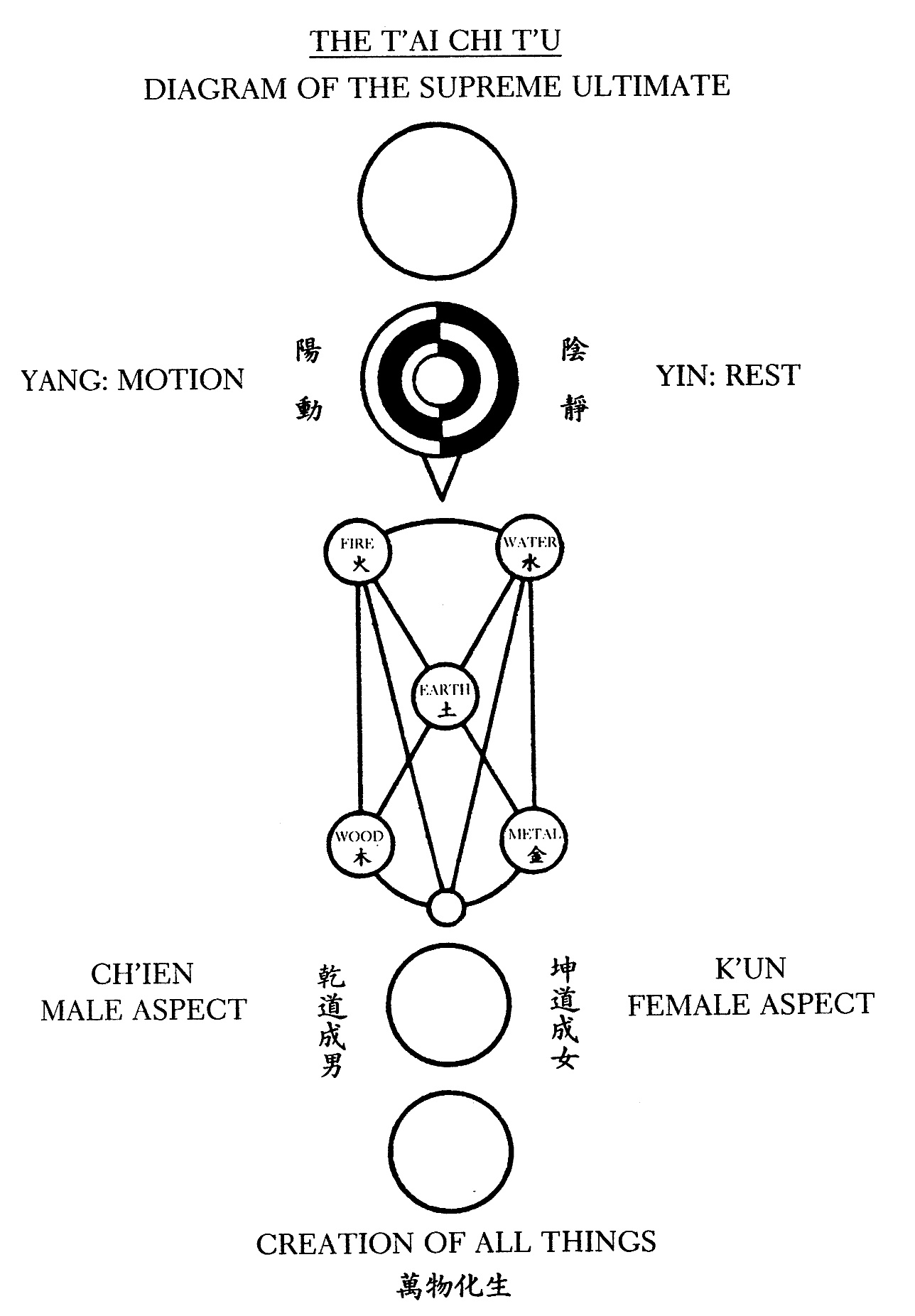


But imagine if you held those models upside-down! The World of 10000 things is the final, most completely diverse manifestation of reality.

In fact, the idea of 'up' and 'down' is factually irrelevant; there is no level of reality that is "more real" or "less real" than another. But what is true is that the root of creation begins with the simplest form, and grows in complexity into the final form. 


Consider the Taijitu: the simplest forms are Wu and Wuji, which are both types of emptiness. Emptiness is present in all levels of creation. Emptiness by definition cannot be either small or large; you can find conceive of emptiness as the tiniest gap or the largest expanse, and without anything else present (to provide boundaries for it) you cannot really consider it to have 'size' at all. Thus Wuji is "boundless".

Then there is Taiji, the ALL. The Taiji must emerge out of Wuji, as it is a more complex thing; Taiji is all that exists and all that is empty at once.

Then there are the two poles: Yin and Yang. These must emerge from the Taiji, because again they are more complex and diverse. The Sixiang emerge from Yin and Yang, the Bagua from the Sixiang, and the World of Ten Thousand Things from the Bagua.

So where could you go that is not part of the World of Ten Thousand Things to find the Bagua? Where could you go apart from the Bagua to find the Sixiang? It is like if you had an object: to find molecules you would have to look inside that object; to find atoms inside that molecule, to find electrons inside that atom, to find quarks inside that electron. You can't go looking for the building-blocks of reality by ignoring the very small, because it the more fundamental things are the smaller things that make up the more complex forms.

The Qabalists have a saying about Kether and Malkuth (the highest and lowest points on their tree of life): "Kether is in Malkuth and Malkuth is in Kether". It is the same in the Taijitu: The Taiji can only be found within the Hexagrams, and the Hexagrams are found within the Taiji. There's no place you could look for the Taiji, nowhere to "seek out the Tao", except within the Yi Fa (the manifested reality); and at the same time, you cannot find the Ten Thousand Things except within the Taiji.

It is the same way with yourself: people want to escape their material existence to seek out some kind of "higher plane" but you cannot find any such "higher" plane. You can find the vastness of reality only by going within, not by escaping to some other place. When the Celestial Eye is opened, what you see are vast universes: those universes all exist in the Yi Fa. In fact, they all exist within your own body, and your body exists within them.

So understand that the vastness of what you will begin to experience is not some other world, it is in fact the hidden interiors of this very Manifested Reality. It is within you.


(if you are interested in joining the Yi Fa society to work through a structured curriculum of spiritual/esoteric Cultivation training for self-transformation,  please contact me for an application)

Wednesday, January 4, 2017

Five Phases and Eight Elements


There's frequently some confusion in those who study Chinese mysticism/magick, in that there are eight trigrams in the I Ching, but in the greater system of esoteric teaching there is also something that is often defined as the "five elements". The initial and superficial similarity between this and the five classical elements of western esotericism (earth, air, water, fire and spirit) cause a lot of confusion.

Regarding the "5 elements": the problem that has caused this confusion relates to the use of the term 'elements'. Because what we usually call in English the 'five Chinese elements' are NOT in fact 'elements' in the sense of the five elements in western occultism!


The '5 Chinese elements' are actually five 'phases' in the cycle of generation to putrefaction.


The equivalent of the five elements of western occultism (earth, air, water, fire and spirit) are the Eight Trigrams.  The eight trigrams are divided in two parts: the four terrestrial trigrams correspond to the elements of Earth, Air, Water and Fire; while the four celestial trigrams correspond to Spirit (you could say "spirit of earth", "spirit of air", "spirit of water" and "spirit of fire").


Then, the 5 chinese elements (the 'wuxing': wood, fire, earth, metal and water), which were most likely first developed in the alchemical teachings of the School of Yin and Yang (around 500 years after the Zhouyi text, the core of the I Ching, was written), correspond to the western 'alchemical elements' (Salt, Sulfur, Mercury). And likewise to the 3 gunas in Indian mysticism.


There are five of these, rather than three, because in the Wuxing system you have three process states (Wood, Earth, and Metal), and two transitory states (Fire and Water).  The process states represent Generation, Plateau, and Decline, while the transitory states represent the moment of peak Flowering and the moment of fullest Barrenness (that is to say, the peak-state and the nadir-state). 

Thus, while the Five Phases look similar to the Five Western Elements, it is in fact representing a totally different esoteric concept, much closer to that of the "alchemical elements" of western occultism.  And it is the Eight Trigrams which are the equivalent of the elements of western occultism.


So you see similar concepts, presented in different ways. Like different languages to describe similar concepts.

This is because the thing being studied is real; it is based on the study of reality, the natural universe, and the universal human condition. So the findings will be the same. But the expression will be different because of differences of distance, history and culture. 

This is discussed a bit further in teachings of Levels 2 and up of the Yi Fa Society.

Monday, December 19, 2016

Zhuge Liang and the Stone Maze

While Zhuge Liang did not follow the same teachings as the Yi Fa descends from, he was a true master of the I Ching.  Liang was a famous general and prime-minister during the period in Chinese history known as the "Three Kingdoms" period, after the fall of the Han dynasty, when China split into three warring states in the early part of the 3rd century AD.  He was the Prime Minister of the state of Shu, one of the three Kingdoms. He was also famed as one of the greatest strategists of all Chinese history, comparable to Sun Tzu (who is more famous in the west).


In the stories relating to the wars between the three kingdoms, there is a famous account of Zhuge Liang making use of the power of the I Ching in magick to confound his enemies.  In of the many military campaigns, Liang's King, Liu Bei, was defeated in battle against an enemy general. His army retreated toward a famous temple-complex called Baidicheng, where Zhuge Liang was waiting. While the troops escaped, Liang arranged a set of stones into 64 piles, of about 5ft in height each. The pattern he arranged them in was corresponding to the arrangement of the eight trigrams of the I Ching. 

When the enemy general arrived, he felt the presence of heavy Qi in the area. He suspected a trap but saw only the strange field of stones. He chose to enter it with his men, thinking it some kind of cheap trick.

But once they'd entered, they suddenly found that the stones seemed like vast mountains. The mists of the temple seemed like a storm of cloud and dust. The men were soon totally bewildered, like in a maze.

They would have perished there, had it not been for an old man who appeared in the maze, Liang's father-in-law. He guided the general and his men out, explaining that Liang had created the maze with his understanding of the eight trigrams and the mysteries of the elements, and that only through understanding could one make one's way through it.  The enemy general, realizing that Zhuge Liang's superior wisdom was unbeatable, chose to halt and turn back from his invasion of the Shu kingdom.

This story is meant to be allegorical, about the maze-like qualities of the contemplation of nature and the eight trigrams and 64 hexagrams, and the gifts that it's contemplation can provide.
However, it is also not solely allegory. The Stone Maze was a real place, found at Baidicheng, where remnants of it had survived all the way until modern times, and had been visible until the area was flooded by the construction of the Three Gorges Dam.