In this latest video, I give you some guidelines as to how you should study the text and structure of the I Ching to maximize your ability to understand it!
Bagua

Showing posts with label cosmology. Show all posts
Showing posts with label cosmology. Show all posts
Tuesday, October 13, 2020

Saturday, March 14, 2020
Time and the I Ching
What is the nature of Time? The I Ching seeks to explain that.
This is important for understanding your own spiritual cultivation, as well as to understanding how Divination works, and why!
Thursday, August 22, 2019
What Story is the I Ching Telling You?
There's really only one story that actually matters: the story of the journey of transformation. All good stories are variations on it.
All hexagrams of the I Ching have within them a story of transformation. Each one tells its own little story. And when you combine them with other hexagrams in permutations, it's telling another story.
And when doing a casting its doing a very specific little story of transformation with regard to the one question you might have at this time. While the whole King Wen sequence tells one great big story.
There were two schools in the period after the School of Yin and Yang, after Confucius, up to the Han Dynasty. These schools were rivals, I've spoken of them before. From that school of inner alchemy, there was a division into two forms of interpretation: Image and Number, and Meaning and Principle.

Image and Number focused on the line structures, trigrams, positions of things, mathematics of the I Ching, the elements, the cosmology. All of that was the focus of the School of Image and Number.
The school of Meaning and Principle looked at it a different way, saying that what mattered was the spiritual/philosophical teaching in the I Ching and that this was found by considering and interpreting the text, rather than the image or the mathematics/cosmology.
I've commented on the imperfection of both of those schools before.
Regardless, the value of what came out of the school of Meaning and Principle was a different approach to looking at groups of hexes, not based on their structure of lines and trigrams, but in terms of the text and grouping various hexagrams based on their common themes. In other words, to look at the stories they tell.
If you do this in combination with the structural elements of the hexagrams, this is the best way to apply your studies in I Ching structure and cosmology to a more grounded and human element of connecting to that personal story of what one must do on a journey of transformation.
Saturday, August 10, 2019
The I Ching, Cosmology and Gender
In my latest video, I talk about the nature of gender according to the I Ching and its cosmology. I know this is a contentious issue, and the answer the I Ching's cosmology provides probably won't quite satisfy anyone.
Wednesday, December 5, 2018
On the Nature of Nuclear Hexagrams
Nuclear Hexagrams are a frequently-misunderstood mystery of the I Ching. In The Magician's I Ching I attempted to give a brief explanation of how to understand them. They can be understood as "nuclear hexagrams" because they are the hexagram the exists inside the "nucleus" of a hexagram: the lower trigram of a nuclear hexagram consists of lines 2, 3 and 4 of the original hexagram, and the upper trigram consists of lines 3, 4 and 5 of the original hexagram.
So for example, Hexagram #19:
 has as its nuclear Hexagram #24:
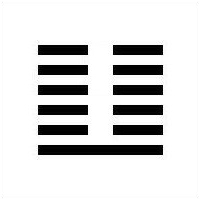 I have seen some people mistakenly look at nuclear hexagrams in an I Ching casting as if it was some additional part of the divination process on its own, as if there was some random element to it which contributed to the 'fortune telling' itself. But the nuclear hexagram is static, every hexagram only has a single nuclear (though in the cases of Hexagram #1 and Hexagram #2, they are their own nuclear).
In fact, Nuclear Hexagrams are part of a system of clusters or connections between hexagrams. On the cover of The Magician's I Ching, you can see this pattern depicted artistically:

The nuclears show you groups of common hexagrams which can be understood to interact in special ways. Their main practical use is for the purpose of contemplating the mysteries and deepening one's understanding of the I Ching as a whole and of the individual hexagrams. The relationship of the hexagrams connected by their nuclear provides important insights.
Let's look, for example, at the hexagrams that have Hexagram #23 as their nuclear:

Hexagram #23 is "Shedding".
In this set of four hexagrams with #23 as their nuclear, for example, you can see the pattern that starts first with the effort of beginning, with Hexagram #3, "challenge":

Then as you build up, it leads to bringing things together, with Hexagram #8 "Union":
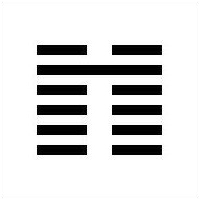
After this, you move to reaching beyond the level of the foundations to be able to discover the greater mastery that is more than the sum of its parts, with Hexagram #20 "Contemplating":

And finally, to the state of making advance to a new level, with Hexagram #42 "Gaining":

So to put it another way, looking at it (for example) in the context of Cultivation: first the initial enthusiasm in the face of a vast undertaking, then the hard work of mastering the basic forms of the exercise, then when that is mastered of understanding what lies beyond the mere technical practice and exploring the essence, and then the genuine growth.
This needs to begin with Shedding (#23); you can almost imagine the "landslide" of Shedding, and following that landslide the tiny sprout of #3 breaking out of the shifted ground, then the hard work of growth, then the bearing fruit, and finally the harvest.
But it is also true that the nuclear governs at each step; as you move from one step to the next there needs to always be a process of shedding off some of what you are doing to make room for the next stage of growth.
In your own I Ching studies, first you need to study and learn the basic meanings of each hexagram by itself. But once you're ready to go deeper, studying the nuclears and the connections between the hexagrams and their nuclears will be of great use for developing a larger understanding of the greater mysteries of the I Ching.
So for example, Hexagram #19:
In fact, Nuclear Hexagrams are part of a system of clusters or connections between hexagrams. On the cover of The Magician's I Ching, you can see this pattern depicted artistically:

The nuclears show you groups of common hexagrams which can be understood to interact in special ways. Their main practical use is for the purpose of contemplating the mysteries and deepening one's understanding of the I Ching as a whole and of the individual hexagrams. The relationship of the hexagrams connected by their nuclear provides important insights.
Let's look, for example, at the hexagrams that have Hexagram #23 as their nuclear:
Hexagram #23 is "Shedding".
In this set of four hexagrams with #23 as their nuclear, for example, you can see the pattern that starts first with the effort of beginning, with Hexagram #3, "challenge":
Then as you build up, it leads to bringing things together, with Hexagram #8 "Union":
After this, you move to reaching beyond the level of the foundations to be able to discover the greater mastery that is more than the sum of its parts, with Hexagram #20 "Contemplating":
And finally, to the state of making advance to a new level, with Hexagram #42 "Gaining":
So to put it another way, looking at it (for example) in the context of Cultivation: first the initial enthusiasm in the face of a vast undertaking, then the hard work of mastering the basic forms of the exercise, then when that is mastered of understanding what lies beyond the mere technical practice and exploring the essence, and then the genuine growth.
This needs to begin with Shedding (#23); you can almost imagine the "landslide" of Shedding, and following that landslide the tiny sprout of #3 breaking out of the shifted ground, then the hard work of growth, then the bearing fruit, and finally the harvest.
But it is also true that the nuclear governs at each step; as you move from one step to the next there needs to always be a process of shedding off some of what you are doing to make room for the next stage of growth.
In your own I Ching studies, first you need to study and learn the basic meanings of each hexagram by itself. But once you're ready to go deeper, studying the nuclears and the connections between the hexagrams and their nuclears will be of great use for developing a larger understanding of the greater mysteries of the I Ching.
Tuesday, August 14, 2018
An Excerpt From a Level-4 Yi Fa Text: Advanced Commentaries
II. The Vast in the Small
People want to imagine a top-down
vision of reality, where there is some "higher" and
"greater" true reality, and their everyday ordinary world
is just some pale shadow of the real thing.

This perspective on reality will lend
itself to escapism. Even many models of creation, like the
Qabalistic Tree of Life or the older Taijitu Tree of Life, give one
the impression that our material world is at the "lowest"
point and everything else is higher (and thus it is suggested, more
important).
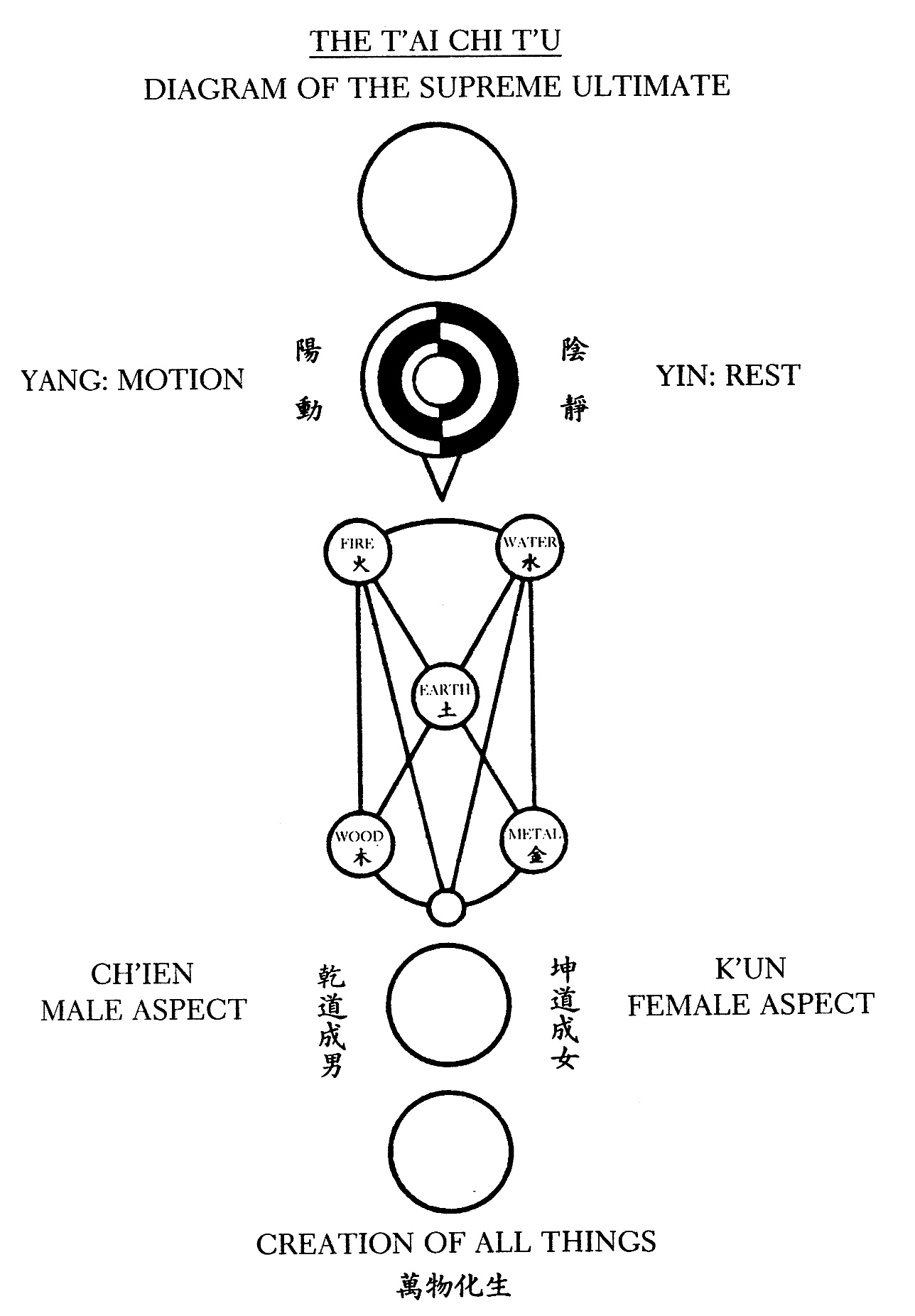
But imagine if you held those models
upside-down! The World of 10000 things is the final, most completely
diverse manifestation of reality.
In fact, the idea of 'up' and 'down' is
factually irrelevant; there is no level of reality that is "more
real" or "less real" than another. But what is true is
that the root of creation begins with the simplest form, and grows in
complexity into the final form.

Consider the Taijitu: the simplest
forms are Wu and Wuji, which are both types of emptiness. Emptiness
is present in all levels of creation. Emptiness by definition cannot
be either small or large; you can find conceive of emptiness as the
tiniest gap or the largest expanse, and without anything else present
(to provide boundaries for it) you cannot really consider it to have
'size' at all. Thus Wuji is "boundless".
Then there is Taiji, the ALL. The Taiji
must emerge out of Wuji, as it is a more complex thing; Taiji is all
that exists and all that is empty at once.
Then there are the two poles: Yin and
Yang. These must emerge from the Taiji, because again they are more
complex and diverse. The Sixiang emerge from Yin and Yang, the Bagua
from the Sixiang, and the World of Ten Thousand Things from the
Bagua.
So where could you go that is not part
of the World of Ten Thousand Things to find the Bagua? Where could
you go apart from the Bagua to find the Sixiang? It is like if you
had an object: to find molecules you would have to look inside that
object; to find atoms inside that molecule, to find electrons inside
that atom, to find quarks inside that electron. You can't go looking
for the building-blocks of reality by ignoring the very small,
because it the more fundamental things are the smaller things that
make up the more complex forms.
The Qabalists have a saying about
Kether and Malkuth (the highest and lowest points on their tree of
life): "Kether is in Malkuth and Malkuth is in Kether". It
is the same in the Taijitu: The Taiji can only be found within the
Hexagrams, and the Hexagrams are found within the Taiji. There's no
place you could look for the Taiji, nowhere to "seek out the
Tao", except within the Yi Fa (the manifested reality); and at
the same time, you cannot find the Ten Thousand Things except within
the Taiji.
It is the same way with yourself:
people want to escape their material existence to seek out some kind
of "higher plane" but you cannot find any such "higher"
plane. You can find the vastness of reality only by going within, not
by escaping to some other place. When the Celestial Eye is opened,
what you see are vast universes: those universes all exist in the Yi
Fa. In fact, they all exist within your own body, and your body
exists within them.
So understand that the vastness of what
you will begin to experience is not some other world, it is in fact
the hidden interiors of this very Manifested Reality. It is within
you.
(if you are interested in joining the Yi Fa society to work through a structured curriculum of spiritual/esoteric Cultivation training for self-transformation, please contact me for an application)
Wednesday, March 7, 2018
"Synchronicity" and the I Ching
Many people in the west try to claim, in answer to the question of how the I Ching works, that it is through "synchronicity". This was a term used by the psychologist C.G. Jung (who was a great admirer of the I Ching, and tried to explain its function through the lens of his psychological theories), and was later bastardized for common use by the new-age movement.

Synchronicity, as it is most often used by people involved in applying the term to the I Ching, supposes that "random" events, random convergence, random meaning, all just comes together as little more than some sort of "coincidence on steroids" (as one of my Yi Fa Society students put it).
It is a way you can feel like something has meaning, but you still don't have to really challenge your ideas beyond the assumption it's all just random chance.
It allows you to 'cop out' in various ways:
-to chicken out of needing to take a casting seriously if you decide you don't like what it's saying
-to chicken out of considering your own deeper consciousness ("I just look for synchronicity and let the universe guide me!!")
-to chicken out of exploring the vaster significance of the I Ching's expression of space-time
-to chicken-out of having to move beyond our 20th/21st century post-modern Baby-Boomer western paradigm
This Western Paradigm is the one that says things like "spirituality is just some kind of primitive superstitious psychology", or "you are the center of the universe so of course the universe will send you personally unique personal messages when you toss some coins around, because of how special you are", or "there is no actual reality, all that matters is what you're feeling and what you imagine"!

But in fact, profound study of the I Ching shows that nothing at all is really "random". All events are caused by Incipiencies: the quality of previous events in space-time synthesizing to plant the seed of future events in space-time. As a certain Canadian philosopher once said: "Fate is just the weight of circumstances". Every event consists of a moment (represented by the Hexagram) that is the product of literally TRILLIONS AND TRILLIONS of previous choices made, that weigh down on that moment to make it THAT moment and no other possible moment.
Within that moment, there are only a certain number of malleable points, where one can act to create a new Incipiency that will work to shift the movement of time in the future. These are represented in an I Ching hexagram by the Changing Lines.
So Incipiency is like the "Gravity" of Time.
If you understand this, then you'd get that "synchronicity" as a notion has nothing to do with the structure of the I Ching. Or, for that matter, with reality, except in the sense that you can take any coincidence and apply meaning to it, sometimes to good purpose.

(Jung, giving a questioning glance at New Age woo)
Synchronicity, as it is most often used by people involved in applying the term to the I Ching, supposes that "random" events, random convergence, random meaning, all just comes together as little more than some sort of "coincidence on steroids" (as one of my Yi Fa Society students put it).
It is a way you can feel like something has meaning, but you still don't have to really challenge your ideas beyond the assumption it's all just random chance.
It allows you to 'cop out' in various ways:
-to chicken out of needing to take a casting seriously if you decide you don't like what it's saying
-to chicken out of considering your own deeper consciousness ("I just look for synchronicity and let the universe guide me!!")
-to chicken out of exploring the vaster significance of the I Ching's expression of space-time
-to chicken-out of having to move beyond our 20th/21st century post-modern Baby-Boomer western paradigm
This Western Paradigm is the one that says things like "spirituality is just some kind of primitive superstitious psychology", or "you are the center of the universe so of course the universe will send you personally unique personal messages when you toss some coins around, because of how special you are", or "there is no actual reality, all that matters is what you're feeling and what you imagine"!
But in fact, profound study of the I Ching shows that nothing at all is really "random". All events are caused by Incipiencies: the quality of previous events in space-time synthesizing to plant the seed of future events in space-time. As a certain Canadian philosopher once said: "Fate is just the weight of circumstances". Every event consists of a moment (represented by the Hexagram) that is the product of literally TRILLIONS AND TRILLIONS of previous choices made, that weigh down on that moment to make it THAT moment and no other possible moment.
Within that moment, there are only a certain number of malleable points, where one can act to create a new Incipiency that will work to shift the movement of time in the future. These are represented in an I Ching hexagram by the Changing Lines.
So Incipiency is like the "Gravity" of Time.
If you understand this, then you'd get that "synchronicity" as a notion has nothing to do with the structure of the I Ching. Or, for that matter, with reality, except in the sense that you can take any coincidence and apply meaning to it, sometimes to good purpose.
Tuesday, January 16, 2018
On The Gender of the Eight Trigrams
The 64 6-line Hexagrams of the I Ching are built on paired combinations of the 8 3-line trigrams (the bagua). Thus, as the hexagrams represent all phenomena in the material world, the trigrams represent the eight fundamental elements, four terrestrial and four celestial elements.
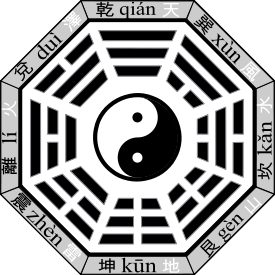
These elements are equivalent to the four classical elements in Western esoteric symbolism. They are in essence a doubled-up version (with terrestrial and celestial/spirit equivalents) of Earth, Air, Water, and Fire.
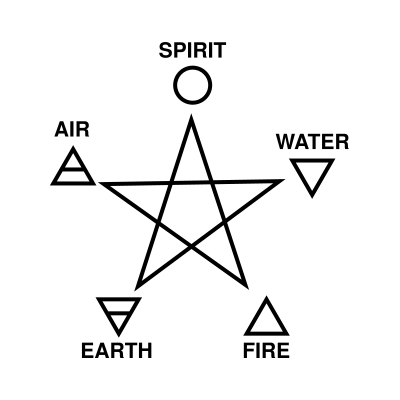
However, there is one complicated detail about these elements versus their western equivalent that some students have brought up: in both systems, there is a traditional attribution of 'genders' to the elements. But these genders do not appear to 'match up'. Let's review the basics:
In BOTH Western and Eastern symbolism, there are fundamental Masculine/Feminine forces: Chokmah/Binah, Animus/Anima, Shiva/Shakti, Yang/Yin, etc.
In Western symbolism, Earth and Water are feminine, Air and Fire are masculine.
In Chinese symbolism:
Earth/Mountain is masculine
Fire/Thunder is masculine
Moon/primordial-Water is masculine
Heaven is masculine
Air/Wind is feminine
Water/Lake is feminine
Sun/primordial-fire is feminine
The World is feminine
Before continuing, you should note that there is a connection between the physical image of the trigrams and their traditional 'gender': all the 'masculine' trigrams require an odd number of brush-strokes to draw, while all the 'feminine' trigrams require an even number of brush-strokes to draw. But the various masculine trigrams and the various feminine trigrams also have another thing in common with each other, which we will bring up below.
So now, let's focus on what is clear: in both systems of esoteric cosmology, there is a force far more fundamental than the level of elements that gets identified as the fundamental Masculine and Feminine duality. These are Yang (masculine) and Yin (feminine).
And of course, even this is not literally about 'gender' in the sense of which we tend to think of it now. Rather, they embody all the notions of duality itself; the important thing about this idea from a cosmological point of view is that it talks about all the qualities that a product of the separation from a single indivisible state of Oneness. All of our material reality is produced by this notion of the division into dualism.
To explain: you can't actually define anything positively. All definition, at its most basic level (that is, when you try to get the definitions of definitions of definitions) comes down to defining things by what they are not. This is because our entire process of thought is based on dualistic thinking. There is white and black, hot and cold, moist and dry, passive and active, positive and negative, etc.
It is only at the highest levels of awareness, and not in the level of phenomena, that this can be transcended, through the mystical process described as the Union of Opposites.
So from the esoteric point of view, the gender consideration of masculine and feminine is really about Dualism.
When we get down beyond the level of yin and yang, we are adding more elements of complexity. So Gender at the level of yin and yang is simple: Yin is everything we can define as archetypal female and Yang is everything we can describe as archetypal masculine.
At the level of elements, the reason for the gendering of elements is something more complex. And here we get to the reason for the difference in the genders of the elements in Western and Chinese symbolism: the complex quality that the former chooses to focus on is different than the complex quality that the latter chooses to focus on.
With the Western elements, the 'male' elements have the quality of active inherent motion, while the 'female' elements have the quality of inherent stillness.
Earth and Water may move, in an earthquake or a rockslide or down-river or pouring down a sink, but this is only in reaction to what is around them: water and earth are passive, they sink down until they can reach a point of rest. Thus, they reflect the quality of Passive or Receptive nature that is attributed to the Feminine. They are also tangible, of matter, they rest in the world.
Fire and Air, however, are in motion. They rise. They only exist in movement. If air has no movement it has no qualities at all (at least, from the classical perspective) and has become foul and deathly. If fire has no movement it is extinguished. Thus they reflect that quality of Active and Creative that is attributed to the Masculine. They are also intangible, you can't actually hold on to them, they have no matter.
In the Chinese system, however, the quality being looked at is not motion and stillness, which is so important to the Yang and Yin duality, but rather the qualities of "strength" and "softness".
The Mountain, the Thunderbolt/fire, The darkness of the Moon (or the deep dangerous waters of the abyss), and the power of Heaven are all considered to be 'strong' forces.
The gentle Airy breeze, the still Lake, the warm clinging light of the Sun, and the receptiveness of the World are all considered to be "soft" forces.
So both classifications of these are examples of how to classify duality, but they focus on different aspects of duality. This is because the purely Masculine and purely Feminine are absolutes. They do not exist anywhere in material reality; where they get closest is in Heaven and The World, but in all aspects at this dimension of reality, all phenomena contain a combination of Yin and Yang. They are a mix of the forces we call 'masculine' and 'feminine'. Depending on which aspects of the male and female you want to observe, there are thus different ways to categorize them.
Friday, December 8, 2017
Understanding Incipiencies
Sometimes great change, disaster or windfall, appears to happen suddenly.
This is an illusion of perception.
The moment where change seems to be happening with great speed is in fact long after the seeds of that change were planted.

The sage can look back and see many conditions, little developments, without which that great change could never have taken place.
All change actually starts with a series of smaller incipient events; often these will not even resemble or seem to have anything to do with the great change they can lead to.
Thus, the skilled practitioner can learn how to observe these earlier conditions, and make great changes eventually happen (or prevent them) with very little effort.
This is the power that a profound study of the I Ching grants: to be able to see the process of time, and how to change things before they happen.
Wednesday, October 11, 2017
The I Ching Teaches us That Reality is a "Doing"
The I Ching's cosmology suggests a reality that isn't a structure of 'things'. It is not a universe of things 'being', it is always a universe of things 'doing', of the interaction of elements.
In the West people tend to imagine that Reality is a noun, rather than a verb. That may be because of the self-referencing perspective; if something is a static object, rather than a moving process, it is easier to define, and to control.
Something static can be more easily controlled. You put a solid cube in one corner of the room, it will stay there. It won't move on its own at least. You can turn it on one side, it'll stay on that side.
On the other hand, it takes a lot of work (energy) to break that cube, or burn it, to make it move or to shape it into something other than a cube.
Static things are easy to control, hard to manipulate.
On the other hand, if you understand reality as a "doing", a constant interplay of the 8 elements that make up the world of 10000 things, then it is much EASIER to manipulate.
Creating change is much less difficult than the illusion of solidity makes it look.
But it is much HARDER to control, than our notion of a static reality leads us to think.
You can alter the course of the river, but you can't just force it into a fixed route forever, make it stop flowing forever, or much less make it change the direction of its flow.
Wednesday, July 26, 2017
The Yi Fa Cosmology
Some people have asked about the cosmology of the Yi Fa curriculum.
In fact, the cosmology of Yi Fa is directly drawn from the teachings of the I Ching.
There are more details of the cosmology in the teachings of levels 2 and 3 of the Yi Fa curriculum.
What follows is only an explanation in brief.
There is the whole, first off (you could call it the Taiji or the Tao if you like, the absolute sum of all that actually exists).
Then there are certain primal forces (Yin and Yang, the four fundamental forces of existence, the eight elements) which all have archetypal existence. Some of them may appear to have personalities but that's really our way of being able to comprehend them.
Then there's the manifested world, "the World of 10000 Things" as the Chinese poetically put it. It contains all of of those things I mentioned above WITHIN it. Those things are the building blocks of the manifested world, what you find when you look at reality on both the cosmic scale, and by going deep within.
So those elements and primal forces and positive and negative (yang and yin) all exist within us. They take shape to make each of us a unique expression of reality.
Human beings are unique (as far as we currently know) in that we are capable of conscious awareness of these forces. We have Will. Even if most of us never actually use it.
We can use this Will to become conscious operators of those forces, not just reactive operators the way other things in the world of 10000 things are. But that consciousness also creates in us an illusion of separateness from reality. We mistake being Unique for being Apart. And this illusion can be called the Persona.
Since it is an illusion, and we cannot ever actually be apart, it creates a conflict within us between the part of us that is Real and the part of us that is fabricated, the Individual and the Person. In Chinese mysticism, these are two separate parts of the human soul, called the Hung and the Po. The Hung is eternal, the Po is temporal and dissolves after death. The Hung is the Superior Individual, the Po is the Inferior Person.
Thus, the cosmology of the Yi Fa curriculum establishes the cause of our human alienation, and also shows the path toward resolving it, by manifesting the Superior Individual.
Friday, June 16, 2017
Video: The Power of the I Ching
Today's video takes a look at the underlying structure of the I Ching, and why it works.
If you are interested in more teachings and receiving information that goes deeper into the structure of the I Ching, the nature of space-time, and personal cultivation, please don't hesitate to contact me about joining the Yi Fa Society.
If you are interested in more teachings and receiving information that goes deeper into the structure of the I Ching, the nature of space-time, and personal cultivation, please don't hesitate to contact me about joining the Yi Fa Society.
Tuesday, September 27, 2016
The Three Powers
In Chinese metaphysics, born in the I Ching, there are the three powers (the "sancai"). These are "The power(Tao) of the World", the "Power of Man", and the "Power of Heaven".
It is the reason why the level of the elements, the Trigrams (which are the building blocks of all reality) are expressed as three-line symbols.
In each trigram, the lower line can be understood as representing the power of the World, the middle line represents the power of Man, and the upper line represents the power of Heaven.
So the world is outside, that which is below, the common, the natural, people and things, society, the law, the default way of things, that which manifests in a concrete manner, etc.
The power of Heaven is beyond, that which is above, that which is uncommon, the supra-natural, the extraordinary, that which manifests in the abstract, unconcerned with the affairs of society, unbound by law.
The power of the Human is the link; it's what between the two, it is what is within, it can touch in either direction, it connects the Heavenly with the Worldly, it is Consciousness, it is the freedom to choose.
 The human being is the BRIDGE between the World (nature) and Heaven (the spiritual realm).
Of all the creatures in creation, only humans are capable of making that connection between what is below and what is above, and uniting the two.
Animals can be powerful, spirits can be powerful, but only human beings can become the Sage, united to the Taiji (the "all", the 'ridge-pole' that unites all things).
It should be noted that this cosmology does not suggest that the Sage is one who leaves behind the animal, or the human, to go up somewhere else and "ascend" into heaven. The Sage, the Enlightened one, is not the Sage because he has left humanity behind. He is the Sage because he has fulfilled that role as the "bridge".
The I Ching guidance to the Superior Individual is a guidance to how to form that 'bridge' in any given circumstance; how to act in such a way, at any time and situation, so as to unite the 'big picture' to the 'little picture'.
It is the reason why the level of the elements, the Trigrams (which are the building blocks of all reality) are expressed as three-line symbols.
In each trigram, the lower line can be understood as representing the power of the World, the middle line represents the power of Man, and the upper line represents the power of Heaven.
So the world is outside, that which is below, the common, the natural, people and things, society, the law, the default way of things, that which manifests in a concrete manner, etc.
The power of Heaven is beyond, that which is above, that which is uncommon, the supra-natural, the extraordinary, that which manifests in the abstract, unconcerned with the affairs of society, unbound by law.
The power of the Human is the link; it's what between the two, it is what is within, it can touch in either direction, it connects the Heavenly with the Worldly, it is Consciousness, it is the freedom to choose.

Of all the creatures in creation, only humans are capable of making that connection between what is below and what is above, and uniting the two.
Animals can be powerful, spirits can be powerful, but only human beings can become the Sage, united to the Taiji (the "all", the 'ridge-pole' that unites all things).
It should be noted that this cosmology does not suggest that the Sage is one who leaves behind the animal, or the human, to go up somewhere else and "ascend" into heaven. The Sage, the Enlightened one, is not the Sage because he has left humanity behind. He is the Sage because he has fulfilled that role as the "bridge".
The I Ching guidance to the Superior Individual is a guidance to how to form that 'bridge' in any given circumstance; how to act in such a way, at any time and situation, so as to unite the 'big picture' to the 'little picture'.
Wednesday, August 17, 2016
The Relationship Between "Spritual" and "Reality"
There is a great spiritual difference between spiritual teachings and religions that place the unmanifested above the manifested, and those that do not. Just as there are materialistic philosophies which deny anything 'spiritual', there are also anti-materialist belief systems that deny the material in favor of something they choose to imagine as 'spiritual', separate from the material.
In ancient China, all three concepts existed. There were strictly materialist philosophies that denied anything but the manifest, the "Yi-fa". There were likewise many movements that wanted to envision the universe as a universe of immaterial 'spirit' and that the manifested world was either an illusion or a corruption, something inferior to the pure and unsullied 'spiritual world'.
But if you study the I Ching and the teachings of the great Sages, it becomes evident that neither of these are a correct reflection of reality.
This same conflict existed in many other places and times, with other names; certain "gnostic" sects in the west claimed that our world was nothing but an illusion. The institutional forms of Buddhism made similar claims, many of them ascribing a higher position to some 'spiritual' world that the Buddha himself denied.
In The Magician's I Ching, I have detailed the story of the debate between Zhang Shi and Zhu Xi, and Zhu Xi's quest to achieve enlightenment as to the true nature of reality, and how to reconcile the difference between the unmanifested (Wei Fa) and the manifested (Yi Fa). It is unsurprising that after coming to realization, Zhu Xi would strongly advocate the study and practice of the I Ching, because within it, it uncovers the truth of this relationship.
Some would-be mystics want to conceive of the nature of reality as a kind of top-down hierarchy where the lowest and least important level of reality is the manifested world. But consider the I Ching: a hexagram contains, within it, the trigrams. Trigrams contain, within them, the Yin and the Yang. Within Yin and Yang are found the Taiji (the undivided polarity). Within the Taiji is the the Wuji (the boundless), and within that boundlessness is Wu (emptiness).
Without trying to confuse scientific concepts with mystical ones, this can't help but bring to mind the nature of physical reality as we understand it today: how within objects there are molecules, those are composed of atoms, atoms are composed of protons and electrons, within those there are quantum particles, and inside all of this is empty space. Reality is not top-down, it is a whole, and that whole has layers, more fundamental and basic layers, and more complex outer layers.
This is the functioning of reality, and it is essential to understand if you are going to practice a real system of cultivation (because any spiritual practice not based on reality will not get you very far)! The Manifested (Yi Fa) and the Unmanifested (Wei Fa) must of necessity both exist, they are both real, but the only place where the unmanifested can possibly exist is within the Manifested. Wei Fa is not 'outside' or 'beyond' Yi Fa, it is only real within Yi Fa.
This is important to spiritual practice, because it means that Wei Fa, for the practitioner, can only be reached through the Yi Fa. You can't reject the body, reject the world, reject reality, and go off into some spiritual wonderland that is somehow beyond all that, because there is nothing to connect to there. You cannot find the Unity of all things by rejecting any thing. You have no tools to connect to the truly 'spiritual' if you ignore your body, your mind, your world, and your interactions with the world. This place, this world, our bodies, our awareness, all the things that exist in the manifested reality are the alchemical laboratory of our self-transformation. Without them, you can go nowhere.
Friday, July 1, 2016
Another way of Looking at How the I Ching Hexagrams Explain Space & Time
Hexagram #1 and Hexagram #2 are the two extremes of Reality. Hexagrams #63 and #64 are where those extremes meet.
Hexagram #1:

All other hexagrams have one of these four as their nuclear; or as the nuclear of their nuclear. #1 and #2 are both nuclears of themselves; hence they are two polar extremes. #63 and #64 are nuclears of each other; hence, they are the center-point where Time and Space collide.
Hexagram #2:

To understand the King Wen sequence (the regular sequence of Hexagrams as they appear in the I Ching) you must think of it as a U-shaped track. On one side are all the odd-numbered hexagrams, starting with Hexagram #1; on the other the even-numbered hexagrams, starting with Hexagram #2. The curve where the two lines meet is #63 and #64. So if you unfolded that track and made it into a straight line, you'd have #1 and #2 at opposite ends of each other, and #63 and #64 right in the middle of the line.
Otherwise you could also envision it as taking the form of a square angle (of 90 degrees, that is, one-fourth of a circle). The Odd numbers would be the vertical and the Even numbers the horizontal. And #63 and #64 would be where they meet, in the center.
Hexagram #63:

Look at Hexagram #1 ("Creation"), and you will see that it is all about time. Look at Hexagram #2 ("Passive") and you will see it is all about space. Where they intersect is the Now, but the now is eternal, and instant. It is so fast it cannot be depicted. The moment you say "it is now" you are no longer in the Now.
So instead, there is the flickering interplay between that vertical Time and horizontal Space, and it finds itself in the connection between Hexagram #63 ("After Ending") and Hexagram #64 ("Before Ending"): Before Ending, After Ending, Before Ending, After Ending. Everything is a series of immediate flickering moments between what Is Changing and what has Not Yet Changed.
Hexagram #64:

Just like Hexagrams #1 and #2 are completely pure in their respective Yang and Yin, as ideal extremes, #63 and #64 are completely mixed; in that messiness of the incipient moment of the Now's explosive crash between Space and Time. #63 has everything in the proper place, #64 has nothing in its proper place. That's Reality.
Between Space, Time, and Now there is Space-Time, all the other situations that are represented by all those hexagrams that are in some way derived from these four hexagrams. They each and all have effects on how we can approach Reality and what we must do to manifest Virtue (which also has four aspects). The Superior Individual is he who chooses to take note of each situation as it is really happening in the Now, and manifest the right Virtue accordingly. The Sage is someone who has been able to experience all of Space-Time and how it is both happening at once and not happening at all.
The Superior Individual has found the axis which forms a square; the Sage has found the Center-point.
Hexagram #1:
All other hexagrams have one of these four as their nuclear; or as the nuclear of their nuclear. #1 and #2 are both nuclears of themselves; hence they are two polar extremes. #63 and #64 are nuclears of each other; hence, they are the center-point where Time and Space collide.
Hexagram #2:
To understand the King Wen sequence (the regular sequence of Hexagrams as they appear in the I Ching) you must think of it as a U-shaped track. On one side are all the odd-numbered hexagrams, starting with Hexagram #1; on the other the even-numbered hexagrams, starting with Hexagram #2. The curve where the two lines meet is #63 and #64. So if you unfolded that track and made it into a straight line, you'd have #1 and #2 at opposite ends of each other, and #63 and #64 right in the middle of the line.
Otherwise you could also envision it as taking the form of a square angle (of 90 degrees, that is, one-fourth of a circle). The Odd numbers would be the vertical and the Even numbers the horizontal. And #63 and #64 would be where they meet, in the center.
Hexagram #63:

Look at Hexagram #1 ("Creation"), and you will see that it is all about time. Look at Hexagram #2 ("Passive") and you will see it is all about space. Where they intersect is the Now, but the now is eternal, and instant. It is so fast it cannot be depicted. The moment you say "it is now" you are no longer in the Now.
So instead, there is the flickering interplay between that vertical Time and horizontal Space, and it finds itself in the connection between Hexagram #63 ("After Ending") and Hexagram #64 ("Before Ending"): Before Ending, After Ending, Before Ending, After Ending. Everything is a series of immediate flickering moments between what Is Changing and what has Not Yet Changed.
Hexagram #64:

Just like Hexagrams #1 and #2 are completely pure in their respective Yang and Yin, as ideal extremes, #63 and #64 are completely mixed; in that messiness of the incipient moment of the Now's explosive crash between Space and Time. #63 has everything in the proper place, #64 has nothing in its proper place. That's Reality.
Between Space, Time, and Now there is Space-Time, all the other situations that are represented by all those hexagrams that are in some way derived from these four hexagrams. They each and all have effects on how we can approach Reality and what we must do to manifest Virtue (which also has four aspects). The Superior Individual is he who chooses to take note of each situation as it is really happening in the Now, and manifest the right Virtue accordingly. The Sage is someone who has been able to experience all of Space-Time and how it is both happening at once and not happening at all.
The Superior Individual has found the axis which forms a square; the Sage has found the Center-point.
Subscribe to:
Posts (Atom)