The video commentary on hexagram #18. Members of the Yi Fa Society have access to a second video with more advanced insights.
Bagua

Showing posts with label I Ching study. Show all posts
Showing posts with label I Ching study. Show all posts
Monday, March 28, 2022

Friday, January 22, 2021
I Ching Hexagram Commentary #16 - Certainty
Here is the latest in the I Ching public video series.
Members of the Yi Fa Society get access to private videos and written teachings that elaborate further on each hexagram covered in this series. If you are interested in applying to the Yi Fa Society please get in touch.
Monday, January 4, 2021
On the Significance of Yuan Heng Li Zhen
The opening words of the I Ching's core text are "Yuan Heng Li Zhen", which is typically translated as "Sublime celestial forces in motion".
When you think of the "celestial force" that is Time itself, you can understand immediately that this first line, the main text description of Hexagram #1, is also an apt description of what the entire I Ching is all about, and it has been treated that way by many scholars and adepts of the I Ching throughout history. As more commentary has been made of Hexagrams 1 & 2 than any of the others, it can also be said that more commentary has been made on those four words than any other words in the entire I Ching.
These words do not appear on in Hexagram 1, however. They are also spread out, often in pairs (Yuan heng, or li zhen) throughout the I Ching core text. Separately, "Yuan heng" means a broad or easy path, or also, a ritual or sacrificial rite. While "Li zhen" means a favorable auspice, clearly a common phrase in the context of divination.
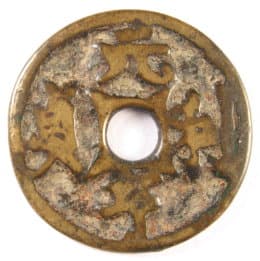
A Chinese coin-shaped talisman inscribed with Yuan Heng Li Zhen
In the Yi Fa teaching, a great deal of emphasis is put on those words as representative of the four facets of Virtue: Union/Love, Discipline, Justness/Harmony, and Truth/Reality.
The description of Yuan Heng Li Zhen as being these four virtue facets originates with the Wenyan Commentary, which dates back to before the Han Dynasty. Here is a quote of that commentary from one translation:
"What is called "the great and originating" (yuan 元) is [in man] the first and chief quality of goodness; what is called "the penetrating" (heng 亨) is the assemblage of excellences; what is called "the advantageous" (li 利) is the harmony of all that is right; and what is called "the correct and firm" (zhen 貞) is the faculty of action."
Here "goodness" is Love/Union, "the Assemblage of excellences" is the process of Discipline, Li is already translated here as Harmony, and the "Faculty of Action" is Truth or Reality, that is to say the perceptual faculty that allows us to take action.
Yuan Heng Li Zhen is also a reference to cycles:
Yuan - sublime, the head. The beginning. Spring
Heng accomplishment, prosperous. Summer
Li beneficence, harvest, autumn.
Zhen determination, endurance, winter
Thus Yuan symbolizes the beginning of all things, Heng their growth, Li their further development, and Zhen their maturity. This concept of the four words connecting to the cycles of growth and the four seasons was particularly elaborated by Cheng Yi, the Song dynasty sage and friend of Shao Yong.

These words are also used in some esoteric contexts as a mantra, and also as words of invocation for ritual purposes. In fact, just as the four words can be used to describe the pattern or process of natural or seasonal cycles, they can also be used to describe the STEPS of a ritual.
In this sense, "Yuan" symbolizes the invocation, calling down what is above, for the sake of Union.
"Heng" symbolizes the correct performance of the ritual, with Discipline.
"Li" means receiving a response from the forces you have called upon; that is to say, your ritual bringing you into Harmony with the universe.
And "Zhen" means applying that response or change in yourself, embodying Truth in the real world.
Friday, November 13, 2020
What is the Nature of the Superior Individual?
In the philosophy of the I Ching, there is a basic truth that in every moment, we have a choice between manifesting the Superior Individual or the inferior person.
Among those who practice cultivation, however, there may be some question as to just what the "Superior Individual" is. In the course of cultivation, one might get a sense of the Superior Individual being some outside entity, the "higher self" sending them messages or guiding their life.
So some have developed a conception where the Superior Individual is some kind of outside spiritual, angelic or divine entity.
But in fact, the Superior Individual is basic part of ourselves. It is not a separate being at all, it is us. The best of us.
This sense of differentness, of the Superior Individual seeming like another being with its own intelligence and communicating with us is a product of people's primary identification with the 'inferior person', which is also a part of us. Thus, we have become separate from the 'higher self'.
Why are we separated from our higher self?
We aren't, but it seems this way.
The issue is this: we are a species in the process of evolution. Our consciousness has multiple layers, which can be generally divided into two parts. In the context of I Ching studies (including the Yi Fa work) these are described as "World" and "Heaven". To Nietzche it was "last man" and "super-man". In others, it could be called "animal" and "divine".

The Chinese actually say that there are two parts to the human soul: Po and Hung. The Po is the part of us that is animal instinct plus conditioned behavior. The Hung is the part of us that is our fullest potential and true Individuality (as opposed to the 'persona' of our inferior po-soul).
We can, at every moment, choose to associate with one or the other. But on account of our intermediary condition and because of our social conditioning we tend to more directly identify ourselves as the "Inferior Person". So much so, that the Superior Individual can sometimes feel like it's a separate entity, some kind of guiding spirit.
You will find, if you engage with discipline in a sincere long-term course of spiritual cultivation, that over time, you will become more and more identified as one with the Superior Individual. At that point, the 'ideas' of the Superior Individual will be identical to your own, and the notions of the inferior person, which will still be present, will instead be the ones that appear to be foreign.
Tuesday, October 13, 2020
How to Master the I Ching
In this latest video, I give you some guidelines as to how you should study the text and structure of the I Ching to maximize your ability to understand it!
Saturday, August 22, 2020
I Ching Questions and Answers: Line 1 and Line 6
I often receive questions about the I Ching, and how to read it more effectively. If you have a question post it in the comments below and I will try to answer it.
Meanwhile, here is one example of a question someone recently sent me, and my answer:
Q: what does it mean when only line 1 and line 6 are changing?
In an I Ching casting, you derive a six-line hexagram. In the casting, any number of those lines, from none at all to all six, could theoretically be changing lines.
Any lines might or might not be changing.
You cast the lines in order from the bottom to the top, so that the bottom line is considered "line 1", and the top line is considered "line 6".
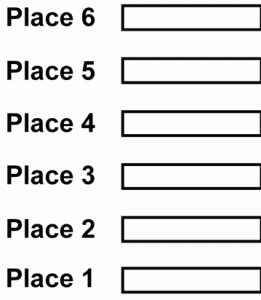
If more than one line is changing, it is important to determine what is the "central line", the part of the casting that is the most important. The way to do this is explained in The Magician's I Ching.
So if you get only two changing lines, and they are line 1 and line 6, of the two the central line of the reading is line 6. Line 1 needs to be read as a kind of prelude to the central line 6.
In an I Ching casting the position of each line has a general sense of importance. As each Hexagram represents a situation, the bottom 1st line represents the very beginning of the situation; often even what happens before the situation is really in action. Line two is often when things get going. Line three the most difficult part (the jump between the lower lines and the upper lines). Line four is when you're past the middle of the situation. Line 5 is usually the climax or peak of the situation, and Line 6 is when the situation is ending or even past due to end.
Since Line 1 usually signifies something taking place very early, and line 6 very late, there is a bigger distance between the two than if they were any other two lines. It can also mean with regard to the question that issues that happened at the beginning of the process are relevant to what is happening right now.
So in a casting where Line 1 and Line 6 are the two changing lines, you ought to think of Line 6 as what's most central right now, but there are things about how the current situation began that are having an important effect or consequence at the time of the situation ending.
Monday, June 22, 2020
The I Ching: Hexagram 15 - Humility
An analysis of the 15th hexagram of the I Ching, in the latest video in the I Ching series:
If you want more teachings on the deeper mysteries of the I Ching, as part of a program of cultivation and spiritual self-development including meditation and Qi Gong practices, please consider applying to the Yi Fa Society!
If you want more teachings on the deeper mysteries of the I Ching, as part of a program of cultivation and spiritual self-development including meditation and Qi Gong practices, please consider applying to the Yi Fa Society!
Saturday, March 14, 2020
Time and the I Ching
What is the nature of Time? The I Ching seeks to explain that.
This is important for understanding your own spiritual cultivation, as well as to understanding how Divination works, and why!
Wednesday, February 26, 2020
Cultivating the True Will and Superior Individual
What you have to understand is that achieving the True Will (what in I Ching terms is called the Superior Individual) requires three basic ingredients:
The first is self-inquiry. That is to say, growing in your understanding of your self, and what you are really capable of, and developing a way of tapping in, at every given moment and each given decision, to what is the best choice you can make to manifest that true will. Both meditation (Qi breathing) and the study of the I Ching helps with this; the former because it connects body and consciousness, the latter because it guides you in the situations where you can come to frame your choices in time and space. The I Ching is used for divination, but in the context of the Great Work it is a lot more than that; sometimes you will need to cast the I Ching to get answers to difficult situations, but as you grow in practice and if you've spent enough time in contemplating and considering the meaning of the I Ching you will eventually develop an ability to understand what to do by an "observation of nature" (that is, by paying attention to where you are in time and space, and being able to manifest the best possible self in your choices at that moment).
The second is developing in Virtue. The term Virtue is a very specific thing in the context of Yi Fa work; it means working on improving your dedication to the four core concepts inherent in "Yuan Heng Li Zhen": Union/Love, Discipline, Harmony/Justness, and Truth/Sincerity.
It isn't enough to just think about or study these concepts; you have to work on trying to embody them in everything you do in your everyday life. This takes a lot of work, it's like an exercise regime: you'll get better at it the more often you do it. The practice of self-inquiry mentioned above is very important in this regard because as you get better at being able to overcome the passions and impulses of the Inferior Person (the opposite of your True Will, your conditionings) the easier it will be to remember to manifest these qualities.
And the third part is the exercises of Yi Fa Qi Gong. These exercise are a kind of internal alchemy; they gradually transform your body and consciousness at the same time. First off by giving you the opportunity to accumulate Qi (life force) within yourself, that is then transformed within your body to a force that breaks down the attachments you have to activities of the Inferior Person (relating to what in modern lingo could be called the mind/body connection). Beyond that, the regular practice of the exercises helps to generate Virtue, which you can then apply as mentioned above in your everyday life.

As you become more advanced in the Qi Gong practice, it will unlock new levels of your consciousness which will grant you the ability to increasingly directly manifest the Superior Individual.
Of course, all of this depends on you practicing the Work with sincerity and dedication. It takes time, but the longer you do it the more cumulative and lasting the benefits become.
The first is self-inquiry. That is to say, growing in your understanding of your self, and what you are really capable of, and developing a way of tapping in, at every given moment and each given decision, to what is the best choice you can make to manifest that true will. Both meditation (Qi breathing) and the study of the I Ching helps with this; the former because it connects body and consciousness, the latter because it guides you in the situations where you can come to frame your choices in time and space. The I Ching is used for divination, but in the context of the Great Work it is a lot more than that; sometimes you will need to cast the I Ching to get answers to difficult situations, but as you grow in practice and if you've spent enough time in contemplating and considering the meaning of the I Ching you will eventually develop an ability to understand what to do by an "observation of nature" (that is, by paying attention to where you are in time and space, and being able to manifest the best possible self in your choices at that moment).
The second is developing in Virtue. The term Virtue is a very specific thing in the context of Yi Fa work; it means working on improving your dedication to the four core concepts inherent in "Yuan Heng Li Zhen": Union/Love, Discipline, Harmony/Justness, and Truth/Sincerity.
It isn't enough to just think about or study these concepts; you have to work on trying to embody them in everything you do in your everyday life. This takes a lot of work, it's like an exercise regime: you'll get better at it the more often you do it. The practice of self-inquiry mentioned above is very important in this regard because as you get better at being able to overcome the passions and impulses of the Inferior Person (the opposite of your True Will, your conditionings) the easier it will be to remember to manifest these qualities.
And the third part is the exercises of Yi Fa Qi Gong. These exercise are a kind of internal alchemy; they gradually transform your body and consciousness at the same time. First off by giving you the opportunity to accumulate Qi (life force) within yourself, that is then transformed within your body to a force that breaks down the attachments you have to activities of the Inferior Person (relating to what in modern lingo could be called the mind/body connection). Beyond that, the regular practice of the exercises helps to generate Virtue, which you can then apply as mentioned above in your everyday life.
As you become more advanced in the Qi Gong practice, it will unlock new levels of your consciousness which will grant you the ability to increasingly directly manifest the Superior Individual.
Of course, all of this depends on you practicing the Work with sincerity and dedication. It takes time, but the longer you do it the more cumulative and lasting the benefits become.
Thursday, August 22, 2019
What Story is the I Ching Telling You?
There's really only one story that actually matters: the story of the journey of transformation. All good stories are variations on it.
All hexagrams of the I Ching have within them a story of transformation. Each one tells its own little story. And when you combine them with other hexagrams in permutations, it's telling another story.
And when doing a casting its doing a very specific little story of transformation with regard to the one question you might have at this time. While the whole King Wen sequence tells one great big story.
There were two schools in the period after the School of Yin and Yang, after Confucius, up to the Han Dynasty. These schools were rivals, I've spoken of them before. From that school of inner alchemy, there was a division into two forms of interpretation: Image and Number, and Meaning and Principle.

Image and Number focused on the line structures, trigrams, positions of things, mathematics of the I Ching, the elements, the cosmology. All of that was the focus of the School of Image and Number.
The school of Meaning and Principle looked at it a different way, saying that what mattered was the spiritual/philosophical teaching in the I Ching and that this was found by considering and interpreting the text, rather than the image or the mathematics/cosmology.
I've commented on the imperfection of both of those schools before.
Regardless, the value of what came out of the school of Meaning and Principle was a different approach to looking at groups of hexes, not based on their structure of lines and trigrams, but in terms of the text and grouping various hexagrams based on their common themes. In other words, to look at the stories they tell.
If you do this in combination with the structural elements of the hexagrams, this is the best way to apply your studies in I Ching structure and cosmology to a more grounded and human element of connecting to that personal story of what one must do on a journey of transformation.
Friday, July 5, 2019
I Ching Hexagram Commentary #13 - Fellowship
Here is the latest I Ching video. If you are interested in deeper teaching on the I Ching as part of an ongoing program of spiritual cultivation, please consider contacting me about applying to the Yi Fa Society.
Saturday, January 5, 2019
Can You Use the I Ching for "Trivial Purposes"?
I have often had students ask me whether it's proper to use the I Ching for 'trivial' questions.
The question usually comes from the defining of certain types of questions as important, and others as unimportant. Sometimes it involves the notion that the I Ching should only be used for questions of Spiritual importance, or deep profound life-decision questions about one's purpose or higher self.
So I am asked, for example, if it is acceptable to ask about lost keys or some problem at work or how things will go at a football game, etc.
So my perspective is that this is absolutely acceptable to do; but I think what we need to define is the difference between something being "mundane" and something being actually "trivial", in the context of the I Ching.
The point isn't that the I Ching can't be used for everyday ordinary things. In fact, the I Ching can be greatly useful for mundane questions. You can use it for everyday subjects, even minor questions or doubts, or nearly-inconsequential problems.
However, where you can't use it is for something that's "trivial" in the sense of being a question you don't really care about.
That's true whether the question is about something very mundane or something of great cosmic, spiritual or life significance.
This is the secret of understanding whether a question is trivial or not: it's not about the subject matter but about whether you have anything actually invested in the subject matter.
If you don't have a sense of the question actually mattering to you, then you should not do an I Ching casting about it.
Note: the idea that "you shouldn't do it" is not in the sense that it would somehow 'dishonor' the I Ching or that it is some kind of spiritual taboo or will cause bad karma or anything along those lines. It's simply that you shouldn't do it because if you don't have some kind of of sense of investment in the question beyond mere curiosity, the casting won't actually work for you.
You need to have some level of caring about the question asked beyond just mere curiosity. It has to matter to you a little more than that, whether it's at the level of something where you just have a strong feeling of wanting an answer even if the casting won't have any real consequence, all the way to "this casting is a matter of life and death". As long as you have investment, as long as there's skin in the game, regardless of the scale or whether the question is incredibly mundane or cosmically profound, the casting will be able to function.
Otherwise, the casting really will be "trivial".
The question usually comes from the defining of certain types of questions as important, and others as unimportant. Sometimes it involves the notion that the I Ching should only be used for questions of Spiritual importance, or deep profound life-decision questions about one's purpose or higher self.
So I am asked, for example, if it is acceptable to ask about lost keys or some problem at work or how things will go at a football game, etc.
So my perspective is that this is absolutely acceptable to do; but I think what we need to define is the difference between something being "mundane" and something being actually "trivial", in the context of the I Ching.
The point isn't that the I Ching can't be used for everyday ordinary things. In fact, the I Ching can be greatly useful for mundane questions. You can use it for everyday subjects, even minor questions or doubts, or nearly-inconsequential problems.
However, where you can't use it is for something that's "trivial" in the sense of being a question you don't really care about.
That's true whether the question is about something very mundane or something of great cosmic, spiritual or life significance.
This is the secret of understanding whether a question is trivial or not: it's not about the subject matter but about whether you have anything actually invested in the subject matter.
If you don't have a sense of the question actually mattering to you, then you should not do an I Ching casting about it.
Note: the idea that "you shouldn't do it" is not in the sense that it would somehow 'dishonor' the I Ching or that it is some kind of spiritual taboo or will cause bad karma or anything along those lines. It's simply that you shouldn't do it because if you don't have some kind of of sense of investment in the question beyond mere curiosity, the casting won't actually work for you.
You need to have some level of caring about the question asked beyond just mere curiosity. It has to matter to you a little more than that, whether it's at the level of something where you just have a strong feeling of wanting an answer even if the casting won't have any real consequence, all the way to "this casting is a matter of life and death". As long as you have investment, as long as there's skin in the game, regardless of the scale or whether the question is incredibly mundane or cosmically profound, the casting will be able to function.
Otherwise, the casting really will be "trivial".
Wednesday, December 5, 2018
On the Nature of Nuclear Hexagrams
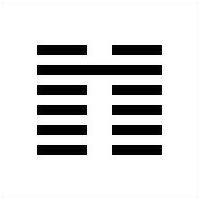
Nuclear Hexagrams are a frequently-misunderstood mystery of the I Ching. In The Magician's I Ching I attempted to give a brief explanation of how to understand them. They can be understood as "nuclear hexagrams" because they are the hexagram the exists inside the "nucleus" of a hexagram: the lower trigram of a nuclear hexagram consists of lines 2, 3 and 4 of the original hexagram, and the upper trigram consists of lines 3, 4 and 5 of the original hexagram.
So for example, Hexagram #19:
 has as its nuclear Hexagram #24:
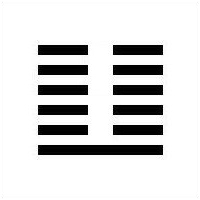 I have seen some people mistakenly look at nuclear hexagrams in an I Ching casting as if it was some additional part of the divination process on its own, as if there was some random element to it which contributed to the 'fortune telling' itself. But the nuclear hexagram is static, every hexagram only has a single nuclear (though in the cases of Hexagram #1 and Hexagram #2, they are their own nuclear).
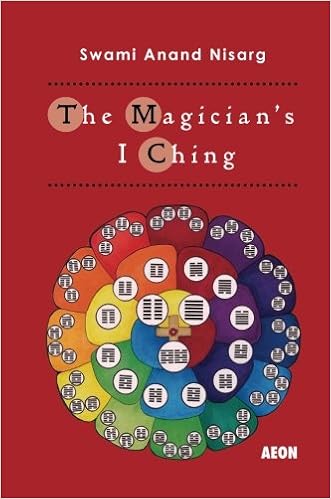
In fact, Nuclear Hexagrams are part of a system of clusters or connections between hexagrams. On the cover of The Magician's I Ching, you can see this pattern depicted artistically:

The nuclears show you groups of common hexagrams which can be understood to interact in special ways. Their main practical use is for the purpose of contemplating the mysteries and deepening one's understanding of the I Ching as a whole and of the individual hexagrams. The relationship of the hexagrams connected by their nuclear provides important insights.
Let's look, for example, at the hexagrams that have Hexagram #23 as their nuclear:

Hexagram #23 is "Shedding".
In this set of four hexagrams with #23 as their nuclear, for example, you can see the pattern that starts first with the effort of beginning, with Hexagram #3, "challenge":

Then as you build up, it leads to bringing things together, with Hexagram #8 "Union":
After this, you move to reaching beyond the level of the foundations to be able to discover the greater mastery that is more than the sum of its parts, with Hexagram #20 "Contemplating":

And finally, to the state of making advance to a new level, with Hexagram #42 "Gaining":

So to put it another way, looking at it (for example) in the context of Cultivation: first the initial enthusiasm in the face of a vast undertaking, then the hard work of mastering the basic forms of the exercise, then when that is mastered of understanding what lies beyond the mere technical practice and exploring the essence, and then the genuine growth.
This needs to begin with Shedding (#23); you can almost imagine the "landslide" of Shedding, and following that landslide the tiny sprout of #3 breaking out of the shifted ground, then the hard work of growth, then the bearing fruit, and finally the harvest.
But it is also true that the nuclear governs at each step; as you move from one step to the next there needs to always be a process of shedding off some of what you are doing to make room for the next stage of growth.
In your own I Ching studies, first you need to study and learn the basic meanings of each hexagram by itself. But once you're ready to go deeper, studying the nuclears and the connections between the hexagrams and their nuclears will be of great use for developing a larger understanding of the greater mysteries of the I Ching.
So for example, Hexagram #19:
In fact, Nuclear Hexagrams are part of a system of clusters or connections between hexagrams. On the cover of The Magician's I Ching, you can see this pattern depicted artistically:

The nuclears show you groups of common hexagrams which can be understood to interact in special ways. Their main practical use is for the purpose of contemplating the mysteries and deepening one's understanding of the I Ching as a whole and of the individual hexagrams. The relationship of the hexagrams connected by their nuclear provides important insights.
Let's look, for example, at the hexagrams that have Hexagram #23 as their nuclear:
Hexagram #23 is "Shedding".
In this set of four hexagrams with #23 as their nuclear, for example, you can see the pattern that starts first with the effort of beginning, with Hexagram #3, "challenge":
Then as you build up, it leads to bringing things together, with Hexagram #8 "Union":
After this, you move to reaching beyond the level of the foundations to be able to discover the greater mastery that is more than the sum of its parts, with Hexagram #20 "Contemplating":
And finally, to the state of making advance to a new level, with Hexagram #42 "Gaining":
So to put it another way, looking at it (for example) in the context of Cultivation: first the initial enthusiasm in the face of a vast undertaking, then the hard work of mastering the basic forms of the exercise, then when that is mastered of understanding what lies beyond the mere technical practice and exploring the essence, and then the genuine growth.
This needs to begin with Shedding (#23); you can almost imagine the "landslide" of Shedding, and following that landslide the tiny sprout of #3 breaking out of the shifted ground, then the hard work of growth, then the bearing fruit, and finally the harvest.
But it is also true that the nuclear governs at each step; as you move from one step to the next there needs to always be a process of shedding off some of what you are doing to make room for the next stage of growth.
In your own I Ching studies, first you need to study and learn the basic meanings of each hexagram by itself. But once you're ready to go deeper, studying the nuclears and the connections between the hexagrams and their nuclears will be of great use for developing a larger understanding of the greater mysteries of the I Ching.
Friday, November 2, 2018
Thursday, July 12, 2018
On the Origin of the I Ching's Lines
How did the lines of the I Ching get the text they did?
1. Often considerations have to do with the nature of the line, especially if its the only line of its type (yin or yang) in the hexagram.
2. The position of the line determines its overall role; so for example the first line is always about beginnings, the sixth about endings, in some sense.
3. In terms of the specific examples, they are often taken out of either common folk stories/sayings, or from events in the pre-zhouyi history (especially events relating to the royal lineage of Zhou, or sometimes of the Shang dynasty they eventually deposed).

But there is also an esoteric aspect that frequently emerges.
Look at a line and its text. Now consider this in the light of three different trigrams:
1. The trigam that line is found in.
2. The trigram that would result when that line changes.
3. The Nuclear trigram that rules it (generally the lower nuclear for lines 1-3 and upper nuclear for lines 4-6, but in the case of line 4 it can sometimes be either).
Studying the qualities that these trigrams have (the elements they are associated with, the qualities of nature they are associated with, and the qualities or spiritual concepts these represent), you will find that the line's text relates to aspects of those three trigrams.
Thursday, June 21, 2018
The Magician's I Ching Facebook Group Has 2300 members!
The Facebook group created in honor of The Magician's I Ching, but which is a general discussion group for all I Ching related subjects, has now reached 2300 members!

So if you haven't already joined the Magician's I Ching Facebook Group, please consider joining! It's free, and filled with interesting conversation and material related to the I Ching and I Ching studies. It's open to people coming from western or eastern traditions. It's very welcoming to newcomers to the I Ching, and you can get questions answered or useful advice. But it also has many very learned and highly experienced advanced students of the I Ching, and if you are one of those people you'll find some excellent higher level discussion about some of the finer points of I Ching study.
While you're at it, please consider joining the Yi Fa Society. Members of the Yi Fa Society also have a (secret) discussion group, and benefit from a complete and detailed training program for studying Yi Fa Qi Gong and the I Ching. Members of the Yi Fa Society are taught additional Qi Gong and I Ching secrets that are not available anywhere public.
At higher levels of membership, the advanced exercises of Yi Fa Qi Gong are taught, and students are provided large numbers of instructional materials (whole books, like "Secret Techniques of the I Ching", "Universal Yi Fa", "The Yi Dao", and "the Great Book of Yi Fa", among others) on how to deepen their work with Qi Gong and I Ching for self-transformation and the work of enlightenment.
Members of the Yi Fa Society can work personally with me to keep up their practice, to resolve problems in their practice, and to develop discipline and structure in their spiritual path. Members also have the opportunity to have monthly Skype meetings with me for the same purpose.
Yi Fa Society membership is not free, but basic membership is on a monthly donation basis set by each student.
If you are interested in joining the Magician's I Ching Facebook group, just click on the link and join, and start reading and sharing with us!
If you are interested in joining the Yi Fa Society, please contact me, here or on Facebook.
Thursday, April 19, 2018
I Ching Commentary Video - Hexagram #11 "Intercourse"
Here is the youtube video for the newest in my commentaries on the I Ching, on the subject of the 11th Hexagram- "Intercourse".
Members of the Yi Fa Society get access to additional I Ching video and text commentaries that go into more depth on the symbolism and divination uses of the I Ching's Hexagrams. If you are interested in joining the Yi Fa Society, please get in touch.
Tuesday, March 20, 2018
"Incipiencies": More on How the I Ching Works
Incipiency is a concept inherent in the I Ching, because it is inherent in space-time. But the term (it's explanation, and centrality to I Ching studies) is largely attributable to the master Zhu Xi.

It emerges out of the question of "how does the I Ching tell the future"? The answer is: it doesn't. The I Ching measures the present, this moment. But you have to imagine this moment as a set of interconnecting streams from trillions of previous choices, from events that took place yesterday, the day before that, 50 years ago, 4000 years ago, 12 million years ago, etc. Each choice both sealed off a whole bunch of possible futures, and created a cascade of effects that would have a possibility of happening in the future. And in the present moment, we have the culmination of that weight of trillions of trillions of circumstances.
With me so far?
So, if we understand that, we also understand that the future is observable in the present moment; by looking at those past streams, where they can and cannot lead, which of them cannot be altered at this time (unchanging lines) and which of them could be (changing lines). The future exists as a kind of seed already in the present. It is not here but the ingredients for it are all here.
In I Ching study there's a saying that goes something like "you cannot change something once it has happened. If you want to change something, you need to change it before it happens".
The changing lines reflect those incipiencies, the malleable spots in the present moment in Space Time, where you can make a choice, you can drop a new pebble in the stream of space-time to alter the current and change the course of the future.
Tuesday, January 16, 2018
On The Gender of the Eight Trigrams
The 64 6-line Hexagrams of the I Ching are built on paired combinations of the 8 3-line trigrams (the bagua). Thus, as the hexagrams represent all phenomena in the material world, the trigrams represent the eight fundamental elements, four terrestrial and four celestial elements.
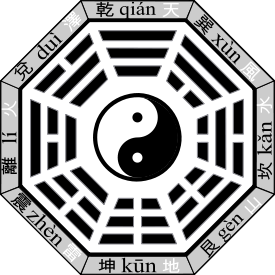
These elements are equivalent to the four classical elements in Western esoteric symbolism. They are in essence a doubled-up version (with terrestrial and celestial/spirit equivalents) of Earth, Air, Water, and Fire.

However, there is one complicated detail about these elements versus their western equivalent that some students have brought up: in both systems, there is a traditional attribution of 'genders' to the elements. But these genders do not appear to 'match up'. Let's review the basics:
In BOTH Western and Eastern symbolism, there are fundamental Masculine/Feminine forces: Chokmah/Binah, Animus/Anima, Shiva/Shakti, Yang/Yin, etc.
In Western symbolism, Earth and Water are feminine, Air and Fire are masculine.
In Chinese symbolism:
Earth/Mountain is masculine
Fire/Thunder is masculine
Moon/primordial-Water is masculine
Heaven is masculine
Air/Wind is feminine
Water/Lake is feminine
Sun/primordial-fire is feminine
The World is feminine
Before continuing, you should note that there is a connection between the physical image of the trigrams and their traditional 'gender': all the 'masculine' trigrams require an odd number of brush-strokes to draw, while all the 'feminine' trigrams require an even number of brush-strokes to draw. But the various masculine trigrams and the various feminine trigrams also have another thing in common with each other, which we will bring up below.
So now, let's focus on what is clear: in both systems of esoteric cosmology, there is a force far more fundamental than the level of elements that gets identified as the fundamental Masculine and Feminine duality. These are Yang (masculine) and Yin (feminine).
And of course, even this is not literally about 'gender' in the sense of which we tend to think of it now. Rather, they embody all the notions of duality itself; the important thing about this idea from a cosmological point of view is that it talks about all the qualities that a product of the separation from a single indivisible state of Oneness. All of our material reality is produced by this notion of the division into dualism.
To explain: you can't actually define anything positively. All definition, at its most basic level (that is, when you try to get the definitions of definitions of definitions) comes down to defining things by what they are not. This is because our entire process of thought is based on dualistic thinking. There is white and black, hot and cold, moist and dry, passive and active, positive and negative, etc.
It is only at the highest levels of awareness, and not in the level of phenomena, that this can be transcended, through the mystical process described as the Union of Opposites.
So from the esoteric point of view, the gender consideration of masculine and feminine is really about Dualism.
When we get down beyond the level of yin and yang, we are adding more elements of complexity. So Gender at the level of yin and yang is simple: Yin is everything we can define as archetypal female and Yang is everything we can describe as archetypal masculine.
At the level of elements, the reason for the gendering of elements is something more complex. And here we get to the reason for the difference in the genders of the elements in Western and Chinese symbolism: the complex quality that the former chooses to focus on is different than the complex quality that the latter chooses to focus on.
With the Western elements, the 'male' elements have the quality of active inherent motion, while the 'female' elements have the quality of inherent stillness.
Earth and Water may move, in an earthquake or a rockslide or down-river or pouring down a sink, but this is only in reaction to what is around them: water and earth are passive, they sink down until they can reach a point of rest. Thus, they reflect the quality of Passive or Receptive nature that is attributed to the Feminine. They are also tangible, of matter, they rest in the world.
Fire and Air, however, are in motion. They rise. They only exist in movement. If air has no movement it has no qualities at all (at least, from the classical perspective) and has become foul and deathly. If fire has no movement it is extinguished. Thus they reflect that quality of Active and Creative that is attributed to the Masculine. They are also intangible, you can't actually hold on to them, they have no matter.
In the Chinese system, however, the quality being looked at is not motion and stillness, which is so important to the Yang and Yin duality, but rather the qualities of "strength" and "softness".
The Mountain, the Thunderbolt/fire, The darkness of the Moon (or the deep dangerous waters of the abyss), and the power of Heaven are all considered to be 'strong' forces.
The gentle Airy breeze, the still Lake, the warm clinging light of the Sun, and the receptiveness of the World are all considered to be "soft" forces.
So both classifications of these are examples of how to classify duality, but they focus on different aspects of duality. This is because the purely Masculine and purely Feminine are absolutes. They do not exist anywhere in material reality; where they get closest is in Heaven and The World, but in all aspects at this dimension of reality, all phenomena contain a combination of Yin and Yang. They are a mix of the forces we call 'masculine' and 'feminine'. Depending on which aspects of the male and female you want to observe, there are thus different ways to categorize them.
Thursday, December 21, 2017
Magic as a Human Tool
In my latest video, I look at forms of esoteric or magical systems, like the I Ching, as a form of human tool or technology (by technology I do not mean a 'machine', I mean some kind of technique, system, or method used in the accomplishment of human objectives; for example, mathematics is a type of technology).
Check it out:
If you're interested in more of this kind of contemplation, please get in touch with me about joining the Yi Fa Society!
Check it out:
If you're interested in more of this kind of contemplation, please get in touch with me about joining the Yi Fa Society!
Subscribe to:
Posts (Atom)