Bagua

Showing posts with label Yi Fa. Show all posts
Showing posts with label Yi Fa. Show all posts
Monday, March 8, 2021

Sunday, March 7, 2021
Psychedelics and Spiritual Cultivation
I have often been asked whether there is any utility or value in the use of psychedelic drugs while engaging in spiritual practices, and specifically cultivation practice like that found in Yi Fa Qi Gong and other authentic Qi Gong cultivation systems.
My answer has always been that one has to be very cautious and prudent in how to approach the question of psychedelics. And in fact, people who are already engaging in or have previously used psychedelics will probably have very little benefit, and potentially drawbacks, from any attempt to use them in the context of cultivation practice.
Not because "drugs are bad" or anything like that, but because in the context of just WHAT they're useful for in terms of spiritual development. Psychedelic drugs need to be used ideally only at very carefully selected moments and in very specially selected contexts. The ancient shamanic cultures throughout the world understood this, as did some of the hermetics and some of the eastern sects.
The central feature of the psychedelic experience is twofold: it temporarily breaks down the ego, and it opens the doors of perception (to paraphrase Huxley).
The latter means that suddenly you're having a sensory experience different to anything you experienced before.
This is what leads to the effect of breaking down the ego: the mind's ability to lock-in to personality is based largely on imprinted behaviors from memory... what you could call "conditioning". Basically, ways you've programmed yourself, some of which is essential for daily living but a lot of which is also highly limiting, including in the spiritual context.
When you use a psychedelic for the first time, it makes your brain unable to refer back to any past experience that was sufficiently similar to allow the ego to assert itself (in the sense of "I know what's happening here, I know what to do") and so you have the potential to have an experience that can break some barriers the Ego has created that could be very hard to break otherwise. It is the inability to put what you're experiencing into some comfortable box of context that makes the experience so potentially charged with the opportunity to make serious Change.
But by the second time you use a psychedelic, you already have a context by which the brain can compare it to in memory; namely, the first time you used it! So even just the second use of a psychedelic will be, spiritually speaking, enormously less useful than the first time.
I would say that generally speaking, the real spiritual utility of psychedelics for transformation (in cultivation practice) is limited to the first two or at most three times you use a drug. Any use after that will, at best, only be useful for attaining a kind of trance state (but that can be done in a lot of ways, including meditation). It's no longer useful as an ego-overwhelming tool. It is just re-creating a former experience.
That means that if you had wasted the first time you used a psychedelic (say, at a party or something), you would wasted a big potential tool that you could never use again.
So you want to think carefully about when you use psychedelics. If you do use them, it should be at a carefully planned moment and in a carefully prepared context so as to make the best use of the power of the ego-overwhelming experience.
Wednesday, July 10, 2019
The Time Travel of the I Ching
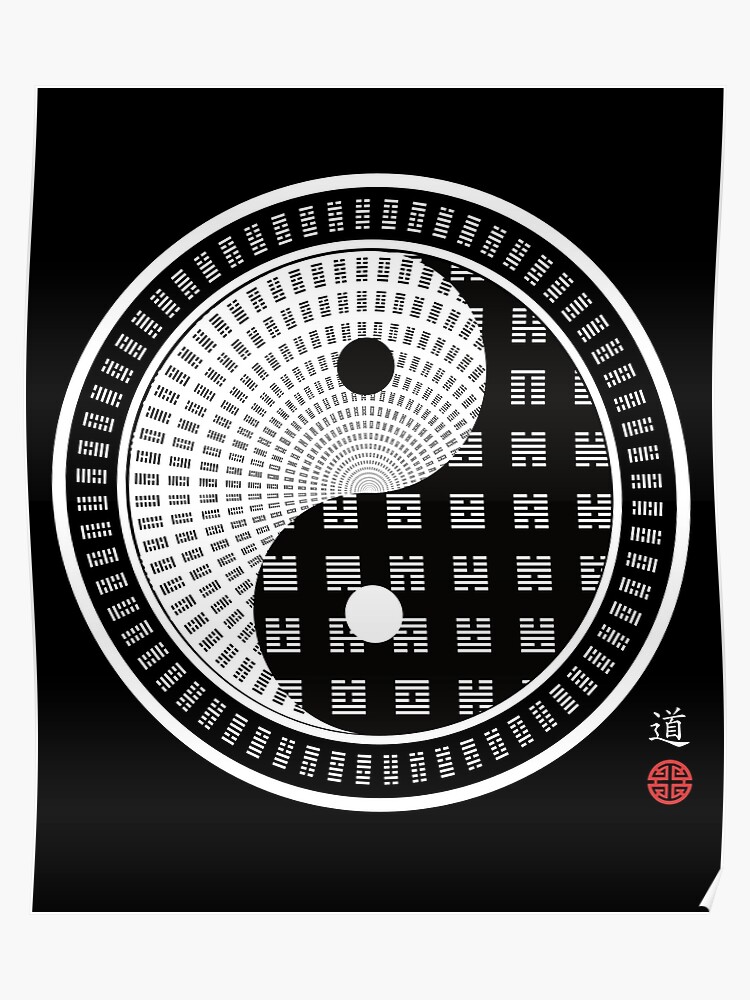
Enter the stream of the I Ching through its symbols.
The I Ching shows that time is like a forest, full of change.
The present is just the place you are at in the forest.
All the steps you took through this forest up until now have put you on this point in the path.
The direction they lead you in points toward where on the path you are heading; this is the future.
If you want to change the future, change it before it happens.
If you want to change the past, change your response to the choices you made in the past.
Tuesday, August 14, 2018
An Excerpt From a Level-4 Yi Fa Text: Advanced Commentaries
II. The Vast in the Small
People want to imagine a top-down
vision of reality, where there is some "higher" and
"greater" true reality, and their everyday ordinary world
is just some pale shadow of the real thing.

This perspective on reality will lend
itself to escapism. Even many models of creation, like the
Qabalistic Tree of Life or the older Taijitu Tree of Life, give one
the impression that our material world is at the "lowest"
point and everything else is higher (and thus it is suggested, more
important).
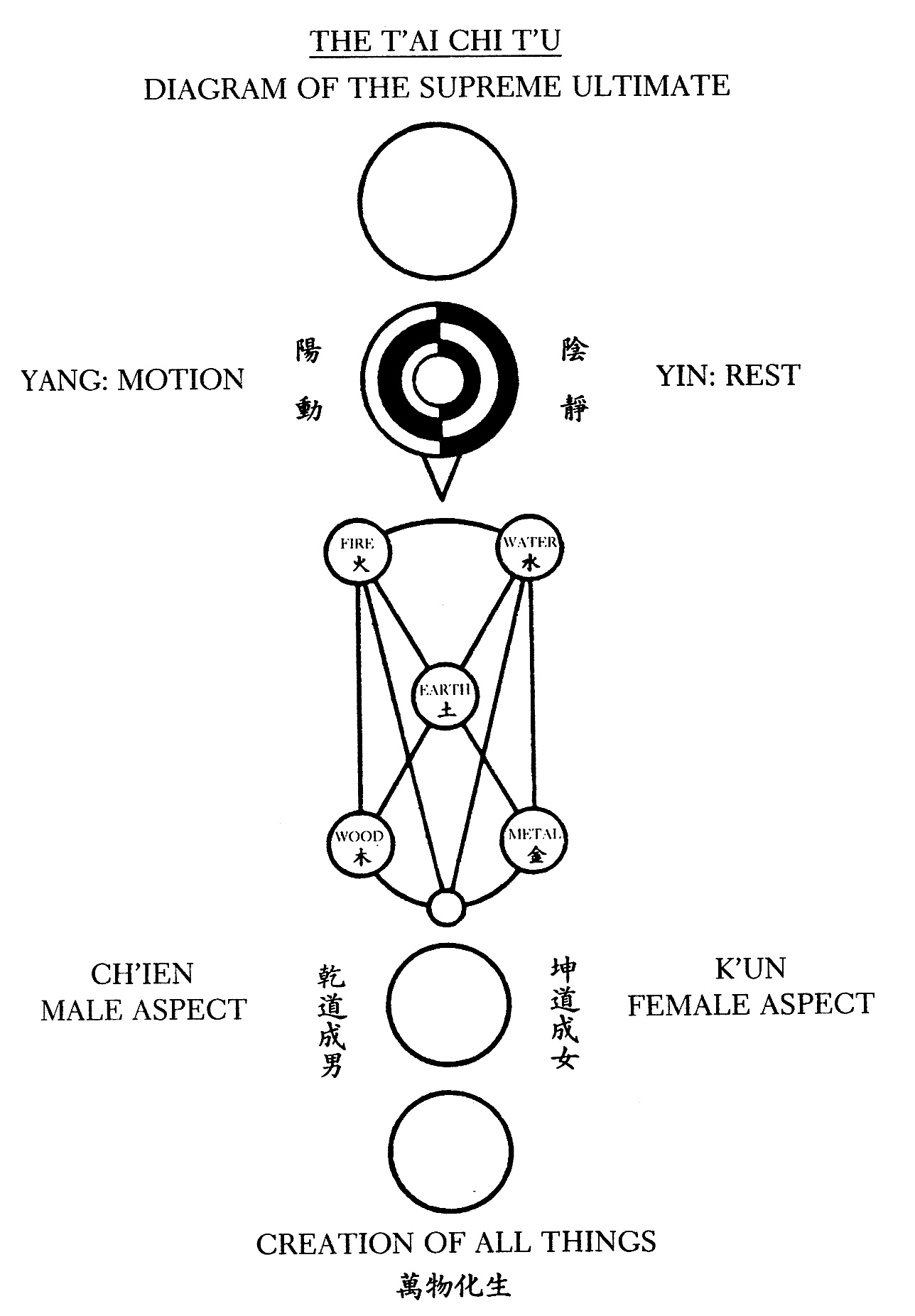
But imagine if you held those models
upside-down! The World of 10000 things is the final, most completely
diverse manifestation of reality.
In fact, the idea of 'up' and 'down' is
factually irrelevant; there is no level of reality that is "more
real" or "less real" than another. But what is true is
that the root of creation begins with the simplest form, and grows in
complexity into the final form.

Consider the Taijitu: the simplest
forms are Wu and Wuji, which are both types of emptiness. Emptiness
is present in all levels of creation. Emptiness by definition cannot
be either small or large; you can find conceive of emptiness as the
tiniest gap or the largest expanse, and without anything else present
(to provide boundaries for it) you cannot really consider it to have
'size' at all. Thus Wuji is "boundless".
Then there is Taiji, the ALL. The Taiji
must emerge out of Wuji, as it is a more complex thing; Taiji is all
that exists and all that is empty at once.
Then there are the two poles: Yin and
Yang. These must emerge from the Taiji, because again they are more
complex and diverse. The Sixiang emerge from Yin and Yang, the Bagua
from the Sixiang, and the World of Ten Thousand Things from the
Bagua.
So where could you go that is not part
of the World of Ten Thousand Things to find the Bagua? Where could
you go apart from the Bagua to find the Sixiang? It is like if you
had an object: to find molecules you would have to look inside that
object; to find atoms inside that molecule, to find electrons inside
that atom, to find quarks inside that electron. You can't go looking
for the building-blocks of reality by ignoring the very small,
because it the more fundamental things are the smaller things that
make up the more complex forms.
The Qabalists have a saying about
Kether and Malkuth (the highest and lowest points on their tree of
life): "Kether is in Malkuth and Malkuth is in Kether". It
is the same in the Taijitu: The Taiji can only be found within the
Hexagrams, and the Hexagrams are found within the Taiji. There's no
place you could look for the Taiji, nowhere to "seek out the
Tao", except within the Yi Fa (the manifested reality); and at
the same time, you cannot find the Ten Thousand Things except within
the Taiji.
It is the same way with yourself:
people want to escape their material existence to seek out some kind
of "higher plane" but you cannot find any such "higher"
plane. You can find the vastness of reality only by going within, not
by escaping to some other place. When the Celestial Eye is opened,
what you see are vast universes: those universes all exist in the Yi
Fa. In fact, they all exist within your own body, and your body
exists within them.
So understand that the vastness of what
you will begin to experience is not some other world, it is in fact
the hidden interiors of this very Manifested Reality. It is within
you.
(if you are interested in joining the Yi Fa society to work through a structured curriculum of spiritual/esoteric Cultivation training for self-transformation, please contact me for an application)
Wednesday, June 6, 2018
Experiencing Harmony
Harmony is one of the four qualities of De (as expressed in the I Ching), the power that can be roughly translated as "Virtue". It is not a concept of morality in the western sense, but rather a state of being.
So Harmony (like the other three aspects of De: Unity, Discipline and Truth) is something you have to work towards, but it is also something that you experience. De can also be translated as "power", and it is the true source of your spiritual power, for Qi Gong or anything else.
So how do we experience Harmony while engaging in Cultivation practice?
The key to Harmony is to understand how to have a direction, in your meditation, in your Qi Gong movements, and in your activities in the everyday world, all while not being unbalanced by your own self-referencing world-view. In other words, being driven by your own 'lust of result' to try to impose your agenda on the world.
But you also shouldn't concern yourself too much about fearing your own Inferior Person, those desires to try to impose yourself on reality, because that fear can also paralyze you and unbalance you.
Rather than trying to resist your own attachments, let go of concerning yourself with attachments at all, and focus on the bigger panoramic vision, first of yourself, and then of yourself in the world.
Find your own vast nature. Not the small little and petty inferior person. The vast and open Superior Individual constantly referred to in the I Ching.
Relax.
Show up, and then open up.
And when you do, connecting to that vast Panorama, you can choose any direction to move within that panorama, and it becomes liberating.
When you aren't doing this, that's when you feel more closed. It feels like you're on a railroad track, you have blinders on, you only see a tunnel going one direction.
When you're acting in Harmony, you see the whole panorama and it feels open and free, to move in any direction while keeping your goals in mind.
Wednesday, July 26, 2017
The Yi Fa Cosmology
Some people have asked about the cosmology of the Yi Fa curriculum.
In fact, the cosmology of Yi Fa is directly drawn from the teachings of the I Ching.
There are more details of the cosmology in the teachings of levels 2 and 3 of the Yi Fa curriculum.
What follows is only an explanation in brief.
There is the whole, first off (you could call it the Taiji or the Tao if you like, the absolute sum of all that actually exists).
Then there are certain primal forces (Yin and Yang, the four fundamental forces of existence, the eight elements) which all have archetypal existence. Some of them may appear to have personalities but that's really our way of being able to comprehend them.
Then there's the manifested world, "the World of 10000 Things" as the Chinese poetically put it. It contains all of of those things I mentioned above WITHIN it. Those things are the building blocks of the manifested world, what you find when you look at reality on both the cosmic scale, and by going deep within.
So those elements and primal forces and positive and negative (yang and yin) all exist within us. They take shape to make each of us a unique expression of reality.
Human beings are unique (as far as we currently know) in that we are capable of conscious awareness of these forces. We have Will. Even if most of us never actually use it.
We can use this Will to become conscious operators of those forces, not just reactive operators the way other things in the world of 10000 things are. But that consciousness also creates in us an illusion of separateness from reality. We mistake being Unique for being Apart. And this illusion can be called the Persona.
Since it is an illusion, and we cannot ever actually be apart, it creates a conflict within us between the part of us that is Real and the part of us that is fabricated, the Individual and the Person. In Chinese mysticism, these are two separate parts of the human soul, called the Hung and the Po. The Hung is eternal, the Po is temporal and dissolves after death. The Hung is the Superior Individual, the Po is the Inferior Person.
Thus, the cosmology of the Yi Fa curriculum establishes the cause of our human alienation, and also shows the path toward resolving it, by manifesting the Superior Individual.
Thursday, August 25, 2016
On the Nature of Ritual and Qi
The other day I posted a Youtube video related to the subject of ritual, in the context of the Bhagavad Gita:
Now, this video is not part of the Yi Fa Curriculum. But the subject of 'ritual' is very significant to the Yi Fa work. As the video points out, ritual is not meant to be something done automatically, or even as such for some kind of ulterior motive: it is its own reward.
This brings to mind the question of 'what is ritual'? We tend to think of ritual in terms of being some kind of ceremony meant for religious or magical purposes.
But in Chinese thought, ritual or "rites" (which is called "li") means not only religious ceremony, but also it encompasses all the notions of 'proper conduct'. It can be understood as including customs, manners, etiquette, 'proper form', etc. We could call it "rules of art". It is tied to the Virtue of harmony; both in the sense of good harmony within our own being (balance), but also harmony with our world, our fellow human beings, and society.
Another of the Confucian Classics, aside from the I Ching, is the "Book of Rites". If you look at that book, you will find that it is not some book of magical rituals, but rather a wide-ranging guide to all kinds of standards of etiquette and ancient customs (from the Zhou dynasty, the dynasty that wrote the I Ching).
In relation to Qi Gong, the practice of the forms of Qi Gong (including Yi Fa Qi Gong) are certainly a type of ritual. It is important to further clarify what this means in the context of Qi. There are many people talking about the "Qi Gong" of other activities: how painting can be Qi Gong, or writing, or dancing, or all sorts of other things (even "Qi Gong Golf" or "Qi Gong Cooking"). In some cases, this is interpreted in some kind of very esoteric way, like as if you are doing some very special mystical technique. But this was not really the purpose of this concept, it is actually just the opposite.
Let's further define an intentional act, and a ritual act. In western esoteric magic, we are told that "any intentional act is a magical act", and that magick is "the art or science of causing change to occur in conformity to the Will". We can thus surmise that any intentional act is an act where you are directing your will.
So what marks the difference between an 'intentional' act and a 'ritual' act is that a ritual act is to direct the will within a certain form. Any practice that has a technique is not only an intentional act, but a ritual act. This is how to understand 'rites' in the context of Qi Gong.
What this means is that if you get up in the morning and brush your teeth, and the practice of brushing your teeth is done in a certain way (you stand in front of the sink, you fill a glass, you lift the glass to your lips and slosh some water in your mouth, then spit it out into the sink; you grab your toothbrush, open the toothpaste, put a bead of toothpaste on the toothbrush, put the toothbrush in your mouth and scrub in a certain fashion going from one part of your teeth to another, then rinse your mouth again, wash off the toothbrush, etc.) then you can say that you have a "technique" of brushing your teeth. But this is not a ritual, unless you are also doing it as an intentional act. As soon as you are doing this exact same technique, just as you always did it before but now as an intentional act, it becomes the Ritual of Brushing Teeth.
It is the same with countless other things you do in your ordinary life. You have techniques for all sorts of ordinary things in your life. Often, these are done mechanically, specifically as a way to avoid paying attention while you are doing it; you can be on 'automatic' because of how familiar you are with these techniques.
In Qi Gong, Qi is a measurement of the direction of your Will. It is treated as a substance, and thus we understand Will not as some invisible thing or only a mental effect but as a part of our material existence. When we do anything as an Intentional act, we are directing Qi. So if we are doing some technique in a mechanical way, we are not directing Qi into these activities. But as soon as we do that technique in an intentional way, we are directing Qi into them: a mechanical activity becomes a Ritual activity. This directing of Qi does not really require any special effort on our part aside from intention; just like in Yi Fa Qi Gong you do not need to do anything mentally to 'move' the Qi, it naturally happens just by performing the practices with intention.
If we are trying to brush our teeth, or paint, or play golf, or prepare breakfast or any other thing, through some technique, whether it is ordinary or somehow fancy or ceremonious or unusual, it is NOT Qi Gong, if it is mechanical. But it can be said to be "Tooth-brushing Qi Gong" or "Painting Qi Gong" or "Golfing Qi Gong" or "Cooking Qi Gong" if we are doing it with a technique and form AND we are also doing it intentionally!
This is why I say people often understand it the opposite way of how it is intended: it is not about reciting some kind of mantra or visualizing something or doing some unusual movements or mentally directing something, while you are doing these ordinary things. It is about doing these ordinary things with order and structure, with harmony and balance, and with the Active Consciousness, with intent. The point is not to try to mystify ordinary activities, but to understand that that all sorts of ordinary things can be mystical, can be part of cultivation, simply by doing them consciously.
And we have to conclude, by this same reasoning, that it is not that Qi Gong is something separate from the ordinary, but very much part of the ordinary. Our ordinary life does not need to be integrated into our cultivation practice; rather, our cultivation practice needs to be integrated into our everyday lives! We do not need to separate ourselves from ordinary existence to find the magical, we have to unite our Will to the ordinary.
There, in the Manifested, is where the Great Work is to be found.
Wednesday, August 17, 2016
The Relationship Between "Spritual" and "Reality"
There is a great spiritual difference between spiritual teachings and religions that place the unmanifested above the manifested, and those that do not. Just as there are materialistic philosophies which deny anything 'spiritual', there are also anti-materialist belief systems that deny the material in favor of something they choose to imagine as 'spiritual', separate from the material.
In ancient China, all three concepts existed. There were strictly materialist philosophies that denied anything but the manifest, the "Yi-fa". There were likewise many movements that wanted to envision the universe as a universe of immaterial 'spirit' and that the manifested world was either an illusion or a corruption, something inferior to the pure and unsullied 'spiritual world'.
But if you study the I Ching and the teachings of the great Sages, it becomes evident that neither of these are a correct reflection of reality.
This same conflict existed in many other places and times, with other names; certain "gnostic" sects in the west claimed that our world was nothing but an illusion. The institutional forms of Buddhism made similar claims, many of them ascribing a higher position to some 'spiritual' world that the Buddha himself denied.
In The Magician's I Ching, I have detailed the story of the debate between Zhang Shi and Zhu Xi, and Zhu Xi's quest to achieve enlightenment as to the true nature of reality, and how to reconcile the difference between the unmanifested (Wei Fa) and the manifested (Yi Fa). It is unsurprising that after coming to realization, Zhu Xi would strongly advocate the study and practice of the I Ching, because within it, it uncovers the truth of this relationship.
Some would-be mystics want to conceive of the nature of reality as a kind of top-down hierarchy where the lowest and least important level of reality is the manifested world. But consider the I Ching: a hexagram contains, within it, the trigrams. Trigrams contain, within them, the Yin and the Yang. Within Yin and Yang are found the Taiji (the undivided polarity). Within the Taiji is the the Wuji (the boundless), and within that boundlessness is Wu (emptiness).
Without trying to confuse scientific concepts with mystical ones, this can't help but bring to mind the nature of physical reality as we understand it today: how within objects there are molecules, those are composed of atoms, atoms are composed of protons and electrons, within those there are quantum particles, and inside all of this is empty space. Reality is not top-down, it is a whole, and that whole has layers, more fundamental and basic layers, and more complex outer layers.
This is the functioning of reality, and it is essential to understand if you are going to practice a real system of cultivation (because any spiritual practice not based on reality will not get you very far)! The Manifested (Yi Fa) and the Unmanifested (Wei Fa) must of necessity both exist, they are both real, but the only place where the unmanifested can possibly exist is within the Manifested. Wei Fa is not 'outside' or 'beyond' Yi Fa, it is only real within Yi Fa.
This is important to spiritual practice, because it means that Wei Fa, for the practitioner, can only be reached through the Yi Fa. You can't reject the body, reject the world, reject reality, and go off into some spiritual wonderland that is somehow beyond all that, because there is nothing to connect to there. You cannot find the Unity of all things by rejecting any thing. You have no tools to connect to the truly 'spiritual' if you ignore your body, your mind, your world, and your interactions with the world. This place, this world, our bodies, our awareness, all the things that exist in the manifested reality are the alchemical laboratory of our self-transformation. Without them, you can go nowhere.
Monday, January 25, 2016
Zhu Xi's 8 Points of Cultivation Training
Zhu Xi was one of the greatest teachers of Yi Fa, and responsible for its fullest elaboration in Chinese Philosophy. He was a strong advocate of cultivation practice in an age where it was not generally approved of by the intelligentsia. His fellow scholars tried to claim that the I Ching should only be studied as a philosophical text, and not actually used; and many of them dismissed Qi Gong and meditation entirely as merely 'mystical' activities that were unnecessary. They believed that a sage only needed to memorize and repeat the classic teachings, or speculate on intellectual matters.
Thus, Zhu Xi had to restore conditions in Cultivation practice that were in a strong state of disrepair. He brought back significance and legitimacy to the active practice of cultivation work, and explained how this was vital to the process of self-transformation.
He had eight key points that he considered essential to being effective at self-cultivation:

Zhu Xi's 8 Points of Cultivation Training
1. Zhujing: maintain a state of composure. In other words, step 1 is to remember to relax and be present.
2. Zhen-tu: Attention in solitude. The practice of Showing Up to reality, letting yourself become attentive and sensitive to the sensations of your body and consciousness to detect the "weifa" (unmanifested reality) within the "yi fa" (reality).
3. Xing-cha: self-inquiry. You must seek to understand the nature of your own being and the sources of your qualities in the past.
4. Cun-yang: "Preserve and nourish". You must hold to your original nature. Find the most natural way of your being and help it be nourished. The 'most natural' here does not mean the easiest or your baser impulse, but rather your higher nature, the Superior Individual.
5. Ke-ji: "conquering the self". Overcome your own tendencies and outside influences to maintain discipline in practice and develop Virtue.
6. Jing-zuo: quiet contemplation. Collect your thoughts, nourish your consciousness.
7. Ke-wu zhih-zhih: "grasping the whole pattern (of events and phenomena)". Observe beyond the merely visible, by making use of your mind, intuition and consciousness, within and without you. Thus you will achieve "guandong", usually translated as "interpenetration": the state of seeing the connections in all things.
8. Xing: "practice". Ceaselessly continue in your practice, ceaselessly apply what you have practiced to your life.
Sunday, November 22, 2015
When, Where and How to Practice Qi Gong
There are many things that can affect your ability to process Qi, most of these internal. What in Qi Gong is often called your 'enlightenment level' (just how Conscious you are), your physical health, whether or not you are under stress, how many distractions there might be and whether you allow them to be distractions, your will (to "show up" for the practice and do it with your main consciousness), and of course the cultivation of Virtue.
And it is important to note that ALL phenomena are 'natural' phenomena from the perspective of Yi Fa, so there is no special advantage in and of itself between practicing on a mountaintop or practicing in the middle of a mall. But of course, that difference could cause differences in those internal conditions I already mentioned. If where you are is more appealing to you, changes your stress level, makes you more willing to show up, etc, it will put you in a better frame of practice. So the golden rule is: do Qi Gong where you feel most inclined to do it, if possible (but above all else, DO QI GONG, do it every day, regardless of whether circumstances are ideal).
There is one external difference that is more important than any other I have found: Qi Gong practice is much more effective if done in a space that has some kind of opportunity for circulation of air. So if you are doing Qi Gong in a place with all the doors and windows closed, it will be less effective. If you are doing it in a small room with the door locked it will be less effective than doing it even in a bigger room with a door to some other rooms open. Practicing in a big indoor space, or outdoors, is more effective than in a small enclosed space.
(the former is from a letter to a Yi Fa Society student. If you are interested in personal training in Qi Gong and the whole system of internal alchemy worked by the Yi Fa Society, please contact me regarding membership)
Friday, November 13, 2015
Yi Fa Qi Gong Video: Mudras
The latest video on the youtube playlist is a guide to the basic Mudras, or hand positions, in Level 1 of the exercises of Yi Fa Qi Gong. These hand positions are crucial to the fully successful performance of Yi Fa Qi Gong.
Wednesday, September 30, 2015
The "Point" of the I Ching
One of our members asked:
"the complete "point' of the i ching ( i mean in a Very Broad sense) is to bring us where or what state finally? It is an ancient tool and gift from Masters, could take lifetimes of study and still get new things... but what is the 'culmination' persay when it comes to lifetimes of learning to live with and use and appreciate the i ching as practicers and devotees (and i am of the least of those) then what is our Release... "
What I would say is this: the I Ching is first and foremost a tool to help us live our lives in the present; and to understand reality better. It lets us understand our reality at this physical level (of what you could call our "daily lives") and to understand the flow of Time and Space in relative dimensions that exist below the surface of that.
So as you grow in understanding of that, you gain in Awareness, your perceptions expand, your consciousness grows. And the I Ching does this through a system that isn't about trying to abandon or ignore our surface reality. This is a very important point. I will write more about this here, probably, and I talk about it explicitly in the book I'm working on; it is based on a spiritual concept called "yi-fa", which could be called "the Law of Change". It says that the best way to understand our "unmanifested reality" is by engaging in the manifested world.
--There's a similar teaching to this in the Book of the Law, when it states "The Khabs is in the Khu, not the Khu in the Khabs" (AL I:8)--
But the teaching of the I Ching (and the concept of Yi-Fa) also has an instruction that works on the personal rather than the universal level. This is the concept of the "Superior Individual". So the I Ching provides a framework of lessons for how to go from being a disconnected person into becoming someone who "embodies Heaven", who is Connected to this Reality. In each hexagram of the I Ching there is a hidden lesson about what we call the "Great Work", about how to develop what the I Ching calls "Virtue", which is not the standard term of that word as something like 'good behaviour', but rather the development of spiritual qualities within you that give you a kind of magical power, the power to Connect with "Heaven" (that is, with fundamental reality).
But in terms of an end-point, there really isn't one. The I Ching, like other profound mystical teachings, ultimately expresses reality as a "Spiral"; there really isn't an end to anything as such, there's no point where suddenly you say "I'm done now, I'm perfect". But it's not just a circle either; it's not that you don't change, and there are important stages along the way. You grow, you end up fulfilling more of your potential, your birthright as a human being. In any case, if there is an end, I have not found it nor seen any hint of it. Lots of things end, including us (our lives end, stages in our lives end) but there's no big final state where Change stops.
That's the fundamental teaching of the I Ching: it is named "The Book of Changes" because it explains that the fundamental truth of reality is Change.
Subscribe to:
Posts (Atom)