The official public blog of the Yi Fa Society, a mystical order dedicated to the teaching and practice of self-transformation through the study of long-hidden practices of internal alchemy.
Bagua
Showing posts with label Elements. Show all posts
Wednesday, October 11, 2017
The I Ching Teaches us That Reality is a "Doing"
The I Ching's cosmology suggests a reality that isn't a structure of 'things'. It is not a universe of things 'being', it is always a universe of things 'doing', of the interaction of elements.
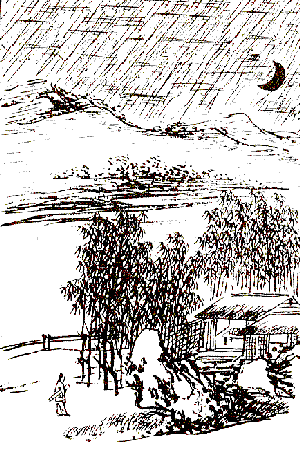
In the West people tend to imagine that Reality is a noun, rather than a verb. That may be because of the self-referencing perspective; if something is a static object, rather than a moving process, it is easier to define, and to control.
Something static can be more easily controlled. You put a solid cube in one corner of the room, it will stay there. It won't move on its own at least. You can turn it on one side, it'll stay on that side.
On the other hand, it takes a lot of work (energy) to break that cube, or burn it, to make it move or to shape it into something other than a cube.
Static things are easy to control, hard to manipulate.
On the other hand, if you understand reality as a "doing", a constant interplay of the 8 elements that make up the world of 10000 things, then it is much EASIER to manipulate.
Creating change is much less difficult than the illusion of solidity makes it look.
But it is much HARDER to control, than our notion of a static reality leads us to think.
You can alter the course of the river, but you can't just force it into a fixed route forever, make it stop flowing forever, or much less make it change the direction of its flow.
Wednesday, January 4, 2017
Five Phases and Eight Elements
There's frequently some confusion in those who study Chinese mysticism/magick, in that there are eight trigrams in the I Ching, but in the greater system of esoteric teaching there is also something that is often defined as the "five elements". The initial and superficial similarity between this and the five classical elements of western esotericism (earth, air, water, fire and spirit) cause a lot of confusion.
Regarding the "5 elements": the problem that has caused this confusion relates to the use of the term 'elements'. Because what we usually call in English the 'five Chinese elements' are NOT in fact 'elements' in the sense of the five elements in western occultism!
The '5 Chinese elements' are actually five 'phases' in the cycle of generation to putrefaction.
The equivalent of the five elements of western occultism (earth, air, water, fire and spirit) are the Eight Trigrams. The eight trigrams are divided in two parts: the four terrestrial trigrams correspond to the elements of Earth, Air, Water and Fire; while the four celestial trigrams correspond to Spirit (you could say "spirit of earth", "spirit of air", "spirit of water" and "spirit of fire").
Then, the 5 chinese elements (the 'wuxing': wood, fire, earth, metal and water), which were most likely first developed in the alchemical teachings of the School of Yin and Yang (around 500 years after the Zhouyi text, the core of the I Ching, was written), correspond to the western 'alchemical elements' (Salt, Sulfur, Mercury). And likewise to the 3 gunas in Indian mysticism.
There are five of these, rather than three, because in the Wuxing system you have three process states (Wood, Earth, and Metal), and two transitory states (Fire and Water). The process states represent Generation, Plateau, and Decline, while the transitory states represent the moment of peak Flowering and the moment of fullest Barrenness (that is to say, the peak-state and the nadir-state).
Thus, while the Five Phases look similar to the Five Western Elements, it is in fact representing a totally different esoteric concept, much closer to that of the "alchemical elements" of western occultism. And it is the Eight Trigrams which are the equivalent of the elements of western occultism.
So you see similar concepts, presented in different ways. Like different languages to describe similar concepts.
This is because the thing being studied is real; it is based on the study of reality, the natural universe, and the universal human condition. So the findings will be the same. But the expression will be different because of differences of distance, history and culture.
This is discussed a bit further in teachings of Levels 2 and up of the Yi Fa Society.
Subscribe to:
Posts (Atom)