The video commentary on hexagram #18. Members of the Yi Fa Society have access to a second video with more advanced insights.
Bagua

Showing posts with label I Ching. Show all posts
Showing posts with label I Ching. Show all posts
Monday, March 28, 2022

Monday, March 8, 2021
Friday, January 22, 2021
I Ching Hexagram Commentary #16 - Certainty
Here is the latest in the I Ching public video series.
Members of the Yi Fa Society get access to private videos and written teachings that elaborate further on each hexagram covered in this series. If you are interested in applying to the Yi Fa Society please get in touch.
Monday, January 4, 2021
On the Significance of Yuan Heng Li Zhen
The opening words of the I Ching's core text are "Yuan Heng Li Zhen", which is typically translated as "Sublime celestial forces in motion".
When you think of the "celestial force" that is Time itself, you can understand immediately that this first line, the main text description of Hexagram #1, is also an apt description of what the entire I Ching is all about, and it has been treated that way by many scholars and adepts of the I Ching throughout history. As more commentary has been made of Hexagrams 1 & 2 than any of the others, it can also be said that more commentary has been made on those four words than any other words in the entire I Ching.
These words do not appear on in Hexagram 1, however. They are also spread out, often in pairs (Yuan heng, or li zhen) throughout the I Ching core text. Separately, "Yuan heng" means a broad or easy path, or also, a ritual or sacrificial rite. While "Li zhen" means a favorable auspice, clearly a common phrase in the context of divination.
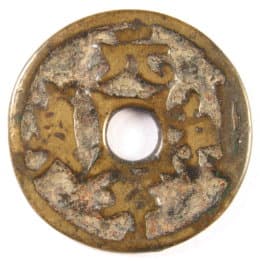
A Chinese coin-shaped talisman inscribed with Yuan Heng Li Zhen
In the Yi Fa teaching, a great deal of emphasis is put on those words as representative of the four facets of Virtue: Union/Love, Discipline, Justness/Harmony, and Truth/Reality.
The description of Yuan Heng Li Zhen as being these four virtue facets originates with the Wenyan Commentary, which dates back to before the Han Dynasty. Here is a quote of that commentary from one translation:
"What is called "the great and originating" (yuan 元) is [in man] the first and chief quality of goodness; what is called "the penetrating" (heng 亨) is the assemblage of excellences; what is called "the advantageous" (li 利) is the harmony of all that is right; and what is called "the correct and firm" (zhen 貞) is the faculty of action."
Here "goodness" is Love/Union, "the Assemblage of excellences" is the process of Discipline, Li is already translated here as Harmony, and the "Faculty of Action" is Truth or Reality, that is to say the perceptual faculty that allows us to take action.
Yuan Heng Li Zhen is also a reference to cycles:
Yuan - sublime, the head. The beginning. Spring
Heng accomplishment, prosperous. Summer
Li beneficence, harvest, autumn.
Zhen determination, endurance, winter
Thus Yuan symbolizes the beginning of all things, Heng their growth, Li their further development, and Zhen their maturity. This concept of the four words connecting to the cycles of growth and the four seasons was particularly elaborated by Cheng Yi, the Song dynasty sage and friend of Shao Yong.

These words are also used in some esoteric contexts as a mantra, and also as words of invocation for ritual purposes. In fact, just as the four words can be used to describe the pattern or process of natural or seasonal cycles, they can also be used to describe the STEPS of a ritual.
In this sense, "Yuan" symbolizes the invocation, calling down what is above, for the sake of Union.
"Heng" symbolizes the correct performance of the ritual, with Discipline.
"Li" means receiving a response from the forces you have called upon; that is to say, your ritual bringing you into Harmony with the universe.
And "Zhen" means applying that response or change in yourself, embodying Truth in the real world.
Friday, November 13, 2020
What is the Nature of the Superior Individual?
In the philosophy of the I Ching, there is a basic truth that in every moment, we have a choice between manifesting the Superior Individual or the inferior person.
Among those who practice cultivation, however, there may be some question as to just what the "Superior Individual" is. In the course of cultivation, one might get a sense of the Superior Individual being some outside entity, the "higher self" sending them messages or guiding their life.
So some have developed a conception where the Superior Individual is some kind of outside spiritual, angelic or divine entity.
But in fact, the Superior Individual is basic part of ourselves. It is not a separate being at all, it is us. The best of us.
This sense of differentness, of the Superior Individual seeming like another being with its own intelligence and communicating with us is a product of people's primary identification with the 'inferior person', which is also a part of us. Thus, we have become separate from the 'higher self'.
Why are we separated from our higher self?
We aren't, but it seems this way.
The issue is this: we are a species in the process of evolution. Our consciousness has multiple layers, which can be generally divided into two parts. In the context of I Ching studies (including the Yi Fa work) these are described as "World" and "Heaven". To Nietzche it was "last man" and "super-man". In others, it could be called "animal" and "divine".

The Chinese actually say that there are two parts to the human soul: Po and Hung. The Po is the part of us that is animal instinct plus conditioned behavior. The Hung is the part of us that is our fullest potential and true Individuality (as opposed to the 'persona' of our inferior po-soul).
We can, at every moment, choose to associate with one or the other. But on account of our intermediary condition and because of our social conditioning we tend to more directly identify ourselves as the "Inferior Person". So much so, that the Superior Individual can sometimes feel like it's a separate entity, some kind of guiding spirit.
You will find, if you engage with discipline in a sincere long-term course of spiritual cultivation, that over time, you will become more and more identified as one with the Superior Individual. At that point, the 'ideas' of the Superior Individual will be identical to your own, and the notions of the inferior person, which will still be present, will instead be the ones that appear to be foreign.
Thursday, October 22, 2020
The Steps of Human Consciousness
There's a teaching in Chinese mysticism that there are two levels of our consciousness. They're associated with the concepts in the I Ching of the "inferior person" and "superior individual".
At every moment in space and time we have a choice of which of the two we associate with in our active consciousness, but most people in general associate with the inferior person. The inferior person is a collection of influences and conditionings based on your physical nature, your environment, and the influences of your past and present choices and people in your life.
The Superior Individual is your true nature, what is real about you behind all those things. But in point of fact most people are so disconnected from their true and essential nature that it feels like it is another person. In many rituals used to "communicate" with the Superior Individual, that division is so notable that it feels like the Superior individual is some totally different entity from "ourselves", which is why in western symbolism its called the "Holy Guardian Angel".
This is also why when one is trying to shift the association of their consciousness from the inferior person to the Superior Individual it feels like dying, like the very essence of who were until now (or rather, who you thought you were) has to be destroyed for you to get to that true self. In a lot of cases, people's motives for getting to that true state involve desires OF the inferior person, so they realize that to get to what's real, they'll have to give up the fantasies of the false person they were, and that's very hard.
This internal conflict is mirrored externally by the struggle between (the inferior person) wanting to imagine one's self the center of the universe, and wanting to have a power that acts on the universe and get to impose its desires on the universe, and the (Superior Individual's) understanding that we are one non-divisible part of reality and are not the central actor but one small part of a very big picture in the vastness of Space and Time, and how this is not something that can just be reasoned out, but has to be experienced through meditative practice and the application of virtue to restore that Union with the Taiji (what in modern English we could call the "Singularity").
So in fact while most of these sorts of studies and articles and ordinary perceptions on the subject of "enlightenment" talk about a two-option process (unconsciousness / enlightenment), the work of spiritual Cultivation is actually a multi-step process of initial glimpses of waking up, initiation, developing discipline, achieving communication with the Superior Individual (in western magick called the "True Will"), working to change one's life and environment to better fit one's efforts at attainment and union, making the shift from general association with the inferior person to general association with the Superior Individual, engaging in teaching or other forms of applying Virtue in the world, attaining states of Union to reality, and finally manifesting that Union fully and becoming the Sage (Enlightenment). There are steps Beyond Enlightenment as well but these are generally not spoken of in lay contexts.
Of the above stages, the big three are:
- Initiation: the beginning of awareness of one's Enlightenment quality, and the start of serious spiritual cultivation.
-Adepthood: the shift into association with the Superior Individual
-Enlightenment: uniting to nature or space-time as a whole (which is to say, overcoming this false notion of separation between self and other, and the self-referencing nature of "thinking you're in the middle of the picture").

Finally, I'll note that the very notion that Enlightenment is some kind of separation from the World or one's humanity is ridiculous and disgusting. That's essentially either nihilism or solipsism, the heresies of the gnostics. You can't become "one with everything" by being less human, or less engaged.
Anyone claiming to be Enlightened while pretending that they don't care about things, or feel things, or that there are certain normal human things that they just don't experience (be it anger, sadness, physical pain, or basic physical needs) are both arguing for Enlightenment being a kind of sub-humanity, and blatant liars.
Enlightenment requires, as my own teacher once said, that you Be More Human.
It's not about separating yourself, it's about Showing Up, being present in the active consciousness.
It's not about feeling less or caring less, it's about Totality. Becoming one part of the big picture, without trying to run away from that big picture, or trying to be right in the middle of that big picture, or trying to control that big picture. It's about being 100% of yourself in the here and now.
Tuesday, September 22, 2020
The Magician's I Ching Facebook Group now has Over 3000 Members!
The Facebook group created in honor of The Magician's I Ching, but which is a general discussion group for all I Ching related subjects, has now reached 3000 members!

So if you haven't already joined the Magician's I Ching Facebook Group, please consider joining! It's free, and filled with interesting conversation and material related to the I Ching and I Ching studies. It's open to people coming from western or eastern traditions. It's very welcoming to newcomers to the I Ching, and you can get questions answered or useful advice. But it also has many very learned and highly experienced advanced students of the I Ching, and if you are one of those people you'll find some excellent higher level discussion about some of the finer points of I Ching study.
While you're at it, please consider joining the Yi Fa Society. Members of the Yi Fa Society also have a (secret) discussion group, and benefit from a complete and detailed training program for studying Yi Fa Qi Gong and the I Ching. Members of the Yi Fa Society are taught additional Qi Gong and I Ching secrets that are not available anywhere public.
At higher levels of membership, the advanced exercises of Yi Fa Qi Gong are taught, and students are provided large numbers of instructional materials (whole books, like "Secret Techniques of the I Ching", "Universal Yi Fa", "The Yi Dao", and "the Great Book of Yi Fa", among others) on how to deepen their work with Qi Gong and I Ching for self-transformation and the work of enlightenment.
Members of the Yi Fa Society can work personally with me to keep up their practice, to resolve problems in their practice, and to develop discipline and structure in their spiritual path. Members also have the opportunity to have monthly Skype meetings with me for the same purpose.
Yi Fa Society membership is not free, but basic membership is on a monthly donation basis set by each student.
If you are interested in joining the Magician's I Ching Facebook group, just click on the link and join, and start reading and sharing with us!
If you are interested in joining the Yi Fa Society, please contact me, here or on Facebook.
Saturday, August 22, 2020
I Ching Questions and Answers: Line 1 and Line 6
I often receive questions about the I Ching, and how to read it more effectively. If you have a question post it in the comments below and I will try to answer it.
Meanwhile, here is one example of a question someone recently sent me, and my answer:
Q: what does it mean when only line 1 and line 6 are changing?
In an I Ching casting, you derive a six-line hexagram. In the casting, any number of those lines, from none at all to all six, could theoretically be changing lines.
Any lines might or might not be changing.
You cast the lines in order from the bottom to the top, so that the bottom line is considered "line 1", and the top line is considered "line 6".
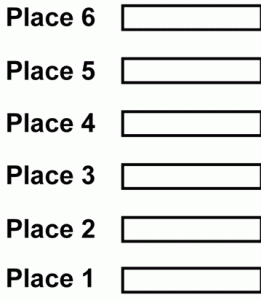
If more than one line is changing, it is important to determine what is the "central line", the part of the casting that is the most important. The way to do this is explained in The Magician's I Ching.
So if you get only two changing lines, and they are line 1 and line 6, of the two the central line of the reading is line 6. Line 1 needs to be read as a kind of prelude to the central line 6.
In an I Ching casting the position of each line has a general sense of importance. As each Hexagram represents a situation, the bottom 1st line represents the very beginning of the situation; often even what happens before the situation is really in action. Line two is often when things get going. Line three the most difficult part (the jump between the lower lines and the upper lines). Line four is when you're past the middle of the situation. Line 5 is usually the climax or peak of the situation, and Line 6 is when the situation is ending or even past due to end.
Since Line 1 usually signifies something taking place very early, and line 6 very late, there is a bigger distance between the two than if they were any other two lines. It can also mean with regard to the question that issues that happened at the beginning of the process are relevant to what is happening right now.
So in a casting where Line 1 and Line 6 are the two changing lines, you ought to think of Line 6 as what's most central right now, but there are things about how the current situation began that are having an important effect or consequence at the time of the situation ending.
Monday, June 22, 2020
The I Ching: Hexagram 15 - Humility
An analysis of the 15th hexagram of the I Ching, in the latest video in the I Ching series:
If you want more teachings on the deeper mysteries of the I Ching, as part of a program of cultivation and spiritual self-development including meditation and Qi Gong practices, please consider applying to the Yi Fa Society!
If you want more teachings on the deeper mysteries of the I Ching, as part of a program of cultivation and spiritual self-development including meditation and Qi Gong practices, please consider applying to the Yi Fa Society!
Saturday, March 14, 2020
Time and the I Ching
What is the nature of Time? The I Ching seeks to explain that.
This is important for understanding your own spiritual cultivation, as well as to understanding how Divination works, and why!
Saturday, February 1, 2020
I Ching Hexagram Commentary #14 - Great Holdings
Here is the latest I Ching
video. If you are interested in deeper teaching on the I Ching as part
of an ongoing program of spiritual cultivation, please consider
contacting me about applying to the Yi Fa Society.
Thursday, October 31, 2019
Who is the Inferior Person?
In the I Ching, we are presented with a division between two levels of the self: the self as the "inferior person", and the self as the "Superior Individual". One of the most fundamental teachings of the I Ching is that in every moment, we are constantly facing a choice between embodying the inferior person, or embodying the Superior Individual.
But if the Superior Individual is our true nature, our consciousness applied to totality, when we are 100% engaged and united to reality... then what is the inferior person? What are you when you are being the inferior person? And what is the real 'problem' of the inferior person?
First, the inferior person is who you usually imagine yourself to be. In fact, it is a groundless mishmash of transitory influences, from influences of our childhood and past, of our environment, of the influences people and ideas and media have made over our notions of reality and who we are, until we wear it all like a false patchwork skin.Wearing this skin gives us a false sense of security and significance, where we "know who we are" and "what we want", and yet ironically it is the real source of our most crippling insecurities and insignificance.

Yourself as the inferior person is really nothing at all; it's a tiny little man, in a very restricted world.
You make yourself small by shutting yourself into your limiting perspective.
You make yourself a world that's small, by only referring to reality through your own centered lens.
And when you're that small, that you affect only your own little controlled world, then what you do doesn't really matter.
It is fleeting, because it is so limited.
It creates a momentary effect, that all too often crashes against a larger reality it tries to defy, and sooner or later your efforts, that you imagined to be so very great, come to nothing.
So the problem of the inferior person is that they are a 'shut-in'. Instead of showing up, letting themselves be part of reality as it is, they are locked into their tiny fantasy universe, seeing only glimpses of heavily-altered reality through that lens of all their desires and fears and programmed beliefs. This means that they are not able to be effective in the world.
Whereas when you don't insist on being only in the center, when you act in Union and accordance with the whole force of the universe, even very small efforts can move along that flow of reality to make huge changes to yourself and to the world.
But if the Superior Individual is our true nature, our consciousness applied to totality, when we are 100% engaged and united to reality... then what is the inferior person? What are you when you are being the inferior person? And what is the real 'problem' of the inferior person?
First, the inferior person is who you usually imagine yourself to be. In fact, it is a groundless mishmash of transitory influences, from influences of our childhood and past, of our environment, of the influences people and ideas and media have made over our notions of reality and who we are, until we wear it all like a false patchwork skin.Wearing this skin gives us a false sense of security and significance, where we "know who we are" and "what we want", and yet ironically it is the real source of our most crippling insecurities and insignificance.
Yourself as the inferior person is really nothing at all; it's a tiny little man, in a very restricted world.
You make yourself small by shutting yourself into your limiting perspective.
You make yourself a world that's small, by only referring to reality through your own centered lens.
And when you're that small, that you affect only your own little controlled world, then what you do doesn't really matter.
It is fleeting, because it is so limited.
It creates a momentary effect, that all too often crashes against a larger reality it tries to defy, and sooner or later your efforts, that you imagined to be so very great, come to nothing.
So the problem of the inferior person is that they are a 'shut-in'. Instead of showing up, letting themselves be part of reality as it is, they are locked into their tiny fantasy universe, seeing only glimpses of heavily-altered reality through that lens of all their desires and fears and programmed beliefs. This means that they are not able to be effective in the world.
Whereas when you don't insist on being only in the center, when you act in Union and accordance with the whole force of the universe, even very small efforts can move along that flow of reality to make huge changes to yourself and to the world.
Thursday, August 22, 2019
What Story is the I Ching Telling You?
There's really only one story that actually matters: the story of the journey of transformation. All good stories are variations on it.
All hexagrams of the I Ching have within them a story of transformation. Each one tells its own little story. And when you combine them with other hexagrams in permutations, it's telling another story.
And when doing a casting its doing a very specific little story of transformation with regard to the one question you might have at this time. While the whole King Wen sequence tells one great big story.
There were two schools in the period after the School of Yin and Yang, after Confucius, up to the Han Dynasty. These schools were rivals, I've spoken of them before. From that school of inner alchemy, there was a division into two forms of interpretation: Image and Number, and Meaning and Principle.

Image and Number focused on the line structures, trigrams, positions of things, mathematics of the I Ching, the elements, the cosmology. All of that was the focus of the School of Image and Number.
The school of Meaning and Principle looked at it a different way, saying that what mattered was the spiritual/philosophical teaching in the I Ching and that this was found by considering and interpreting the text, rather than the image or the mathematics/cosmology.
I've commented on the imperfection of both of those schools before.
Regardless, the value of what came out of the school of Meaning and Principle was a different approach to looking at groups of hexes, not based on their structure of lines and trigrams, but in terms of the text and grouping various hexagrams based on their common themes. In other words, to look at the stories they tell.
If you do this in combination with the structural elements of the hexagrams, this is the best way to apply your studies in I Ching structure and cosmology to a more grounded and human element of connecting to that personal story of what one must do on a journey of transformation.
Saturday, August 10, 2019
The I Ching, Cosmology and Gender
In my latest video, I talk about the nature of gender according to the I Ching and its cosmology. I know this is a contentious issue, and the answer the I Ching's cosmology provides probably won't quite satisfy anyone.
Friday, July 5, 2019
I Ching Hexagram Commentary #13 - Fellowship
Here is the latest I Ching video. If you are interested in deeper teaching on the I Ching as part of an ongoing program of spiritual cultivation, please consider contacting me about applying to the Yi Fa Society.
Saturday, January 5, 2019
Can You Use the I Ching for "Trivial Purposes"?
I have often had students ask me whether it's proper to use the I Ching for 'trivial' questions.
The question usually comes from the defining of certain types of questions as important, and others as unimportant. Sometimes it involves the notion that the I Ching should only be used for questions of Spiritual importance, or deep profound life-decision questions about one's purpose or higher self.
So I am asked, for example, if it is acceptable to ask about lost keys or some problem at work or how things will go at a football game, etc.
So my perspective is that this is absolutely acceptable to do; but I think what we need to define is the difference between something being "mundane" and something being actually "trivial", in the context of the I Ching.
The point isn't that the I Ching can't be used for everyday ordinary things. In fact, the I Ching can be greatly useful for mundane questions. You can use it for everyday subjects, even minor questions or doubts, or nearly-inconsequential problems.
However, where you can't use it is for something that's "trivial" in the sense of being a question you don't really care about.
That's true whether the question is about something very mundane or something of great cosmic, spiritual or life significance.
This is the secret of understanding whether a question is trivial or not: it's not about the subject matter but about whether you have anything actually invested in the subject matter.
If you don't have a sense of the question actually mattering to you, then you should not do an I Ching casting about it.
Note: the idea that "you shouldn't do it" is not in the sense that it would somehow 'dishonor' the I Ching or that it is some kind of spiritual taboo or will cause bad karma or anything along those lines. It's simply that you shouldn't do it because if you don't have some kind of of sense of investment in the question beyond mere curiosity, the casting won't actually work for you.
You need to have some level of caring about the question asked beyond just mere curiosity. It has to matter to you a little more than that, whether it's at the level of something where you just have a strong feeling of wanting an answer even if the casting won't have any real consequence, all the way to "this casting is a matter of life and death". As long as you have investment, as long as there's skin in the game, regardless of the scale or whether the question is incredibly mundane or cosmically profound, the casting will be able to function.
Otherwise, the casting really will be "trivial".
The question usually comes from the defining of certain types of questions as important, and others as unimportant. Sometimes it involves the notion that the I Ching should only be used for questions of Spiritual importance, or deep profound life-decision questions about one's purpose or higher self.
So I am asked, for example, if it is acceptable to ask about lost keys or some problem at work or how things will go at a football game, etc.
So my perspective is that this is absolutely acceptable to do; but I think what we need to define is the difference between something being "mundane" and something being actually "trivial", in the context of the I Ching.
The point isn't that the I Ching can't be used for everyday ordinary things. In fact, the I Ching can be greatly useful for mundane questions. You can use it for everyday subjects, even minor questions or doubts, or nearly-inconsequential problems.
However, where you can't use it is for something that's "trivial" in the sense of being a question you don't really care about.
That's true whether the question is about something very mundane or something of great cosmic, spiritual or life significance.
This is the secret of understanding whether a question is trivial or not: it's not about the subject matter but about whether you have anything actually invested in the subject matter.
If you don't have a sense of the question actually mattering to you, then you should not do an I Ching casting about it.
Note: the idea that "you shouldn't do it" is not in the sense that it would somehow 'dishonor' the I Ching or that it is some kind of spiritual taboo or will cause bad karma or anything along those lines. It's simply that you shouldn't do it because if you don't have some kind of of sense of investment in the question beyond mere curiosity, the casting won't actually work for you.
You need to have some level of caring about the question asked beyond just mere curiosity. It has to matter to you a little more than that, whether it's at the level of something where you just have a strong feeling of wanting an answer even if the casting won't have any real consequence, all the way to "this casting is a matter of life and death". As long as you have investment, as long as there's skin in the game, regardless of the scale or whether the question is incredibly mundane or cosmically profound, the casting will be able to function.
Otherwise, the casting really will be "trivial".
Friday, December 21, 2018
What is the Yi Fa Society?
The Yi Fa Society is a "Secret School" founded on ancient formulas for the teaching of a complete system of inner alchemy. It provides a complete curriculum of training taught over various levels, with both practical and philosophical teaching material. It utilizes a complete system of Qi Gong (Yi Fa Qi Gong) for the cultivation of consciousness, and trains its members in the secrets and symbolic language of the I Ching. Its 8-level curriculum allows students to progress in understanding and self-transformation.
The structure of the Yi Fa Society emerged from a series of revelations which came as a result of a twenty-year study of the I Ching. The I Ching is the foundational text of all Chinese spirituality; a three-thousand year old book that has been in continuous use since its creation, the oldest book of such kind in the world. Used by most as a mere fortune-telling device, sages throughout history have understood it to contain a profound system of metaphysics, and the keys to understanding reality itself. It also contains within it a system for personal transformation through a process of "inner alchemy".
The I Ching provides the symbolic basis of the system of meditation and inner-alchemy known as Qi Gong, but this too has usually been misunderstood by laymen as a mere system of health-exercises. Thus, the Yi Fa Society has designed a new set of Qi Gong practices, known as Yi Fa Qi Gong, which are meant to use the principles of the eight elements (the four celestial and four terrestrial elements) to establish a progressive set of teachings by which its members can develop inner transformation, leading to what the I Ching refers to as the emergence of the "Superior Individual", the higher or true self, through the establishment of the True Will (that is, our fundamental natures).
The Yi Fa Society's system of teachings are done in eight levels, each of which provides a graduated series of secret practices and teachings that build on the former levels. It is not tied to any specific religious teaching, but rather to the perennial philosophy of enlightenment; although it makes use of symbols and concepts that have come into common use in Confucianism, Taoism and Buddhism (as all three were influenced by the symbolism and philosophy of the I Ching).
Where to Begin?
If you are interested in joining the Yi Fa Society, please contact me here, on Facebook, or Google+ to receive an application form. Likewise, please write if you have any questions.
The foundation of the Yi Fa is found in the I Ching. This book provides the foundation for the entire Yi Fa curriculum, and while there are many worthwhile versions of the I Ching in publication today, the specific teachings of the Yi Fa are best expressed in the book "The Magician's I Ching", where the teachings of the I Ching as a system of divination, decision making, and tool for transcendence are explained in straightforward terms specifically designed for western readers, and for those who plan to actually use the I Ching as a system for self-transformation.
(if you are interested in joining the Yi Fa Society and working its curriculum, which is a complete system of esoteric training, please contact me!)
Wednesday, December 5, 2018
On the Nature of Nuclear Hexagrams
Nuclear Hexagrams are a frequently-misunderstood mystery of the I Ching. In The Magician's I Ching I attempted to give a brief explanation of how to understand them. They can be understood as "nuclear hexagrams" because they are the hexagram the exists inside the "nucleus" of a hexagram: the lower trigram of a nuclear hexagram consists of lines 2, 3 and 4 of the original hexagram, and the upper trigram consists of lines 3, 4 and 5 of the original hexagram.
So for example, Hexagram #19:
 has as its nuclear Hexagram #24:
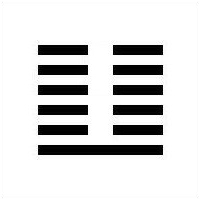 I have seen some people mistakenly look at nuclear hexagrams in an I Ching casting as if it was some additional part of the divination process on its own, as if there was some random element to it which contributed to the 'fortune telling' itself. But the nuclear hexagram is static, every hexagram only has a single nuclear (though in the cases of Hexagram #1 and Hexagram #2, they are their own nuclear).
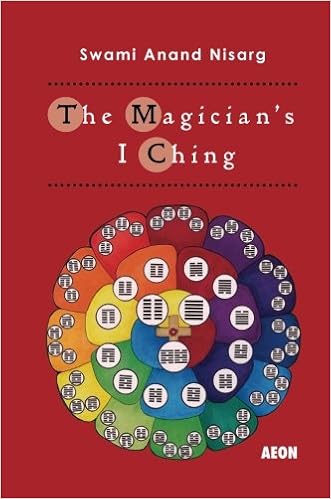
In fact, Nuclear Hexagrams are part of a system of clusters or connections between hexagrams. On the cover of The Magician's I Ching, you can see this pattern depicted artistically:

The nuclears show you groups of common hexagrams which can be understood to interact in special ways. Their main practical use is for the purpose of contemplating the mysteries and deepening one's understanding of the I Ching as a whole and of the individual hexagrams. The relationship of the hexagrams connected by their nuclear provides important insights.
Let's look, for example, at the hexagrams that have Hexagram #23 as their nuclear:

Hexagram #23 is "Shedding".
In this set of four hexagrams with #23 as their nuclear, for example, you can see the pattern that starts first with the effort of beginning, with Hexagram #3, "challenge":

Then as you build up, it leads to bringing things together, with Hexagram #8 "Union":
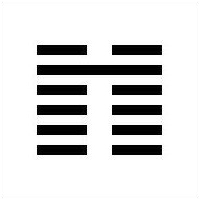
After this, you move to reaching beyond the level of the foundations to be able to discover the greater mastery that is more than the sum of its parts, with Hexagram #20 "Contemplating":

And finally, to the state of making advance to a new level, with Hexagram #42 "Gaining":

So to put it another way, looking at it (for example) in the context of Cultivation: first the initial enthusiasm in the face of a vast undertaking, then the hard work of mastering the basic forms of the exercise, then when that is mastered of understanding what lies beyond the mere technical practice and exploring the essence, and then the genuine growth.
This needs to begin with Shedding (#23); you can almost imagine the "landslide" of Shedding, and following that landslide the tiny sprout of #3 breaking out of the shifted ground, then the hard work of growth, then the bearing fruit, and finally the harvest.
But it is also true that the nuclear governs at each step; as you move from one step to the next there needs to always be a process of shedding off some of what you are doing to make room for the next stage of growth.
In your own I Ching studies, first you need to study and learn the basic meanings of each hexagram by itself. But once you're ready to go deeper, studying the nuclears and the connections between the hexagrams and their nuclears will be of great use for developing a larger understanding of the greater mysteries of the I Ching.
So for example, Hexagram #19:
In fact, Nuclear Hexagrams are part of a system of clusters or connections between hexagrams. On the cover of The Magician's I Ching, you can see this pattern depicted artistically:

The nuclears show you groups of common hexagrams which can be understood to interact in special ways. Their main practical use is for the purpose of contemplating the mysteries and deepening one's understanding of the I Ching as a whole and of the individual hexagrams. The relationship of the hexagrams connected by their nuclear provides important insights.
Let's look, for example, at the hexagrams that have Hexagram #23 as their nuclear:
Hexagram #23 is "Shedding".
In this set of four hexagrams with #23 as their nuclear, for example, you can see the pattern that starts first with the effort of beginning, with Hexagram #3, "challenge":
Then as you build up, it leads to bringing things together, with Hexagram #8 "Union":
After this, you move to reaching beyond the level of the foundations to be able to discover the greater mastery that is more than the sum of its parts, with Hexagram #20 "Contemplating":
And finally, to the state of making advance to a new level, with Hexagram #42 "Gaining":
So to put it another way, looking at it (for example) in the context of Cultivation: first the initial enthusiasm in the face of a vast undertaking, then the hard work of mastering the basic forms of the exercise, then when that is mastered of understanding what lies beyond the mere technical practice and exploring the essence, and then the genuine growth.
This needs to begin with Shedding (#23); you can almost imagine the "landslide" of Shedding, and following that landslide the tiny sprout of #3 breaking out of the shifted ground, then the hard work of growth, then the bearing fruit, and finally the harvest.
But it is also true that the nuclear governs at each step; as you move from one step to the next there needs to always be a process of shedding off some of what you are doing to make room for the next stage of growth.
In your own I Ching studies, first you need to study and learn the basic meanings of each hexagram by itself. But once you're ready to go deeper, studying the nuclears and the connections between the hexagrams and their nuclears will be of great use for developing a larger understanding of the greater mysteries of the I Ching.
Friday, November 2, 2018
Thursday, October 4, 2018
The I Ching, Reality and Rules For Living
There is no one formula for what to do in life.
But there is a path to work out what to do in each moment.
But there is a path to work out what to do in each moment.
Subscribe to:
Posts (Atom)