In this week's video, I talk about freedom, on both the level of the individual and also of society. And I try to explain that freedom is the fundamental requirement for spiritual transformation in an individual; and that a society that values freedom is going to be more open to evolve socially than one who disregards the freedom of the individual.
Bagua

Showing posts with label metaphysics. Show all posts
Showing posts with label metaphysics. Show all posts
Thursday, January 17, 2019
Video: Freedom is the Basis of All Spiritual Transformation
In this week's video, I talk about freedom, on both the level of the individual and also of society. And I try to explain that freedom is the fundamental requirement for spiritual transformation in an individual; and that a society that values freedom is going to be more open to evolve socially than one who disregards the freedom of the individual.

Tuesday, January 16, 2018
On The Gender of the Eight Trigrams
The 64 6-line Hexagrams of the I Ching are built on paired combinations of the 8 3-line trigrams (the bagua). Thus, as the hexagrams represent all phenomena in the material world, the trigrams represent the eight fundamental elements, four terrestrial and four celestial elements.
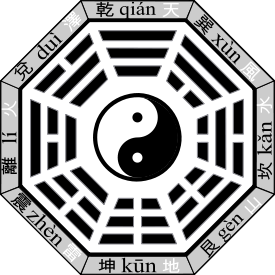
These elements are equivalent to the four classical elements in Western esoteric symbolism. They are in essence a doubled-up version (with terrestrial and celestial/spirit equivalents) of Earth, Air, Water, and Fire.

However, there is one complicated detail about these elements versus their western equivalent that some students have brought up: in both systems, there is a traditional attribution of 'genders' to the elements. But these genders do not appear to 'match up'. Let's review the basics:
In BOTH Western and Eastern symbolism, there are fundamental Masculine/Feminine forces: Chokmah/Binah, Animus/Anima, Shiva/Shakti, Yang/Yin, etc.
In Western symbolism, Earth and Water are feminine, Air and Fire are masculine.
In Chinese symbolism:
Earth/Mountain is masculine
Fire/Thunder is masculine
Moon/primordial-Water is masculine
Heaven is masculine
Air/Wind is feminine
Water/Lake is feminine
Sun/primordial-fire is feminine
The World is feminine
Before continuing, you should note that there is a connection between the physical image of the trigrams and their traditional 'gender': all the 'masculine' trigrams require an odd number of brush-strokes to draw, while all the 'feminine' trigrams require an even number of brush-strokes to draw. But the various masculine trigrams and the various feminine trigrams also have another thing in common with each other, which we will bring up below.
So now, let's focus on what is clear: in both systems of esoteric cosmology, there is a force far more fundamental than the level of elements that gets identified as the fundamental Masculine and Feminine duality. These are Yang (masculine) and Yin (feminine).
And of course, even this is not literally about 'gender' in the sense of which we tend to think of it now. Rather, they embody all the notions of duality itself; the important thing about this idea from a cosmological point of view is that it talks about all the qualities that a product of the separation from a single indivisible state of Oneness. All of our material reality is produced by this notion of the division into dualism.
To explain: you can't actually define anything positively. All definition, at its most basic level (that is, when you try to get the definitions of definitions of definitions) comes down to defining things by what they are not. This is because our entire process of thought is based on dualistic thinking. There is white and black, hot and cold, moist and dry, passive and active, positive and negative, etc.
It is only at the highest levels of awareness, and not in the level of phenomena, that this can be transcended, through the mystical process described as the Union of Opposites.
So from the esoteric point of view, the gender consideration of masculine and feminine is really about Dualism.
When we get down beyond the level of yin and yang, we are adding more elements of complexity. So Gender at the level of yin and yang is simple: Yin is everything we can define as archetypal female and Yang is everything we can describe as archetypal masculine.
At the level of elements, the reason for the gendering of elements is something more complex. And here we get to the reason for the difference in the genders of the elements in Western and Chinese symbolism: the complex quality that the former chooses to focus on is different than the complex quality that the latter chooses to focus on.
With the Western elements, the 'male' elements have the quality of active inherent motion, while the 'female' elements have the quality of inherent stillness.
Earth and Water may move, in an earthquake or a rockslide or down-river or pouring down a sink, but this is only in reaction to what is around them: water and earth are passive, they sink down until they can reach a point of rest. Thus, they reflect the quality of Passive or Receptive nature that is attributed to the Feminine. They are also tangible, of matter, they rest in the world.
Fire and Air, however, are in motion. They rise. They only exist in movement. If air has no movement it has no qualities at all (at least, from the classical perspective) and has become foul and deathly. If fire has no movement it is extinguished. Thus they reflect that quality of Active and Creative that is attributed to the Masculine. They are also intangible, you can't actually hold on to them, they have no matter.
In the Chinese system, however, the quality being looked at is not motion and stillness, which is so important to the Yang and Yin duality, but rather the qualities of "strength" and "softness".
The Mountain, the Thunderbolt/fire, The darkness of the Moon (or the deep dangerous waters of the abyss), and the power of Heaven are all considered to be 'strong' forces.
The gentle Airy breeze, the still Lake, the warm clinging light of the Sun, and the receptiveness of the World are all considered to be "soft" forces.
So both classifications of these are examples of how to classify duality, but they focus on different aspects of duality. This is because the purely Masculine and purely Feminine are absolutes. They do not exist anywhere in material reality; where they get closest is in Heaven and The World, but in all aspects at this dimension of reality, all phenomena contain a combination of Yin and Yang. They are a mix of the forces we call 'masculine' and 'feminine'. Depending on which aspects of the male and female you want to observe, there are thus different ways to categorize them.
Thursday, December 21, 2017
Magic as a Human Tool
In my latest video, I look at forms of esoteric or magical systems, like the I Ching, as a form of human tool or technology (by technology I do not mean a 'machine', I mean some kind of technique, system, or method used in the accomplishment of human objectives; for example, mathematics is a type of technology).
Check it out:
If you're interested in more of this kind of contemplation, please get in touch with me about joining the Yi Fa Society!
Check it out:
If you're interested in more of this kind of contemplation, please get in touch with me about joining the Yi Fa Society!
Wednesday, October 11, 2017
The I Ching Teaches us That Reality is a "Doing"
The I Ching's cosmology suggests a reality that isn't a structure of 'things'. It is not a universe of things 'being', it is always a universe of things 'doing', of the interaction of elements.
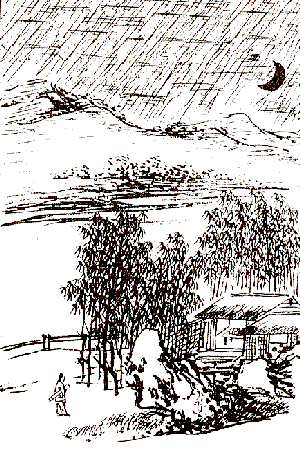
In the West people tend to imagine that Reality is a noun, rather than a verb. That may be because of the self-referencing perspective; if something is a static object, rather than a moving process, it is easier to define, and to control.
Something static can be more easily controlled. You put a solid cube in one corner of the room, it will stay there. It won't move on its own at least. You can turn it on one side, it'll stay on that side.
On the other hand, it takes a lot of work (energy) to break that cube, or burn it, to make it move or to shape it into something other than a cube.
Static things are easy to control, hard to manipulate.
On the other hand, if you understand reality as a "doing", a constant interplay of the 8 elements that make up the world of 10000 things, then it is much EASIER to manipulate.
Creating change is much less difficult than the illusion of solidity makes it look.
But it is much HARDER to control, than our notion of a static reality leads us to think.
You can alter the course of the river, but you can't just force it into a fixed route forever, make it stop flowing forever, or much less make it change the direction of its flow.
Wednesday, July 26, 2017
The Yi Fa Cosmology
Some people have asked about the cosmology of the Yi Fa curriculum.
In fact, the cosmology of Yi Fa is directly drawn from the teachings of the I Ching.
There are more details of the cosmology in the teachings of levels 2 and 3 of the Yi Fa curriculum.
What follows is only an explanation in brief.
There is the whole, first off (you could call it the Taiji or the Tao if you like, the absolute sum of all that actually exists).
Then there are certain primal forces (Yin and Yang, the four fundamental forces of existence, the eight elements) which all have archetypal existence. Some of them may appear to have personalities but that's really our way of being able to comprehend them.
Then there's the manifested world, "the World of 10000 Things" as the Chinese poetically put it. It contains all of of those things I mentioned above WITHIN it. Those things are the building blocks of the manifested world, what you find when you look at reality on both the cosmic scale, and by going deep within.
So those elements and primal forces and positive and negative (yang and yin) all exist within us. They take shape to make each of us a unique expression of reality.
Human beings are unique (as far as we currently know) in that we are capable of conscious awareness of these forces. We have Will. Even if most of us never actually use it.
We can use this Will to become conscious operators of those forces, not just reactive operators the way other things in the world of 10000 things are. But that consciousness also creates in us an illusion of separateness from reality. We mistake being Unique for being Apart. And this illusion can be called the Persona.
Since it is an illusion, and we cannot ever actually be apart, it creates a conflict within us between the part of us that is Real and the part of us that is fabricated, the Individual and the Person. In Chinese mysticism, these are two separate parts of the human soul, called the Hung and the Po. The Hung is eternal, the Po is temporal and dissolves after death. The Hung is the Superior Individual, the Po is the Inferior Person.
Thus, the cosmology of the Yi Fa curriculum establishes the cause of our human alienation, and also shows the path toward resolving it, by manifesting the Superior Individual.
Wednesday, August 17, 2016
The Relationship Between "Spritual" and "Reality"
There is a great spiritual difference between spiritual teachings and religions that place the unmanifested above the manifested, and those that do not. Just as there are materialistic philosophies which deny anything 'spiritual', there are also anti-materialist belief systems that deny the material in favor of something they choose to imagine as 'spiritual', separate from the material.
In ancient China, all three concepts existed. There were strictly materialist philosophies that denied anything but the manifest, the "Yi-fa". There were likewise many movements that wanted to envision the universe as a universe of immaterial 'spirit' and that the manifested world was either an illusion or a corruption, something inferior to the pure and unsullied 'spiritual world'.
But if you study the I Ching and the teachings of the great Sages, it becomes evident that neither of these are a correct reflection of reality.
This same conflict existed in many other places and times, with other names; certain "gnostic" sects in the west claimed that our world was nothing but an illusion. The institutional forms of Buddhism made similar claims, many of them ascribing a higher position to some 'spiritual' world that the Buddha himself denied.
In The Magician's I Ching, I have detailed the story of the debate between Zhang Shi and Zhu Xi, and Zhu Xi's quest to achieve enlightenment as to the true nature of reality, and how to reconcile the difference between the unmanifested (Wei Fa) and the manifested (Yi Fa). It is unsurprising that after coming to realization, Zhu Xi would strongly advocate the study and practice of the I Ching, because within it, it uncovers the truth of this relationship.
Some would-be mystics want to conceive of the nature of reality as a kind of top-down hierarchy where the lowest and least important level of reality is the manifested world. But consider the I Ching: a hexagram contains, within it, the trigrams. Trigrams contain, within them, the Yin and the Yang. Within Yin and Yang are found the Taiji (the undivided polarity). Within the Taiji is the the Wuji (the boundless), and within that boundlessness is Wu (emptiness).
Without trying to confuse scientific concepts with mystical ones, this can't help but bring to mind the nature of physical reality as we understand it today: how within objects there are molecules, those are composed of atoms, atoms are composed of protons and electrons, within those there are quantum particles, and inside all of this is empty space. Reality is not top-down, it is a whole, and that whole has layers, more fundamental and basic layers, and more complex outer layers.
This is the functioning of reality, and it is essential to understand if you are going to practice a real system of cultivation (because any spiritual practice not based on reality will not get you very far)! The Manifested (Yi Fa) and the Unmanifested (Wei Fa) must of necessity both exist, they are both real, but the only place where the unmanifested can possibly exist is within the Manifested. Wei Fa is not 'outside' or 'beyond' Yi Fa, it is only real within Yi Fa.
This is important to spiritual practice, because it means that Wei Fa, for the practitioner, can only be reached through the Yi Fa. You can't reject the body, reject the world, reject reality, and go off into some spiritual wonderland that is somehow beyond all that, because there is nothing to connect to there. You cannot find the Unity of all things by rejecting any thing. You have no tools to connect to the truly 'spiritual' if you ignore your body, your mind, your world, and your interactions with the world. This place, this world, our bodies, our awareness, all the things that exist in the manifested reality are the alchemical laboratory of our self-transformation. Without them, you can go nowhere.
In ancient China, all three concepts existed. There were strictly materialist philosophies that denied anything but the manifest, the "Yi-fa". There were likewise many movements that wanted to envision the universe as a universe of immaterial 'spirit' and that the manifested world was either an illusion or a corruption, something inferior to the pure and unsullied 'spiritual world'.
But if you study the I Ching and the teachings of the great Sages, it becomes evident that neither of these are a correct reflection of reality.
This same conflict existed in many other places and times, with other names; certain "gnostic" sects in the west claimed that our world was nothing but an illusion. The institutional forms of Buddhism made similar claims, many of them ascribing a higher position to some 'spiritual' world that the Buddha himself denied.
In The Magician's I Ching, I have detailed the story of the debate between Zhang Shi and Zhu Xi, and Zhu Xi's quest to achieve enlightenment as to the true nature of reality, and how to reconcile the difference between the unmanifested (Wei Fa) and the manifested (Yi Fa). It is unsurprising that after coming to realization, Zhu Xi would strongly advocate the study and practice of the I Ching, because within it, it uncovers the truth of this relationship.
Some would-be mystics want to conceive of the nature of reality as a kind of top-down hierarchy where the lowest and least important level of reality is the manifested world. But consider the I Ching: a hexagram contains, within it, the trigrams. Trigrams contain, within them, the Yin and the Yang. Within Yin and Yang are found the Taiji (the undivided polarity). Within the Taiji is the the Wuji (the boundless), and within that boundlessness is Wu (emptiness).
Without trying to confuse scientific concepts with mystical ones, this can't help but bring to mind the nature of physical reality as we understand it today: how within objects there are molecules, those are composed of atoms, atoms are composed of protons and electrons, within those there are quantum particles, and inside all of this is empty space. Reality is not top-down, it is a whole, and that whole has layers, more fundamental and basic layers, and more complex outer layers.
This is the functioning of reality, and it is essential to understand if you are going to practice a real system of cultivation (because any spiritual practice not based on reality will not get you very far)! The Manifested (Yi Fa) and the Unmanifested (Wei Fa) must of necessity both exist, they are both real, but the only place where the unmanifested can possibly exist is within the Manifested. Wei Fa is not 'outside' or 'beyond' Yi Fa, it is only real within Yi Fa.
This is important to spiritual practice, because it means that Wei Fa, for the practitioner, can only be reached through the Yi Fa. You can't reject the body, reject the world, reject reality, and go off into some spiritual wonderland that is somehow beyond all that, because there is nothing to connect to there. You cannot find the Unity of all things by rejecting any thing. You have no tools to connect to the truly 'spiritual' if you ignore your body, your mind, your world, and your interactions with the world. This place, this world, our bodies, our awareness, all the things that exist in the manifested reality are the alchemical laboratory of our self-transformation. Without them, you can go nowhere.
Friday, October 9, 2015
The I Ching's Perspective on Gender
It's important to note that at its core, the I Ching system is a Binary system; it's yin/yang, 1 and 2. These express themselves as simple binaries (at the level of individual lines being yang-male or yin-female) and complex binaries (ie. the combination of two trigrams, where you might have for example the combination of a trigram that's two-parts yin one-part yang with a trigram that's three parts yang; or that sort of thing).
So with regard to gender, the perspective that the symbolic/mathematical language of I Ching takes is of necessity that there isn't a spectrum of entirely different types of gender (eg. gender-1, gender-2, gender-3, gender-5, gender-52) which are all inherently different from one another; but that there's a spectrum of genders that are different accumulations of those two basic forces (eg. at the level of trigrams this would be something like male-3, male-2 female-1, male-1 female-2, female-3; at the level of hexagrams things like male-4 female-2, male-3 female-3, etc.).
There is an added degree of complexity when you understand that it's not just the quantity of yin and yang in each trigram/hexagram that matters, but also where the lines are placed. So female-2 male-1 where the one male line is at the bottom is a different expression than female-2 male-1 where the one male line is in the center.
I think that at times, there is a tendency to imagine that the I Ching is fairly absolutist about gender, after all Yang is "male" and Yin is "female". But remember that there, we are talking about "constituent forces". Yin and Yang as separate forces exist Nowhere at the material level of reality; the I Ching is really saying that while at dimensions beyond the actual manifested material world we live in, you can talk about something Archetypical or even Primordially "male" or "female". But at the level of manifestation (the hexagrams), in our actual world, there's nothing that is only purely male or only purely female. Even the hexagrams #1 and #2, which consist of all "male" lines and all "female" lines respectively, and are thus as-male/female-as-you-can-get in this level of reality, still have within them the potential for changing. Any one of the lines that is solid can theoretically become a changing line and then mutate into its opposite. So even those two cases cannot be thought of as "Absolute" in their maleness or femaleness.
Monday, October 5, 2015
The I Ching's Hyperdimensionality

The image presented here is of the "boolean lattice" arrangement of the I Ching hexagrams. It demonstrates how the I Ching can be mathematically projected into a sixth dimensional hyper-geometrical prismatic figure. That is to say, some of the hexagrams existing within other hexagrams (nuclearity) are meant to reflect hyper-dimensionality.
So together, the hexagrams are a conceptual of "drawing" time itself in the same way we might draw distance. From the point of view of a sixth-dimensional universe, time would look like a physical object (just like if we existed in a second-dimensional universe depth would not have solid form).
This is difficult even now to wrap our heads around, but it means that the hexagrams of the I Ching collectively are as much a "physical map" of TIME like one could have a physical map of, say, Norway.
Note that this is not a new concept, either, as such ordering is also present in traditional Chinese understandings of the I Ching:

Tuesday, September 29, 2015
I Ching: The Four Staves Casting Method
This is a new method I have devised for myself, after having felt dissatisfaction with the imperfect mirroring of change from the more popular “three coin” method, while at the same time finding the complexities of the traditional counting method using 50 yarrow stalks to be often too impractical. While it is called “four staves” and my own preference is to use four wooden sticks, you could in fact use any four two-sided objects; these can be coins, or flat sticks, or anything else, where the two sides are distinguishable from one another (coins with a "head" and "tail", for example, or sticks that have a mark on one side). In my own case, I use four carpenter's pencils (which are two-sided) and have marked one side of each with a black line to delineate the “Yang” side.
To perform a reading, begin with the ritual procedure delineated in the Magician's I Ching.
You should be prepared with paper and pen, to note the results, and then you toss the devices. For simplicity's sake, assume one side of the device is the “yang” side, and the other is the “yin” side; If you are using something other than coins, its a good idea to mark only one side to allow for quick and easy distinction as to which side is which.
When you throw the devices, you have to see how they each came up:
If all four come up Yin, the result is a broken changing line. Draw a split line and put a mark or an “x” next to it, to note it is a changing line.
If three come up Yin (and one yang): the result is a broken line. Draw a split line.
If they are tied (2 and 2) you have to look at the one that fell furthest to your left:
if that one is a Yin: the result is a broken line (draw a split line)
if that one is a Yang: the result is a solid changing line (draw it and put a mark or an “x” next to it, to note that it is a changing line)
If three come up Yang (and one Yin), OR if all four come up Yang: the result is a solid line. Draw a straight line on your page.
As usual, you do this six times to generate the hexagram.
The reason this method is preferable to the “three coin method” is that in that latter method there is an equal chance of getting a solid or broken line; and an equal (lesser) chance of getting a solid changing or broken changing line. But in the “Four Staves” method it is most rare to get a broken changing line (1/16 chance); slightly less rare to get a solid changing line (3/16); less rare still to get a solid line (5/16), and most common of all to get a broken line (7/16).
These odds match those of the oldest method of I Ching divination, the complicated counting method of 50 yarrow stalks. The odds with that method are almost exactly the same as in this method. And it is important because this method more accurately reflects the probabilities of Change. It is more probable in reality that something be in a state of weakness than in a state of strength; and more probable that something strong will weakening, than something weak strengthening.
This is the nature of reality; so by using this method you get the most accurate approximation of the laws of nature.
Subscribe to:
Posts (Atom)