The official public blog of the Yi Fa Society, a mystical order dedicated to the teaching and practice of self-transformation through the study of long-hidden practices of internal alchemy.
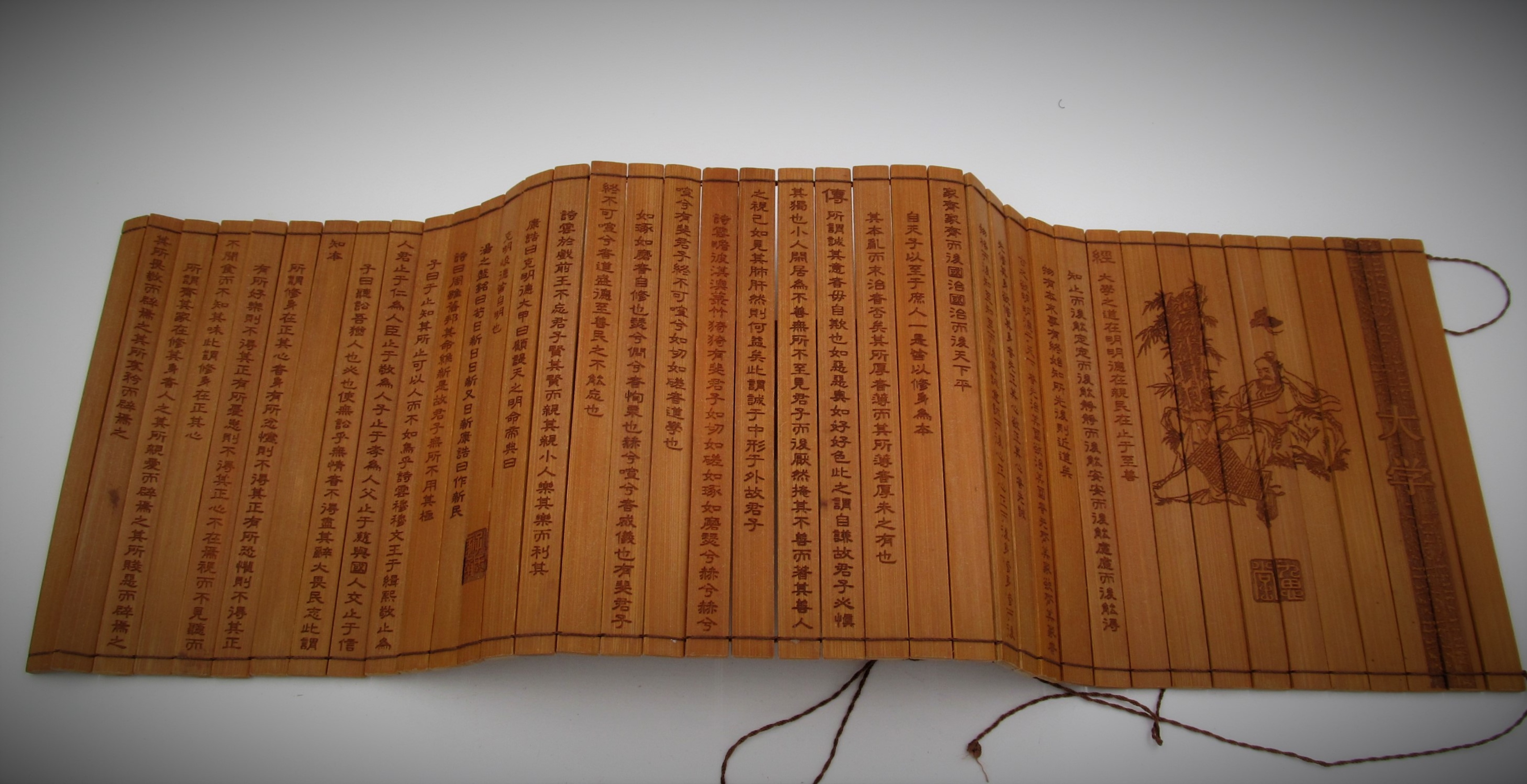
In Chinese Civilization, from the establishment of the Chinese education system until the end of the Imperial era, this teaching, from "The Great Learning" and attributed to Confucius was one of the elementary teachings taught to every schoolchild:
The ancient people who desired to have a clear moral harmony in the world would first order their national life.
Those who desired to order their national life would first regulate their home life.
Those who desired to regulate their home life would first cultivate their personal lives.
Those who desired to cultivate their personal lives would first set their hearts right.
Those who desired to set their hearts right, would first make their wills sincere.
Those who desired to make their wills sincere would first arrive at understanding.
Understanding comes from the exploration of knowledge of things.
When the knowledge of things is gained, then understanding is reached.
When understanding is reached, then the will is sincere.
When the will is sincere, then the heart is set right.
When the heart is set right, then the personal life is cultivated.
When the personal life is cultivated, then the home life is regulated.
When the home life is regulated, then the national life is orderly; and when the
national life is orderly; then the world is at peace.
From the Emperor down to the common man, the cultivation of the personal life is the foundation for all.
It is impossible that when the foundation is disorderly, the superstructure can be orderly.
There has never been a tree whose trunk is slender and whose top branches are heavy and strong. There is a cause and a sequence in things, and a beginning and end in human affairs.
To know the order of precedence is to have the beginning of wisdom.
The other day I posted a Youtube video related to the subject of ritual, in the context of the Bhagavad Gita:
Now, this video is not part of the Yi Fa Curriculum. But the subject of 'ritual' is very significant to the Yi Fa work. As the video points out, ritual is not meant to be something done automatically, or even as such for some kind of ulterior motive: it is its own reward.
This brings to mind the question of 'what is ritual'? We tend to think of ritual in terms of being some kind of ceremony meant for religious or magical purposes.
But in Chinese thought, ritual or "rites" (which is called "li") means not only religious ceremony, but also it encompasses all the notions of 'proper conduct'. It can be understood as including customs, manners, etiquette, 'proper form', etc. We could call it "rules of art". It is tied to the Virtue of harmony; both in the sense of good harmony within our own being (balance), but also harmony with our world, our fellow human beings, and society.
Another of the Confucian Classics, aside from the I Ching, is the "Book of Rites". If you look at that book, you will find that it is not some book of magical rituals, but rather a wide-ranging guide to all kinds of standards of etiquette and ancient customs (from the Zhou dynasty, the dynasty that wrote the I Ching).
In relation to Qi Gong, the practice of the forms of Qi Gong (including Yi Fa Qi Gong) are certainly a type of ritual. It is important to further clarify what this means in the context of Qi. There are many people talking about the "Qi Gong" of other activities: how painting can be Qi Gong, or writing, or dancing, or all sorts of other things (even "Qi Gong Golf" or "Qi Gong Cooking"). In some cases, this is interpreted in some kind of very esoteric way, like as if you are doing some very special mystical technique. But this was not really the purpose of this concept, it is actually just the opposite.
Let's further define an intentional act, and a ritual act. In western esoteric magic, we are told that "any intentional act is a magical act", and that magick is "the art or science of causing change to occur in conformity to the Will". We can thus surmise that any intentional act is an act where you are directing your will. So what marks the difference between an 'intentional' act and a 'ritual' act is that a ritual act is to direct the will within a certain form. Any practice that has a technique is not only an intentional act, but a ritual act. This is how to understand 'rites' in the context of Qi Gong.
What this means is that if you get up in the morning and brush your teeth, and the practice of brushing your teeth is done in a certain way (you stand in front of the sink, you fill a glass, you lift the glass to your lips and slosh some water in your mouth, then spit it out into the sink; you grab your toothbrush, open the toothpaste, put a bead of toothpaste on the toothbrush, put the toothbrush in your mouth and scrub in a certain fashion going from one part of your teeth to another, then rinse your mouth again, wash off the toothbrush, etc.) then you can say that you have a "technique" of brushing your teeth. But this is not a ritual, unless you are also doing it as an intentional act. As soon as you are doing this exact same technique, just as you always did it before but now as an intentional act, it becomes the Ritual of Brushing Teeth.
It is the same with countless other things you do in your ordinary life. You have techniques for all sorts of ordinary things in your life. Often, these are done mechanically, specifically as a way to avoid paying attention while you are doing it; you can be on 'automatic' because of how familiar you are with these techniques.
In Qi Gong, Qi is a measurement of the direction of your Will. It is treated as a substance, and thus we understand Will not as some invisible thing or only a mental effect but as a part of our material existence. When we do anything as an Intentional act, we are directing Qi. So if we are doing some technique in a mechanical way, we are not directing Qi into these activities. But as soon as we do that technique in an intentional way, we are directing Qi into them: a mechanical activity becomes a Ritual activity. This directing of Qi does not really require any special effort on our part aside from intention; just like in Yi Fa Qi Gong you do not need to do anything mentally to 'move' the Qi, it naturally happens just by performing the practices with intention.
If we are trying to brush our teeth, or paint, or play golf, or prepare breakfast or any other thing, through some technique, whether it is ordinary or somehow fancy or ceremonious or unusual, it is NOT Qi Gong, if it is mechanical. But it can be said to be "Tooth-brushing Qi Gong" or "Painting Qi Gong" or "Golfing Qi Gong" or "Cooking Qi Gong" if we are doing it with a technique and form AND we are also doing it intentionally!
This is why I say people often understand it the opposite way of how it is intended: it is not about reciting some kind of mantra or visualizing something or doing some unusual movements or mentally directing something, while you are doing these ordinary things. It is about doing these ordinary things with order and structure, with harmony and balance, and with the Active Consciousness, with intent. The point is not to try to mystify ordinary activities, but to understand that that all sorts of ordinary things can be mystical, can be part of cultivation, simply by doing them consciously.
And we have to conclude, by this same reasoning, that it is not that Qi Gong is something separate from the ordinary, but very much part of the ordinary. Our ordinary life does not need to be integrated into our cultivation practice; rather, our cultivation practice needs to be integrated into our everyday lives! We do not need to separate ourselves from ordinary existence to find the magical, we have to unite our Will to the ordinary.
There, in the Manifested, is where the Great Work is to be found.
The Master Zhu Xi (1130-1200) was one of the greatest sages of Chinese history; second among the Confucians only to Confucius himself. He is considered the founder of Neo-Confucianism, and was the only Confucian who was not a personal student of Confucius himself to have been granted the status of a Confucian Immortal.
He is of particular significance to the Yi Fa Society because he was the teacher who perfected the expression of the Yi Fa as a concept. Some details of his life and his discovery of the Yi Fa are detailed in The Magician's I Ching. He wrote two texts on the I Ching and was one of many true Sages who tried to restore the genuine role of the I Ching in Confucian society; as had happened many times before, in Zhu Xi's time the mainstream establishment of Confucian literati did not believe in actually using the I Ching for divination, but he strongly advocated that to truly understand the I Ching it had to be worked!
We can assume that Zhu Xi made frequent use of the I Ching. However, there is only occasion in history that a record remains of his use of it. This event is recorded at the time of the greatest crisis in Zhu's life and the future of his school.
Near the end of his career and life, Zhu Xi was a provincial governor, and was part of the movement that attempted to clean up the rampant corruption and incompetence of the late (southern) Song Dynasty Imperial court. Naturally, those who benefited from this corruption sought to accuse him and his followers of conspiracy against the Emperor. He nevertheless pushed forward, quoting the I Ching in defending his actions, pointing out that if good men do not join together to mobilize change, bad men will triumph ("Base men use their power, if the Superior Individuals don't use theirs"). This was treading dangerous ground, as in the earlier period of the Song Dynasty (when they were based in the north) sages had attempted to reform the State to save it from its decline, and they were ignored and accused of treason. The failure to reform had led to the eventual collapse of the Song and the court was forced to flee to the south in the face of barbarian invasions.
By 1195, the corrupt officials opposing Zhu Xi's faction had begun a series of purges, accusing those involved not just of treason, but of "wei xue", meaning "false (or empty) learning". They were accused, in essence, of teaching untrue and harmful ideas that were dangerous to the state. Zhu Xi's mystical practices in his school also led to these corrupt officials accusing him and 58 of his students of practicing 'sorcery'.
Zhu Xi's students were very frightened for him, that he might soon be imprisoned or executed. They begged him to retire from public service to save his own life, but he would not listen to them, being determined to fight on, and not to abandon his students and allies to these false accusations. He planned instead to write a manifesto condemning the corrupt officials and their abuses in the most extreme terms.
One of Zhu Xi's students, Cai Yuanding (who would eventually die in exile after being persecuted by the "false learning" purge), was one of the most dedicated practitioners of the I Ching in Zhu Xi's school. He tried one last attempt to get Zhu Xi to back down; he suggested that Zhu Xi consult the I Ching to be certain of his path.
Zhu Xi agreed to this, and cast the I Ching. The result was Hexagram #33: Retreat. Its changing lines were L.1 ("he delays his retreat and is routed. Cornered - disaster! It is useless to seek any goal") and L.4 ("Even though he cares for his subordinates he must retreat!"). These lines create the resulting hexagram #37 "The Household", with the description "the family, and home".
Realizing that the I Ching made it clear that his cause was lost, and that there was nothing to gain in persisting now, he destroyed his manifesto, and retired for the last time. He took on the title of "The old man who retreated". He was nevertheless stripped of all offices and died under sentence of execution.
In spite of this, it was thanks to his retiring at that moment that after his death, his students were able to gradually change the balance of power and win over the Imperial Court to the wisdom of Zhu Xi. The same Emperor who had condemned Zhu Xi and forbidden his teachings would, only eight years after Zhu's death, giving him the title of "Venerable man of Culture" and in essence conceding to the Virtue of Zhu's teaching. His guidelines for education and civil service would become the standard for Chinese culture for hundreds of years to come, throughout all the rest of the Imperial period.
Note: the following is an excerpt from the chapter entitled "Spontaneous Gong Manifestation" in The Great Book of Yi Fa, a secret document for Level 3 Yi Fa Society students:
There are two
key parts to the practicing of Virtue outside of cultivation. And as
these also still apply to practitioner, it is useful to talk about
them to Yi Fa students too. The first of these is what Confucius
called “Ren”. This is a very difficult word to translate from
Chinese to English; one way might be to just call it 'truth' but this
definition is vague and incomplete. A better way might be to say it
is “the true experiencing of reality”, but this is difficult to
comprehend. So another way to define it, if a bit tautological, is
that “Ren” means “the quality of experiencing Virtue”. That
is, when you are engaging in practicing Virtue in your everyday life,
it becomes an experience; you can feel the difference between when
you are embodying Virtue and when you are not. That experience, that
feeling, is “Ren”. Some of the same qualities Confucius defined
as Ren were also present in the lay precepts laid down by the Buddha;
in other words, this is the most basic and accessible type of
Cultivation practice available even to people who for one reason or
another cannot engage in a full cultivation practice.
Confucius
said of Ren that “it is not very far-off; whoever seeks it can find
it”. This is because Virtue is not just a human concept, it is a
part of the nature of the Universe. Unity, Discipline, Harmony, and
Truth are universal qualities; thus it is that human teachers
discovered and taught these qualities in different times and places
without ever having necessarily been connected to each other. This
means that “Ren” is a natural state; and in fact it is the true
natural state of human beings. Ren is “human-ness”, so anyone
who seeks sincerely to be more naturally human will be able to find
it.
What is the
easiest way to find Ren? Confucius said “Ren is established when,
seeking to establish yourself, you also seek to establish everyone
else. When seeking to grow, you seek for everyone else to grow as
well”. So the easiest way to find Ren, and to practice Virtue, is
when you can break away from the self-referencing perspective, and
make sure that Virtue is not 'about you'. It is about following the
law of the universe.
The chief
obstacle to this is the other key part of practicing Virtue outside
of cultivation. And that is to be able to discern the difference
between what Confucius called “Norm” and what he called
“Justness”. “Norm” is what society deems appropriate. It
is societal conditioning, a product of culture, and part of what
makes up the Inferior Person. “Justness”, on the other hand, is
not what society deems appropriate but what IS appropriate. It is
that quality of what is correct regardless of what culture thinks.
Confucius and all great teachers were very clear that while sometimes
a norm may be identical to justness, there are also many times when
norm and justness are not the same thing; where what society
considers right is not what actually is right. Those rare
individuals who are capable of generating Gong without cultivation all
have in common that they come to learn how to tell the difference
between norm and justness; and can thus engage in Ren without
consideration of what society has told them is the way to behave.
---
If you are interested in joining the Yi Fa Society please feel free to contact me.
The lineage of this society begins with Swami Anand Nisarg, and then retroactively comes to include the likes of Zhu Xi, Shao Yong, Cheng Hao, Lu Dongbin, Dong Shongzhu, Zi Yi, and Kong Fuzi.
This is only the redacted list, of course, there are many other great luminaries and forgotten masters have retroactively joined the current of authority of the society. Aleister Crowley was also offered a membership but being busy with the A.'.A.'. (another universal order but focused on western symbols, that otherwise has almost identical goals to the Yi Fa Society), he declined full involvement and took an honorary membership instead.
In spite of this remarkable list of incredible figures associated retroactively with the school, I would advise you that if what you are looking for is some kind of impressive traditional authenticity above all else, you should probably look elsewhere. Odds are that if you do, you will gladly find someone who will lie to you about how old their secret society is, and then you could happily join.
You might even be really lucky and find a school that has incontrovertible proof that it was founded centuries ago by some amazing but long since non-living Master, and then you could marvel at being a member of a society that may have once been worth something though almost certainly will not be today, after centuries of mismanagement by worthless 'lineage-holders'.
On the other hand, if what you want is to work in an authentic, modern, universal and living system of self-transformation with a breathing and walking teacher who has done it himself, the Yi Fa Society might be for you.
The I Ching is a simulation of the whole of Heaven and the World, thus it includes all of these. If we study its ways we can look up and observe all celestial events, and down to study all worldly features. We can learn the secrets of visible and invisible principles. We can study the origin of all things in the universe, and from this chart their end points; we can thus understand the cycles of creation and destruction.
The Qi builds up and forms shapes into living creatures, essence floats and dissolves constantly into different elements; thus we can understand the ways of the spirits.
Understanding the ways of Heaven and the World in the I Ching, people avoid violating these ways in their actions; this allows people to avoid troubles by acting in harmony with space and time, according with the Will of Heaven. People learn how to use its Power (Virtue) and not to seek to move beyond its landmarks, thus they are relaxed and can act sincerely and with benevolence, extending love throughout the land.
The I Ching measures all Change in Heaven and the World with great precision, assisting carefully in the development (of all who study it), giving insight by day and by night and omitting nothing. Thus, this wondrous book is not limited to being a guide to any single area, and the Changes marked in the book are not restricted to any limited definitions.