Bagua

Bagua
Showing posts with label Virtue. Show all posts

Thursday, April 29, 2021

"Stale Qi" Part II

 The previous post on this blog, regarding the matter of "stale Qi", had a number of comments on social media from ordinary practitioners as well as serious Qi Gong practitioners or alleged teachers.

Among these comments, some were in agreement, others strongly disagreed and tried to argue that "stale qi" or other "varieties" of Qi are a real phenomenon.


However, the most interesting comments came from people who suggested that whether or not the phenomenon itself was real, my statement about it wasn't relevant because it doesn't really matter in terms of effects. In other words, even if "stale" Qi (or any of the many other types of descriptors of Qi, including things like "scattered qi", stolen qi, sinking qi, rising qi, boiling qi, small qi, long qi, weak qi, strong qi, still qi, hard qi, etc.) wasn't actually real and Qi is just Qi, the description of these things as 'types' of Qi can be helpful for a student to understand what they're working through and it can potentially help them to engage with Qi Gong practice.

Now, first of all, if you think about all those statements being attributed to Qi, you can see that they're not really talking about Qi itself at all, but rather about how YOU process Qi.


 (It's not the Qi that's scattered, it's you)


It is technically correct, that from a 'practical' point of view, it doesn't immediately matter whether it's the Qi that's "bad" or your body that is "bad" due to your failure of cultivation and/or lack of Virtue.


However, in the bigger picture, there is an important difference! 

If people believe it's the Qi that's bad, they can go looking for magic potions and quick fixes and fake Wu or plastic new-age "taoists" who will do "energy cleanses" that will "fix their Bad Qi".
 

On the other hand, if they realize Qi is Qi, and the problem is THEMSELVES, they might understand that the only way to fix the problems are by their own discipline and virtue.
So that's a HUGE difference.

Sunday, March 21, 2021

Can Qi Really go "Stale"?


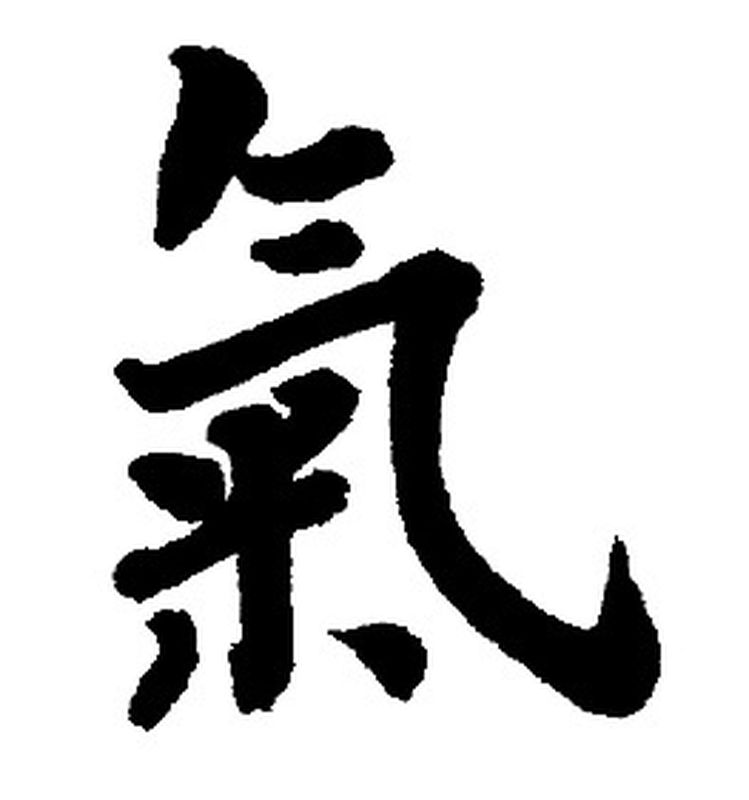
Qi is really just Qi. But at times it is useful in speaking about Qi, in the context of things like Qi Gong, cultivation practice, esoteric studies or traditional healing to describe particular interactions of Qi with our body or our consciousness through the use of metaphorical conditions. However, this has led over the  years to different systems or teachings in esoteric schools to end up using a variety of terms, like "positive qi", "negative qi", "Yin Qi" or "Yang Qi", "Natal Qi", "Active Qi" or "Stale Qi"; but all of these gradually came to be thought of as different "types" of Qi, which is inaccurate. 


As an example, let's consider the example of "stale Qi":

 There are two ways to understand Qi in any way that Qi could be said to be 'stale'. The term is a deceptive because it implies that it is the Qi that is bad or corrupted or in some sense different from normal Qi.

The first is in the sense of physical well-being, where if someone has failed to be natural for a long time, developing harmful physical habits that lead to physical tension, a failure to breathe naturally, tightness/restriction of the body in varied ways, then the circulation of Qi through the body is not open and fluid, and so Qi will tend to accumulate only in certain areas of the body and not others, leading to physical disharmony. Notice that it is not in fact a problem with Qi, or that Qi is any different, it is a problem with the body and its ability to be open and receptive and fluid in relation to Qi.

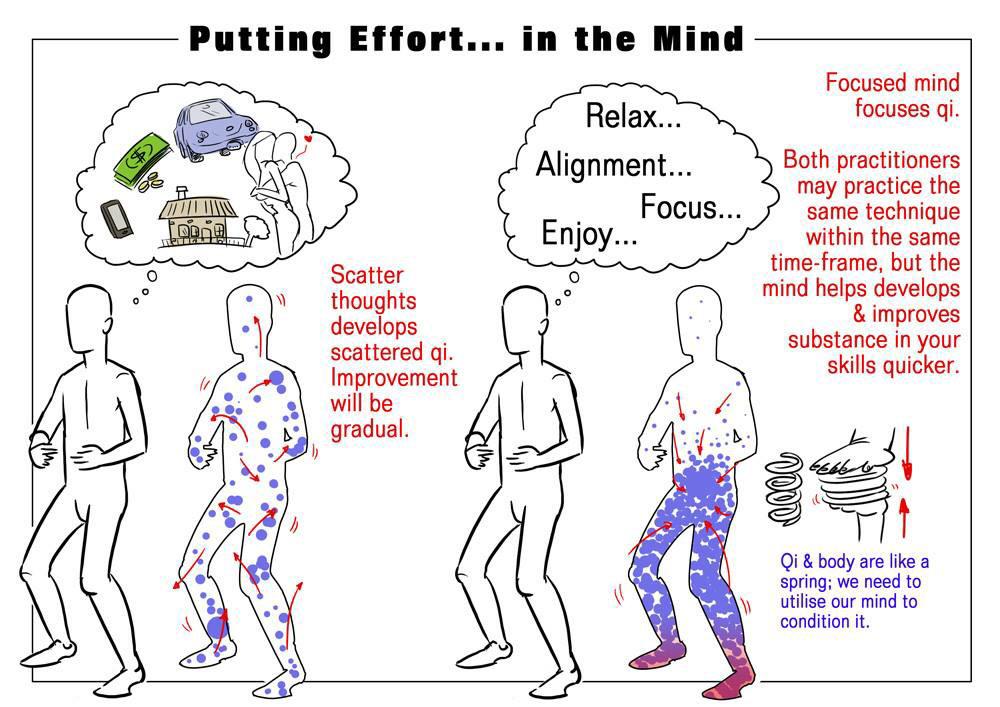
The second is in the sense of understanding Qi not only as life-force but as Will. Our will is directed to certain things. We put our will into certain things. This includes things that must be done in the immediate sense, like very ordinary things, and also things that we are trying to achieve in a bigger sense, but it also means anything we've intentionally or unintentionally invested ourselves in. This investment means that some of our will, our Qi, will be directed in certain ways, and normally this isn't a problem, it's perfectly normal.  But if we have invested our will into things that we cannot resolve, into things that are unreal, or things that are no longer real, our attention and our emotions (fear or desire) and our mind and our pain clinging to those things in spite of their unreality, then the Qi gets locked in to being invested in that. Part of our will is stuck there. 

That manifests also in the body, as tension (tension here meaning anything from physical rigidity to posture, to breathing, to other symptoms like sleeplessness or intestinal troubles, to serious disease). The Qi there is 'stale' because it is stuck clinging to something unresolved and that cannot ever be resolved in the usual way. Once again note that the problem is not with Qi, or that the Qi is different, but rather a problem that our mind is locking-in our Qi, limiting its fluidity because of our obsessions.

So the ways to resolve these sorts of problem are either by physical practice (Qi breathing) or by Virtue (through self-inquiry). The former uses the body to loosen the bonds of the mind, the latter uses awareness to loosen these bonds. Typically, a combination of both is best.

Monday, January 4, 2021

On the Significance of Yuan Heng Li Zhen

 The opening words of the I Ching's core text are "Yuan Heng Li Zhen", which is typically translated as "Sublime celestial forces in motion". 

When you think of the "celestial force" that is Time itself, you can understand immediately that this first line, the main text description of Hexagram #1, is also an apt description of what the entire I Ching is all about, and it has been treated that way by many scholars and adepts of the I Ching throughout history. As more commentary has been made of Hexagrams 1 & 2 than any of the others, it can also be said that more commentary has been made on those four words than any other words in the entire I Ching.

 These words do not appear on in Hexagram 1, however. They are also spread out, often in pairs (Yuan heng, or li zhen) throughout the I Ching core text.  Separately, "Yuan heng" means a broad or easy path, or also, a ritual or sacrificial rite. While "Li zhen" means a favorable auspice, clearly a common phrase in the context of divination. 


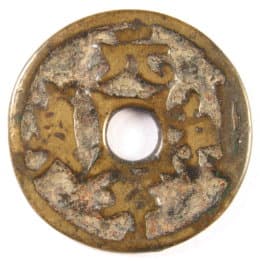
A Chinese coin-shaped talisman inscribed with Yuan Heng Li Zhen


In the Yi Fa teaching, a great deal of emphasis is put on those words as representative of the four facets of Virtue: Union/Love, Discipline, Justness/Harmony, and Truth/Reality. 

The description of Yuan Heng Li Zhen as being these four virtue facets originates with the Wenyan Commentary, which dates back to before the Han Dynasty. Here is a quote of that commentary from one translation:

 "What is called "the great and originating" (yuan 元) is [in man] the first and chief quality of goodness; what is called "the penetrating" (heng 亨) is the assemblage of excellences; what is called "the advantageous" (li 利) is the harmony of all that is right; and what is called "the correct and firm" (zhen 貞) is the faculty of action."

Here "goodness" is Love/Union, "the Assemblage of excellences" is the process of Discipline, Li is already translated here as Harmony, and the "Faculty of Action" is Truth or Reality, that is to say the perceptual faculty that allows us to take action.

Yuan Heng Li Zhen is also a reference to cycles:

Yuan - sublime, the head. The beginning. Spring
Heng accomplishment, prosperous. Summer
Li beneficence, harvest, autumn.
Zhen determination, endurance, winter

Thus Yuan symbolizes the beginning of all things, Heng their growth, Li their further development, and Zhen their maturity.  This concept of the four words connecting to the cycles of growth and the four seasons was particularly elaborated by Cheng Yi, the Song dynasty sage and friend of Shao Yong. 


These words are also used in some esoteric contexts as a mantra, and also as words of invocation for ritual purposes. In fact, just as the four words can be used to describe the pattern or process of natural or seasonal cycles, they can also be used to describe the STEPS of a ritual.

In this sense, "Yuan" symbolizes the invocation, calling down what is above, for the sake of Union.

"Heng" symbolizes the correct performance of the ritual, with Discipline.

"Li" means receiving a response from the forces you have called upon; that is to say, your ritual bringing you into Harmony with the universe.

And "Zhen" means applying that response or change in yourself, embodying Truth in the real world.


Thursday, October 22, 2020

The Steps of Human Consciousness

 There's a teaching in Chinese mysticism that there are two levels of our consciousness. They're associated with the concepts in the I Ching of the "inferior person" and "superior individual". 

At every moment in space and time we have a choice of which of the two we associate with in our active consciousness, but most people in general associate with the inferior person. The inferior person is a collection of influences and conditionings based on your physical nature, your environment, and the influences of your past and present choices and people in your life.

The Superior Individual is your true nature, what is real about you behind all those things. But in point of fact most people are so disconnected from their true and essential nature that it feels like it is another person. In many rituals used to "communicate" with the Superior Individual, that division is so notable that it feels like the Superior individual is some totally different entity from "ourselves", which is why in western symbolism its called the "Holy Guardian Angel". 

This is also why when one is trying to shift the association of their consciousness from the inferior person to the Superior Individual it feels like dying, like the very essence of who were until now (or rather, who you thought you were) has to be destroyed for you to get to that true self. In a lot of cases, people's motives for getting to that true state involve desires OF the inferior person, so they realize that to get to what's real, they'll have to give up the fantasies of the false person they were, and that's very hard.

This internal conflict is mirrored externally by the struggle between (the inferior person) wanting to imagine one's self the center of the universe, and wanting to have a power that acts on the universe and get to impose its desires on the universe, and the (Superior Individual's) understanding that we are one non-divisible part of reality and are not the central actor but one small part of a very big picture in the vastness of Space and Time, and how this is not something that can just be reasoned out, but has to be experienced through meditative practice and the application of virtue to restore that Union with the Taiji (what in modern English we could call the "Singularity").


So in fact while most of these sorts of studies and articles and ordinary perceptions on the subject of "enlightenment" talk about a two-option process (unconsciousness / enlightenment), the work of spiritual Cultivation is actually a multi-step process of initial glimpses of waking up, initiation, developing discipline, achieving communication with the Superior Individual (in western magick called the "True Will"), working to change one's life and environment to better fit one's efforts at attainment and union, making the shift from general association with the inferior person to general association with the Superior Individual, engaging in teaching or other forms of applying Virtue in the world, attaining states of Union to reality, and finally manifesting that Union fully and becoming the Sage (Enlightenment). There are steps Beyond Enlightenment as well but these are generally not spoken of in lay contexts.

Of the above stages, the big three are:

- Initiation: the beginning of awareness of one's Enlightenment quality, and the start of serious spiritual cultivation.

-Adepthood: the shift into association with the Superior Individual

-Enlightenment: uniting to nature or space-time as a whole (which is to say, overcoming this false notion of separation between self and other, and the self-referencing nature of "thinking you're in the middle of the picture").


Finally, I'll note that the very notion that Enlightenment is some kind of separation from the World or one's humanity is ridiculous and disgusting. That's essentially either nihilism or solipsism, the heresies of the gnostics. You can't become "one with everything" by being less human, or less engaged. 

Anyone claiming to be Enlightened while pretending that they don't care about things, or feel things, or that there are certain normal human things that they just don't experience (be it anger, sadness, physical pain, or basic physical needs) are both arguing for Enlightenment being a kind of sub-humanity, and blatant liars.

Enlightenment requires, as my own teacher once said, that you Be More Human.

It's not about separating yourself, it's about Showing Up, being present in the active consciousness.
It's not about feeling less or caring less, it's about Totality. Becoming one part of the big picture, without trying to run away from that big picture, or trying to be right in the middle of that big picture, or trying to control that big picture. It's about being 100% of yourself in the here and now.


Thursday, May 21, 2020

Why Do People Hide In Their Own Fake Realities?


Q: why do people try to stay in the center of their own little universes?


 We stay in little universes, that we can pretend we're in the center of. At first glance, this might seem to be a way to get something, to gain some fantasies we have. But it's more about trying not to lose.
We fear being vulnerable, so we shut ourselves up in our own little universes, separating ourselves from reality, as a way to create the illusion of greater control in our lives. If we can be at the center of things that means that we are in control and can avoid dangers and can justify anything we do; of course that's all just delusion, but that's how we imagine it'll work. Instead of accomplishing what you want it to, you become trapped in your own tiny box.


Making yourself NOT the center of your own universe means Losing Control, and having to trust: first of all, to trust yourself, that you won't fail without total control. Most people don't believe in their own abilities, so they create this tiny little box-world where they can feel like the big fish of it (what Reich called the "little man").

Second, trust other people.

And third, trust reality itself.

And those are very hard because what we want is not to be harmed and of course all those things WILL harm us. We will fail (sometimes), we will be hurt by people (sometimes) and life will definitely kill us, eventually.

But the expansion of our fears of those things happening, our failure to go ahead and trust anyways and therefore have a chance of creating purpose for our lives, leads us instead to hide away in that fantasy of self-referencing where ultimately all the things we fear will happen anyways, and on top of that we will have failed to have purpose.

And absolutely, through cultivating Virtue, we grow to understand the pointlessness of trying to put ourselves in the center of our own little universe instead of diving into our corner of the great big one and getting to be one precious part of that.


Wednesday, April 1, 2020

Flaws in Virtue

The following is an excerpt from a Level 4 text of the Yi Fa Society:


If a practitioner tries to cultivate without Union, he will only be cultivating for himself. His successes might strengthen him, but only reinforce his narcissism. He will start to feel disconnected from the rest of reality around him, and will reinforce the petty interests of his Inferior Person as if these were significant. He will develop a sense of greatness he will not be able to apply to his actual surroundings. In this way, he will eventually subvert all his own progress.

If a practitioner tries to cultivate without Discipline, he will practice in starts and stops. He may at times seek to overcompensate, even practicing in unhealthy ways. He will fall into excuses for why his irregular practice is not a problem, or even how it is unnecessary for him to practice. He may hide in intellect or in emotion, making pretensions of great spiritual feelings or thoughts, while disdaining simple and basic practice. This will eventually mean that he loses all his momentum.

If a practitioner tries to cultivate without Harmony, he will be afraid of his weaknesses, and will put all his focus on his strengths. He will work with great effort at things he's already good at, while neglecting anything he is bad at. He will make a great show of his best qualities, while trying to deny existence of his worst qualities. In this way he will be unable to continue generating Virtue, or receive Gong.

If a practitioner tries to cultivate without Truth, he will delude himself with any fantasy. He may do the physical exercises, but they will exist in his own little bubble. He will interpret Virtue as anything he feels like. He will be unable to receive insight into how to manifest the Superior Individual. He will be unable to manifest Virtue in the world.


Wednesday, February 26, 2020

Cultivating the True Will and Superior Individual

What you have to understand is that achieving the True Will (what in I Ching terms is called the Superior Individual) requires three basic ingredients:

The first is self-inquiry. That is to say, growing in your understanding of your self, and what you are really capable of, and developing a way of tapping in, at every given moment and each given decision, to what is the best choice you can make to manifest that true will. Both meditation (Qi breathing) and the study of the I Ching helps with this; the former because it connects body and consciousness, the latter because it guides you in the situations where you can come to frame your choices in time and space. The I Ching is used for divination, but in the context of the Great Work it is a lot more than that; sometimes you will need to cast the I Ching to get answers to difficult situations, but as you grow in practice and if you've spent enough time in contemplating and considering the meaning of the I Ching you will eventually develop an ability to understand what to do by an "observation of nature" (that is, by paying attention to where you are in time and space, and being able to manifest the best possible self in your choices at that moment).

The second is developing in Virtue. The term Virtue is a very specific thing in the context of Yi Fa work; it means working on improving your dedication to the four core concepts inherent in "Yuan Heng Li Zhen": Union/Love, Discipline, Harmony/Justness, and Truth/Sincerity.


It isn't enough to just think about or study these concepts; you have to work on trying to embody them in everything you do in your everyday life. This takes a lot of work, it's like an exercise regime: you'll get better at it the more often you do it. The practice of self-inquiry mentioned above is very important in this regard because as you get better at being able to overcome the passions and impulses of the Inferior Person (the opposite of your True Will, your conditionings) the easier it will be to remember to manifest these qualities.

And the third part is the exercises of Yi Fa Qi Gong. These exercise are a kind of internal alchemy; they gradually transform your body and consciousness at the same time. First off by giving you the opportunity to accumulate Qi (life force) within yourself, that is then transformed within your body to a force that breaks down the attachments you have to activities of the Inferior Person (relating to what in modern lingo could be called the mind/body connection). Beyond that, the regular practice of the exercises helps to generate Virtue, which you can then apply as mentioned above in your everyday life.


As you become more advanced in the Qi Gong practice, it will unlock new levels of your consciousness which will grant you the ability to increasingly directly manifest the Superior Individual.

Of course, all of this depends on you practicing the Work with sincerity and dedication. It takes time, but the longer you do it the more cumulative and lasting the benefits become.

Monday, June 3, 2019

What is "Virtue" in Cultivation?

There are two forms of Virtue: Virtue can mean "force" or "power", in the sense that 'virtue' relates to the word 'virility'. This power depends on one's ability to impose his force on the world.

In the most obvious sense, Virtue is the physical force that a person can impose on his surroundings. This includes his physical strength and health, but also things like his intellect and wit.

But these things are limited. Even in one's prime, there are limits to what a person's physical strength or vigor can accomplish. Even at the peak of one's intellect, there's limits to what one can manage to achieve through the mind.

And over time, these forces reach a peak and then ebb. Even someone who has made a great effort to develop physical strength, or speed, or endurance, will find that over a few years those things will weaken and fade, ravaged by time.  And even the sharpest mind will find that over a few decades, their intellect will weaken too, the mind will become less sharp, forgetfulness will increase and mental exhaustion will develop.

The second kind of Virtue is one's spiritual strength.  This is developed by accumulating Virtue through practice, and then applying that inner Virtue to emanate Virtue in the outer world. This force does not ebb, it only gains. It cannot be dulled by time or the ravages of age.

Inner Cultivation is not easy; it takes more work than building up the muscles or even sharpening the mind. But it is also a power that endures.


Sunday, May 26, 2019

VIDEO: "Healing Magic" vs True Health


The following video is not on a topic I cover very often. Most perceptions of Qi Gong as being "for health" as a primary purpose are utterly wrong, and I don't want to encourage these perceptions. But then again, most people's perceptions of health and of what spiritual or alternative-medical practices are capable of doing for their health are totally wrong as well!

So, here I set the record straight:


Tuesday, April 9, 2019

Unfolding the Nature of Truth


Truth is a more complicated concept than we tend to understand it to be. It is also a fundamental pillar of the practice of Cultivation and the development of Virtue.  In particular, in the western world, there has been a kind of crisis over the nature of truth that has developed over the last several decades; in our society, certain philosophies have tried to advocate the idea that there is really no such thing as truth, or that truth is an entirely subjective personal affair (which is effectively the same as suggesting there's no such thing as truth), or that "truth" is really just some kind of collective notion where if enough people believe in something that makes it true (which is just a delusion of collective solipsism rather than individual solipsism).

This is in stark contrast to certain other paradigms that suggest that truth is starkly and plainly absolute, a thing is either true or it isn't.  This latter concept may be more accurate in the sense that Truth is an absolute feature of reality, but it is not really much more productive because it fails to consider the human element of how we relate to Truth, of the process of understanding Truth.

There is absolute and objective Truth. However, what is true at any given time is not immune to the nature of Change, which the I Ching clearly demonstrates is the fundamental nature of all of reality, to which Truth is not immune. The most absolute Truth is change itself. In all other levels, Truth is only absolute in the context of Space-Time. That is, in certain places or in certain times, something can be true.

If, for example, it is raining where you are right now, that it rains is Truth, when and where you are. There's no relativity to that Truth, no amount of believing differently changes the fact that it is raining, and thus we see that it is objectively true; but we also know that it was not raining before, nor will it be raining later, so it is also a truth that is affected by Change.  Saying "it is raining" is true only while it rains.  With other, much vaster things, the time-span of how long something is true can be orders of magnitude greater, but it is just as affected by Change.

Our awareness as a whole, which includes elements like senses, our ability to reason, and our conscience, allow us to process and attempt to determine Truth. Because we are imperfect, and because the nature of what is true can change over time and place, the process of understanding Truth is a constant and ongoing process. We must continually unfold truth from our inner awareness and our observation of reality.

How do we do this, in practical Cultivation terms?  As always, the process must begin within ourselves.

The first step to unfolding truth is found in our own choice to make the attempt to pursue truth, over what is not true. This can be defined as "sincerity".  It also requires Discipline, to have not only a sincere dedication to seeking truth within and without your own being but to do what is necessary to embody this process in the world. Sincerity is important on a rational basis because if you are deluding yourself it is bound to impede your ability to see what is true about nature and reality; in a more esoteric sense, one could say that it is the nurturing of Truth within your own being that can allow you to connect to Truth in the macrocosm beyond you.

This leads you to the second step, of being able to examine the nature of Reality on a regular basis; through both rational study and the development of learning, and meditation and the development of consciousness.

This observation allows the third step, where you can determine what are right actions, truthful actions, within reality at any given place and time. This allows you to operate in Harmony within yourself, and with your surroundings.

Finally, there is a fourth element to this process, which is the question of how you relate Truth to your responsibility for humanity, how to apply truth to benefit humanity through contributing to its spiritual evolution (what can be called the Great Work). Being sincere and harmonious within ourselves develops within us a quality of fairness, where we wish for the world to be a fair place, for ourselves to be treated justly and for others to be treated justly. Our observation of the interconnection between all things in the tapestry of Space-Time makes it clear to us that this is necessary, because our well-being depends on the well being of others, and vice-versa. Similarly, any claim we have over any natural rights depends on others having the same natural rights.
At the same time, it is only through observation of Truth, and the degree to which we are able to accurately observe Truth, that we can consciously apply this sense of justice. We must be capable of being able to pragmatically manifest concepts like justice, rights, and well-being, in the degree to which is possible in the time and place we are located.

It is only through that degree of understanding what is true that we can manage to enact beneficial change (for ourselves and others, in the short term and building up into the long-term) that can actually work as intended, harmoniously with the reality of what is functional.

Thursday, October 4, 2018

The I Ching, Reality and Rules For Living

There is no one formula for what to do in life.
But there is a path to work out what to do in each moment.


Wednesday, June 6, 2018

Experiencing Harmony


Harmony is one of the four qualities of De (as expressed in the I Ching), the power that can be roughly translated as "Virtue". It is not a concept of morality in the western sense, but rather a state of being.

So Harmony (like the other three aspects of De: Unity, Discipline and Truth) is something you have to work towards, but it is also something that you experience. De can also be translated as "power", and it is the true source of your spiritual power, for Qi Gong or anything else.

So how do we experience Harmony while engaging in Cultivation practice?

The key to Harmony is to understand how to have a direction, in your meditation, in your Qi Gong movements, and in your activities in the everyday world, all while not being unbalanced by your own self-referencing world-view. In other words, being driven by your own 'lust of result' to try to impose your agenda on the world.

But you also shouldn't concern yourself too much about fearing your own Inferior Person, those desires to try to impose yourself on reality, because that fear can also paralyze you and unbalance you.

Rather than trying to resist your own attachments, let go of concerning yourself with attachments at all, and focus on the bigger panoramic vision, first of yourself, and then of yourself in the world.

Find your own vast nature. Not the small little and petty inferior person. The vast and open Superior Individual constantly referred to in the I Ching.
Relax.
Show up, and then open up.
And when you do, connecting to that vast Panorama, you can choose any direction to move within that panorama, and it becomes liberating.

When you aren't doing this, that's when you feel more closed. It feels like you're on a railroad track, you have blinders on, you only see a tunnel going one direction.

When you're acting in Harmony, you see the whole panorama and it feels open and free, to move in any direction while keeping your goals in mind.

Tuesday, February 27, 2018

Scaling Yongjia's Green Crag Mountain

Scaling Yongjia's Green Crag Mountain

(An I Ching poem, by Xie Lingyun, 4th century poet)


With provisions packed and a thin staff,
I walked a winding path, and scaled to a hidden place,
I went upstream and went beyond the trail.
I reached the peak, but had not yet found harmony.
The gentle rivulets frosted in winter beauty.
Strong bamboo glistened with frost.
The stream wound along, often losing its direction.
The forest was vast, the mountains deep.
I looked west anticipating the moonrise;
I glanced east, observing the light of sunset.
I walked on until night, having marched from dawn to dusk.
Even the most hidden places have become known to me.
The top line of Gu (#18): serve no king or prince.
The second line of Lu (#10): right pushing brings good luck.
A Hermit will always walk peacefully.
His great Virtue is incomparable.
How far is the distance from "yes" to "no"?
In stillness, I dedicate myself to Union.
As Harmony and Truth combine,
Only then can one begin to Repair.

Friday, March 24, 2017

On the Scope of the Great Work


On a personal level, the Great Work involves each individual's progress to manifesting the Superior Individual, and attaining to the level of the Sage (Enlightenment).

But on a greater scale, the Great Work involves the spiritual evolution of humanity as a whole.
In that greater scale, the work you do applying Virtue in the world is not meant to change the world at this present time, but to lay down currents of Change that will change the world over the course of cosmic Time. 

Presidencies, nations and whole civilizations will come and go while we perform the Great Work.
Things happening in the world now are the ripple-effect of things Initiates did 300 years ago.

The things we do with consciousness now will ripple forward to change the entire world 300 years from now.
The Great Work on this scale is done not for one's own gratification, because it is not anything any of us will live to see.


It is work to change the future.

Friday, February 24, 2017

Why Do People Naturally Cultivate Virtue?


(The following is an excerpt from a letter to a Yi Fa Society student)

The answer to the question "why do humans decide to cultivate Virtue naturally" is because Virtue is a part of nature, it's part of the fundamental structure of reality.

However, another thing I think you need to somewhat distance yourself from is the idea that Virtue is tied into our ideas of "good".
There's a lot of things a given culture (including ours) will think of as "good" which is not a part of Virtue in the sense of "De", of nature.

And it can be better to understand Virtue, if you are able, as a natural substance, which as such is actually "neutral" in comparison to our ideas of morality.
This is an inherent understanding of Eastern philosophy, and especially in both the I Ching and the Tao Te Ching.

Because it is natural, people do try inherently to cultivate Virtue; but because people are so often distanced from what is Real and what is Natural, it is often very difficult for them to go far.
In particular, a lot of people will only take partial measures to generate Virtue; some will try to work on Virtue only in their minds and ways of thinking, others will try to do so only in terms of acts, and most will fail to engage in the cultivation of their Consciousness (not even realizing that this is essential to understand and develop Virtue; they think they already "know" what Virtue is, so it's not necessary to actually expand their consciousness as a prerequisite to becoming Virtuous!).

On the other hand, some spiritual practitioners will think that meditation and spiritual exercises alone, without the actual application of Virtue in their lives, is enough. Like that thinking happy thoughts, or trying to calm the mind, is itself Virtue.
That's not the case either.

There's much further elaboration on these issues in the Yi Fa Curriculum at Level 2 and especially Level 3.

Friday, December 9, 2016

More on the Cultivation of Virtue


Virtue ("De"), in the context of the Yi Fa work, should not be mistaken for some kind of an idea of absolute morality, or an abstract and impractical set of ironclad religious rules.

Virtue involves the encouraging of a set of qualities, embodied as Yuan Heng Li Zhen, of the growth of those qualities as a substance within one's being.  To encourage and cultivate, through actions, Union, Discipline, Harmony, and Truth. 

What it is really about is being able to act in a way that is:
a) connected to the rest of the world (not shut inside yourself)
b) able to focus and be effective (not dithering or lost in the mind or distracted)
c) balanced and harmonious within yourself and on the outside (as opposed to being divided inside, and wavering from totality on the outside)
d) dealing with things as they really are, right now (and not driven by fantasies or desires or frustrations/fears of the past)

So how do you work these things?
a) by working on connecting to the world and engaging in it
b) by working on a disciplined routine in your activities, including a spiritual discipline.
c) by working on putting an emphasis on those parts of yourself and your life that you are weaker in, rather than hiding only in the ones you are stronger at. Also, by meditation.
d) by committing yourself to honesty and sincerity, and with dealing with things in life as they are rather than running away from them.

Friday, November 25, 2016

Four Virtues, Four Approaches to the I Ching


In the study of the I Ching through the Yi Fa Society, a great deal of emphasis is put on the cultivation of Virtue ("De").

Virtue is here symbolized by the first four words of Hexagram #1 of the I Ching: Yuan Heng Li Zhen.  These words mean "Sublime Celestial Forces in Motion".  But they are also representative of the four facets of Virtue emphasized in Yi Fa cultivation: Union, Discipline, Harmony, and Truth.

These four concepts are also esoterically connected to the sixiang, the four bigrams of two lines which exist at a more primordial cosmological level to the eight trigrams. In esoteric symbolism these are represented by the icons of an Azure Dragon, a Black Turtle, a Vermillion Bird, and a White Tiger. These symbols are further explored in the higher levels of the Yi Fa Curriculum.


Reflected in the concept of these four cardinal facets of Virtue, you can also understand that there are four key approaches to understanding and interpreting the I Ching. These are Image, Number, Meaning, and Principle.

Historically, during the Han era there were two rival schools of I Ching study, the "Image and Number" school, and the "Meaning and Principle" school. Later schools under the inspiration of Yidao masters like Shao Yong and Zhu Xi reintegrated these into unified study.

"Image" involves studying the structure of the I Ching hexagrams and their component trigrams themselves, and the images these evoke. "Number" involves a study of the mathematical systems of the I Ching and their numerical structures. "Meaning" involves an interpretation of the textual descriptions of the Hexagrams and their lines. And "Principle" involves contemplation on the philosophical significance of the text in terms of it's significance for attaining to the Superior Individual.

With the four facets of Virtue, there can be times when emphasizing a certain facet can be important, but it is ultimately essential to cultivate all four facets if one is to achieve higher-level attainment.  Likewise, with the study of the I Ching, it can be useful at certain times to engage with in-depth specific study of one of the four approaches to the I Ching, it is ultimately necessary to engage in all four methods of study to gain a full and profound understanding of the I Ching's mysteries.

Tuesday, November 15, 2016

The Curriculum of the Yi Fa Society, Level 3

Each level of the Yi Fa Society has its own curriculum, with new material presented for the student's growth, practice and study.  Previous entries already detailed the Curriculum of Level 1, and Level 2.

The Curriculum of Level 3, in brief, consists of the following points:

1. The "Great Book of Yi Fa": a 95-page "secret text", this book elaborates on some of the mysteries already revealed about the philosophy of Yi Fa, the practices of Yi Fa Qi Gong, and the great work of Enlightenment (personal and universal).

2. The Guide to the Taijitu:  this short text consists of an explanation of the Taijitu, the I Ching cosmology's equivalent of the Qabalistic Tree of Life (though it is in fact older than the Tree of Life), and how the different dimensions of manifested reality unfold.

3.  The Level 3 Yi Fa Qi Gong exercise. This is a secret exercise taught only to members of level 3 of the Yi Fa Society program.

4.  The Zhong Yong: a 9-page text on cosmology, philosophy and virtue, revealing the nature of the Middle Pillar.

5. An exercise for understanding the Image of the Hexagrams.

6. The basic instruction on the techniques of Qi Extension.


These advanced teachings are only available to those students who are members of the Yi Fa Society and complete the Level 1 & 2 curriculum.

If you are interested in membership in the Yi Fa Society, please contact me!

Monday, June 6, 2016

Harmony and Approaches to Studying the I Ching

There are so many ways to approach the I Ching. A key Virtue of the practice of I Ching studies is Harmony. Part of what this means is balancing out one's natural tendencies in how to approach I Ching study.

Those who are looking at the I Ching through study of the text may benefit from considering the I Ching through number. 
Those looking at it through number might benefit by considering the I Ching through the imagery. 
Those inclined to consider the imagery of the I Ching might benefit from considering the I Ching through its stories.

Gradually, you can consider all of these directions. It is important to recognize those directions you are already inclined to favor in your study, and balance this out by looking at it through those directions you are less inclined to consider.

Tuesday, April 26, 2016

Yi Fa Qi Gong and Food, and Other Taboos


The following is an excerpt from a book that's part of the curriculum of Level 2 of the Yi Fa Society, The Universal Yi Fa.

 
There are some Qi Gong schools that make their students follow special diets. Sometimes these are general restrictions (like eating no meat, or abstaining from alcohol). Other times they are seemingly very specific and unusual restrictions (such as avoiding Onions or Garlic). Likewise, some Qi Gong schools teach that sexual abstinence is essential to Qi Gong practice, to preserve the 'primordial Qi' of the body that they claim would be wasted through sexual activity.


Yi Fa Qi Gong has no such taboos. 


It is clear that some of the greatest Masters and Sages of history ate meat (or onions, or garlic), drank alcohol, and had sexual relations, even as other great Masters and Sages did not. Thus, it is obvious that neither one nor the other has any effect on cultivation. What does matter is Virtue, which requires that a person practice harmony in their life, and discipline in their actions. Thus, no specific things are forbidden, but moderation in avoiding excessive indulgence is recommended.