Bagua

Bagua
Showing posts with label commentary. Show all posts

Monday, January 4, 2021

On the Significance of Yuan Heng Li Zhen

 The opening words of the I Ching's core text are "Yuan Heng Li Zhen", which is typically translated as "Sublime celestial forces in motion". 

When you think of the "celestial force" that is Time itself, you can understand immediately that this first line, the main text description of Hexagram #1, is also an apt description of what the entire I Ching is all about, and it has been treated that way by many scholars and adepts of the I Ching throughout history. As more commentary has been made of Hexagrams 1 & 2 than any of the others, it can also be said that more commentary has been made on those four words than any other words in the entire I Ching.

 These words do not appear on in Hexagram 1, however. They are also spread out, often in pairs (Yuan heng, or li zhen) throughout the I Ching core text.  Separately, "Yuan heng" means a broad or easy path, or also, a ritual or sacrificial rite. While "Li zhen" means a favorable auspice, clearly a common phrase in the context of divination. 
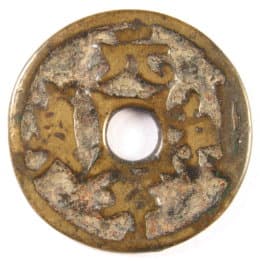

A Chinese coin-shaped talisman inscribed with Yuan Heng Li Zhen


In the Yi Fa teaching, a great deal of emphasis is put on those words as representative of the four facets of Virtue: Union/Love, Discipline, Justness/Harmony, and Truth/Reality. 

The description of Yuan Heng Li Zhen as being these four virtue facets originates with the Wenyan Commentary, which dates back to before the Han Dynasty. Here is a quote of that commentary from one translation:

 "What is called "the great and originating" (yuan 元) is [in man] the first and chief quality of goodness; what is called "the penetrating" (heng 亨) is the assemblage of excellences; what is called "the advantageous" (li 利) is the harmony of all that is right; and what is called "the correct and firm" (zhen 貞) is the faculty of action."

Here "goodness" is Love/Union, "the Assemblage of excellences" is the process of Discipline, Li is already translated here as Harmony, and the "Faculty of Action" is Truth or Reality, that is to say the perceptual faculty that allows us to take action.

Yuan Heng Li Zhen is also a reference to cycles:

Yuan - sublime, the head. The beginning. Spring
Heng accomplishment, prosperous. Summer
Li beneficence, harvest, autumn.
Zhen determination, endurance, winter

Thus Yuan symbolizes the beginning of all things, Heng their growth, Li their further development, and Zhen their maturity.  This concept of the four words connecting to the cycles of growth and the four seasons was particularly elaborated by Cheng Yi, the Song dynasty sage and friend of Shao Yong. 


These words are also used in some esoteric contexts as a mantra, and also as words of invocation for ritual purposes. In fact, just as the four words can be used to describe the pattern or process of natural or seasonal cycles, they can also be used to describe the STEPS of a ritual.

In this sense, "Yuan" symbolizes the invocation, calling down what is above, for the sake of Union.

"Heng" symbolizes the correct performance of the ritual, with Discipline.

"Li" means receiving a response from the forces you have called upon; that is to say, your ritual bringing you into Harmony with the universe.

And "Zhen" means applying that response or change in yourself, embodying Truth in the real world.



Friday, July 5, 2019

I Ching Hexagram Commentary #13 - Fellowship


Here is the latest I Ching video. If you are interested in deeper teaching on the I Ching as part of an ongoing program of spiritual cultivation, please consider contacting me about applying to the Yi Fa Society.


Thursday, November 8, 2018

Hexagram #12 and the Mulberry Buds

After posting the video commentary to Hexagram #12, where I had recited the text of the hexagram as it appears in The Magician's I Ching, someone presented me with an interesting question:

"What happened to the roots of the mulberry tree in line 5? Anyway, I am surprised that your version is so much different from the original text, that's all."

I felt that it was important to present an answer to this, for those who are students of the Yi Fa Society or readers of my book.


For a start, line five, in the original text, doesn't refer to any 'roots'. It refers to the flower-buds of the Mulberry tree. This is a reference to fortune, patience, and constancy.

So for those who know what the reference to the mulberry tree means, the meaning is in the line I quoted. For those who don't know what the reference to the mulberry tree means, the meaning is in the line I quoted.

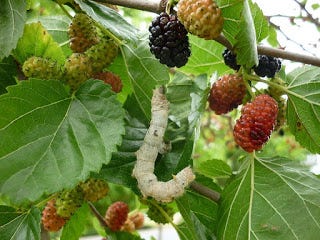
"Bao" refers to the calyx or bud of a flower. Xi in this case (to tie) refers to a silkworm, which will make its cocoon next to the flower bud of a mulberry tree.


In other words, it is a stuckness that must be done, to follow one's true will. When the flower bud unsticks, naturally, in the flowering moment, then the silkworm's cocoon opens as well, and the silkmoth will be freed. The Superior individual must remind himself constantly, to create constancy and patience, to bring an end to corruption.


As far as the absence of the analogy in the text, the questioner actually gives a perfect example of why I kept it out. Trying to explain this analogy which is so out of western culture would have required too much room for this type of text, and leaving it as it was for some kind of academic precision in the blind dumb service of sinology would only have created something impractical for actual use for most readers.

Again, those who UNDERSTAND the meaning of the mulberry in this line would understand the line as I wrote it. Those who don't know the existence of the symbol would receive the meaning without the symbol present, and avoid confusion. The only ones who would be distressed by the line as I presented it are people who know, but do not understand.

Saturday, May 20, 2017

New I Ching Video: Hexagram #9 - Small Nourisher


Here is the latest commentary video in the I Ching series. This one covers Hexagram #9 - the Small Nourisher.


Members of the Yi Fa Society get access to additional I Ching video and text commentaries that go into more depth on the symbolism and divination uses of the I Ching's Hexagrams. If you are interested in joining the Yi Fa Society, please get in touch.

Monday, February 1, 2016

Trigram Notes: "Kun", The World

  
Kun is the trigram traditionally translated as “earth”, but its meaning is “The World” (the opposite of Chien, which is “Heaven”). 

Kun is pure Yin, broken lines. It is the worldly power, all the content of creation, weak, the hot force, the feminine, the yoni, darkness, the mother. It is the quality of spaciousness; as Heaven is the “force”, so is World the “field”. Its key spiritual concept is “Receptive”.


Kun is the great nourisher, spacious and vast.  Being passive in nature, its influence in hexagrams is always in relation to the other trigram it is combined with.  More understanding regarding The World trigram can be gleaned from examining Hexagram #2, which is The World doubled; as well as through studying the Confucian commentaries.  Additional information on these are presented in Level 2 of the Yi Fa Society curriculum.

If you are interested in undertaking the esoteric training program of the Yi Fa Society, please do not hesitate to contact me here, or on Facebook.

Friday, October 23, 2015

I Ching Commentary: Hexagram #1

This is additional commentary on Hexagram #1, going beyond what is in my book (The Magician's I Ching).


 If you find this material interesting and want to deepen your work and studies, please keep in mind that in the Yi Fa Society there is even more instructional material (and personal guidance) available. If you are interested in joining the training program of the Yi Fa Society, please contact me.


Tuesday, October 13, 2015

Confucius on the I Ching

Confucius: The Survey (chapter 4)

The I Ching is a simulation of the whole of Heaven and the World, thus it includes all of these.  If we study its ways we can look up and observe all celestial events, and down to study all worldly features.  We can learn the secrets of visible and invisible principles.  We can study the origin of all things in the universe, and from this chart their end points; we can thus understand the cycles of creation and destruction. 

The Qi builds up and forms shapes into living creatures, essence floats and dissolves constantly into different elements; thus we can understand the ways of the spirits. 

Understanding the ways of Heaven and the World in the I Ching, people avoid violating these ways in their actions; this allows people to avoid troubles by acting in harmony with space and time, according with the Will of Heaven.  People learn how to use its Power (Virtue) and not to seek to move beyond its landmarks, thus they are relaxed and can act sincerely and with benevolence, extending love throughout the land.

The I Ching measures all Change in Heaven and the World with great precision, assisting carefully in the development (of all who study it), giving insight by day and by night and omitting nothing.  Thus, this wondrous book is not limited to being a guide to any single area, and the Changes marked in the book are not restricted to any limited definitions.