The official public blog of the Yi Fa Society, a mystical order dedicated to the teaching and practice of self-transformation through the study of long-hidden practices of internal alchemy.
The previous post on this blog, regarding the matter of "stale Qi", had a number of comments on social media from ordinary practitioners as well as serious Qi Gong practitioners or alleged teachers.
Among these comments, some were in agreement, others strongly disagreed and tried to argue that "stale qi" or other "varieties" of Qi are a real phenomenon.
However, the most interesting comments came from people who suggested that whether or not the phenomenon itself was real, my statement about it wasn't relevant because it doesn't really matter in terms of effects. In other words, even if "stale" Qi (or any of the many other types of descriptors of Qi, including things like "scattered qi", stolen qi, sinking qi, rising qi, boiling qi, small qi, long qi, weak qi, strong qi, still qi, hard qi, etc.) wasn't actually real and Qi is just Qi, the description of these things as 'types' of Qi can be helpful for a student to understand what they're working through and it can potentially help them to engage with Qi Gong practice.
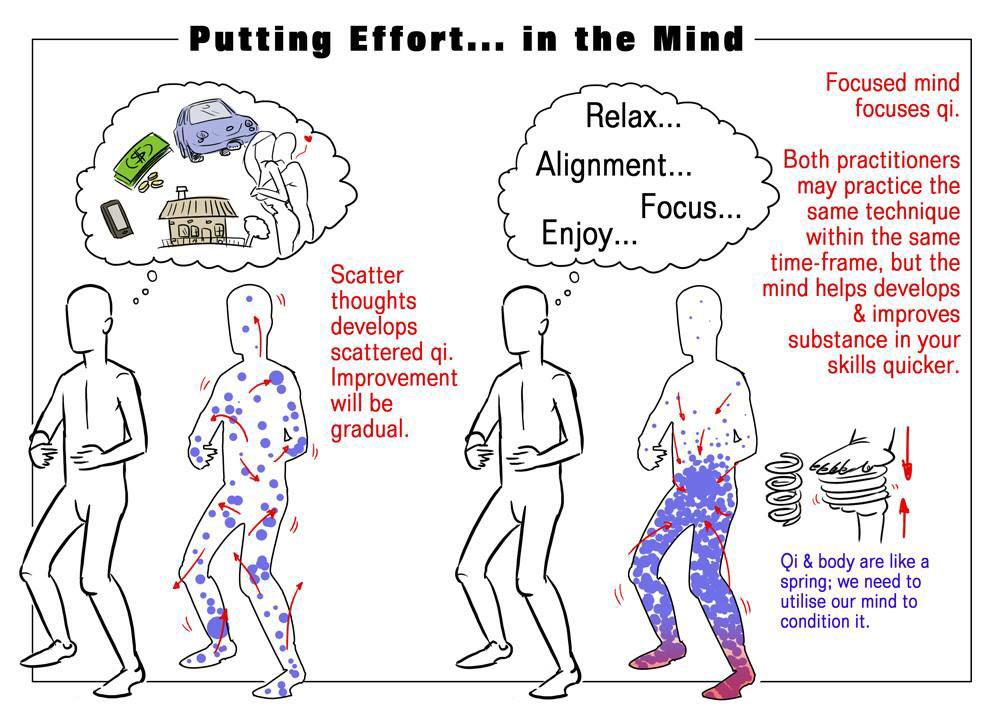
Now, first of all, if you think about all those statements being attributed to Qi, you can see that they're not really talking about Qi itself at all, but rather about how YOU process Qi.
(It's not the Qi that's scattered, it's you)
It is technically correct, that from a 'practical' point of view, it doesn't immediately matter whether it's the Qi that's "bad" or your body that is "bad" due to your failure of cultivation and/or lack of Virtue.
However, in the bigger picture, there is an important difference!
If people believe it's the Qi that's bad, they can go looking for magic potions and quick fixes and fake Wu or plastic new-age "taoists" who will do "energy cleanses" that will "fix their Bad Qi".
On the other hand, if they realize Qi is Qi, and the problem is THEMSELVES, they might understand that the only way to fix the problems are by their own discipline and virtue. So that's a HUGE difference.
Qi is really just Qi. But at times it is useful in speaking about Qi, in the context of things like Qi Gong, cultivation practice, esoteric studies or traditional healing to describe particular interactions of Qi with our body or our consciousness through the use of metaphorical conditions. However, this has led over the years to different systems or teachings in esoteric schools to end up using a variety of terms, like "positive qi", "negative qi", "Yin Qi" or "Yang Qi", "Natal Qi", "Active Qi" or "Stale Qi"; but all of these gradually came to be thought of as different "types" of Qi, which is inaccurate.
As an example, let's consider the example of "stale Qi":
There are two ways to understand Qi in any way that Qi could be said to be 'stale'. The term is a deceptive because it implies that it is the Qi that is bad or corrupted or in some sense different from normal Qi.
The first is in the sense of physical well-being, where if someone has failed to be natural for a long time, developing harmful physical habits that lead to physical tension, a failure to breathe naturally, tightness/restriction of the body in varied ways, then the circulation of Qi through the body is not open and fluid, and so Qi will tend to accumulate only in certain areas of the body and not others, leading to physical disharmony. Notice that it is not in fact a problem with Qi, or that Qi is any different, it is a problem with the body and its ability to be open and receptive and fluid in relation to Qi.
The second is in the sense of understanding Qi not only as life-force but as Will. Our will is directed to certain things. We put our will into certain things. This includes things that must be done in the immediate sense, like very ordinary things, and also things that we are trying to achieve in a bigger sense, but it also means anything we've intentionally or unintentionally invested ourselves in. This investment means that some of our will, our Qi, will be directed in certain ways, and normally this isn't a problem, it's perfectly normal. But if we have invested our will into things that we cannot resolve, into things that are unreal, or things that are no longer real, our attention and our emotions (fear or desire) and our mind and our pain clinging to those things in spite of their unreality, then the Qi gets locked in to being invested in that. Part of our will is stuck there.
That manifests also in the body, as tension (tension here meaning anything from physical rigidity to posture, to breathing, to other symptoms like sleeplessness or intestinal troubles, to serious disease). The Qi there is 'stale' because it is stuck clinging to something unresolved and that cannot ever be resolved in the usual way. Once again note that the problem is not with Qi, or that the Qi is different, but rather a problem that our mind is locking-in our Qi, limiting its fluidity because of our obsessions.
So the ways to resolve these sorts of problem are either by physical practice (Qi breathing) or by Virtue (through self-inquiry). The former uses the body to loosen the bonds of the mind, the latter uses awareness to loosen these bonds. Typically, a combination of both is best.
I have often been asked whether there is any utility or value in the use of psychedelic drugs while engaging in spiritual practices, and specifically cultivation practice like that found in Yi Fa Qi Gong and other authentic Qi Gong cultivation systems.
My answer has always been that one has to be very cautious and prudent in how to approach the question of psychedelics. And in fact, people who are already engaging in or have previously used psychedelics will probably have very little benefit, and potentially drawbacks, from any attempt to use them in the context of cultivation practice.
Not because "drugs are bad" or anything like that, but because in the context of just WHAT they're useful for in terms of spiritual development. Psychedelic drugs need to be used ideally only at very carefully selected moments and in very specially selected contexts. The ancient shamanic cultures throughout the world understood this, as did some of the hermetics and some of the eastern sects.
The central feature of the psychedelic experience is twofold: it temporarily breaks down the ego, and it opens the doors of perception (to paraphrase Huxley).
The latter means that suddenly you're having a sensory experience different to anything you experienced before.
This is what leads to the effect of breaking down the ego: the mind's ability to lock-in to personality is based largely on imprinted behaviors from memory... what you could call "conditioning". Basically, ways you've programmed yourself, some of which is essential for daily living but a lot of which is also highly limiting, including in the spiritual context.
When you use a psychedelic for the first time, it makes your brain unable to refer back to any past experience that was sufficiently similar to allow the ego to assert itself (in the sense of "I know what's happening here, I know what to do") and so you have the potential to have an experience that can break some barriers the Ego has created that could be very hard to break otherwise. It is the inability to put what you're experiencing into some comfortable box of context that makes the experience so potentially charged with the opportunity to make serious Change.
But by the second time you use a psychedelic, you already have a context by which the brain can compare it to in memory; namely, the first time you used it! So even just the second use of a psychedelic will be, spiritually speaking, enormously less useful than the first time.
I would say that generally speaking, the real spiritual utility of psychedelics for transformation (in cultivation practice) is limited to the first two or at most three times you use a drug. Any use after that will, at best, only be useful for attaining a kind of trance state (but that can be done in a lot of ways, including meditation). It's no longer useful as an ego-overwhelming tool. It is just re-creating a former experience.
That means that if you had wasted the first time you used a psychedelic (say, at a party or something), you would wasted a big potential tool that you could never use again.
So you want to think carefully about when you use psychedelics. If you do use them, it should be at a carefully planned moment and in a carefully prepared context so as to make the best use of the power of the ego-overwhelming experience.
Qi Gong Practitioners often develop problems in their practice due to a predictable pattern of behavior. The root of this is placing very high expectations on your experience of practice.
High expectations tend to develop in one of two ways: the first is where you begin with a simple practice that has some powerful experiences and real results, and so want to maintain that intensity and try to do so by doing more: making more advanced practices, longer exercises, adding little details, etc. until you have overburdened your practice.
The second is where you are doing a practice and feel that it is not working well, so you decide to modify or add to it. This produces a positive result, which was really caused by making a change, but which you might interpret as having been due to adding complexity or greater effort. So you continue to add more complexity and detail in your practice to try to keep increasing your experience.
This focus on excessive complexity can lead to creating a false illusion of effectiveness, that only seems to be creating results for you as long as you keep trying to build it up and innovate in your practice. It is doomed to lead to a collapse.
So it's important not to over-complicate things, not to worry about meeting some kind of ever-growing quota of expectations.
This is often a sign you are in a cycle of creating a false reality (maybe of your success, or even of struggle), when you need to create ever increasing complexities to the work you're doing or to the results you expect; this is actually you trying to dedicate more and more of your own Qi to create a bubble of fictional reality around yourself. It's because there was something that you found useful, so you clung to it.
But in so doing, you lose what's actually useful (and often, good and enjoyable) about it.
So when you realize that this is what you're doing, you have to let the bubble deflate (before it outright pops), and return to the moment, and return to figuring out how to show up in the Active Consciousness to this moment, to this simple practice, to this pass-time, to this job, etc.
The key isn't about complexity, it's about being able to relax in your practice.
It's always about relaxing into it. So for a lot of people, relaxing feels like a really profound surrender because they're so resistant to the letting-go of control that relaxation entails.
Remember to breathe.
The following video is not on a topic I cover very often. Most perceptions of Qi Gong as being "for health" as a primary purpose are utterly wrong, and I don't want to encourage these perceptions. But then again, most people's perceptions of health and of what spiritual or alternative-medical practices are capable of doing for their health are totally wrong as well!
It's very important to find your center in the body.
But then, when you are seeking to unite to the rest of the universe, you can't achieve that if you are looking at your own being as the 'center' of the universe.
The universe is vast and if you try to push your own being into the center place of it, you won't be able to Unite; you will still be trying to have your own separate being at the middle, you're essentially trying to demand that the Universe unite with you (or "around" you).
When connecting to the Universe, you have to realize that you are United to it as an inseparable part of it, but not the center around which all other things orbit.
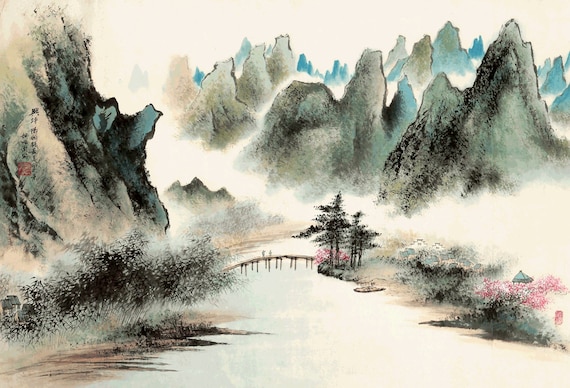
It is like the pictures in Chinese art. You see this style where there are great landscapes, symbolic of Nature and the Universe, and then somewhere in some little edge or corner, there is a person.
(note the tiny human figures, crossing the bridge, over the waters between the mountains)
When you try to put yourself at the center of the Universe, this naturally alienates you from reality, and from the physical, and from association with your body. Conversely, when you return your meditation to the body, you go within, and step out of the illusion of your own centrality. Paradoxically, only by doing so can you experience the vastness of the universal in a truthful way.
You do not need to be in the middle of this vastness; in fact, you can't be. You can't achieve that and create the appropriate place for the universe.
To Unite, you need to see your place in the enormous vastness of space/time that came before you and comes after you, that is beyond you and behind you.
That is to say, of your notion of you.
When you can be comfortable and fulfilled with just being a part of the big picture, even as a small figure on one edge of the canvas, then you can achieve Union.
The Yi Fa Society is a "Secret School" founded on ancient formulas for the teaching of a complete system of inner alchemy. It provides a complete curriculum of training taught over various levels, with both practical and philosophical teaching material. It utilizes a complete system of Qi Gong (Yi Fa Qi Gong) for the cultivation of consciousness, and trains its members in the secrets and symbolic language of the I Ching. Its 8-level curriculum allows students to progress in understanding and self-transformation.
The structure of the Yi Fa Society emerged from a series of revelations which came as a result of a twenty-year study of the I Ching. The I Ching is the foundational text of all Chinese spirituality; a three-thousand year old book that has been in continuous use since its creation, the oldest book of such kind in the world. Used by most as a mere fortune-telling device, sages throughout history have understood it to contain a profound system of metaphysics, and the keys to understanding reality itself. It also contains within it a system for personal transformation through a process of "inner alchemy".
The I Ching provides the symbolic basis of the system of meditation and inner-alchemy known as Qi Gong, but this too has usually been misunderstood by laymen as a mere system of health-exercises. Thus, the Yi Fa Society has designed a new set of Qi Gong practices, known as Yi Fa Qi Gong, which are meant to use the principles of the eight elements (the four celestial and four terrestrial elements) to establish a progressive set of teachings by which its members can develop inner transformation, leading to what the I Ching refers to as the emergence of the "Superior Individual", the higher or true self, through the establishment of the True Will (that is, our fundamental natures).
The Yi Fa Society's system of teachings are done in eight levels, each of which provides a graduated series of secret practices and teachings that build on the former levels. It is not tied to any specific religious teaching, but rather to the perennial philosophy of enlightenment; although it makes use of symbols and concepts that have come into common use in Confucianism, Taoism and Buddhism (as all three were influenced by the symbolism and philosophy of the I Ching).
Where to Begin?
If you are interested in joining the Yi Fa Society, please contact me here, on Facebook, or Google+ to receive an application form. Likewise, please write if you have any questions.
The foundation of the Yi Fa is found in the I Ching. This book provides the foundation for the entire Yi Fa curriculum, and while there are many worthwhile versions of the I Ching in publication today, the specific teachings of the Yi Fa are best expressed in the book "The Magician's I Ching", where the teachings of the I Ching as a system of divination, decision making, and tool for transcendence are explained in straightforward terms specifically designed for western readers, and for those who plan to actually use the I Ching as a system for self-transformation.
(if you are interested in joining the Yi Fa Society and working its curriculum, which is a complete system of esoteric training, please contact me!)
Harmony is one of the four qualities of De (as expressed in the I Ching), the power that can be roughly translated as "Virtue". It is not a concept of morality in the western sense, but rather a state of being.
So Harmony (like the other three aspects of De: Unity, Discipline and Truth) is something you have to work towards, but it is also something that you experience. De can also be translated as "power", and it is the true source of your spiritual power, for Qi Gong or anything else.
So how do we experience Harmony while engaging in Cultivation practice?
The key to Harmony is to understand how to have a direction, in your meditation, in your Qi Gong movements, and in your activities in the everyday world, all while not being unbalanced by your own self-referencing world-view. In other words, being driven by your own 'lust of result' to try to impose your agenda on the world.
But you also shouldn't concern yourself too much about fearing your own Inferior Person, those desires to try to impose yourself on reality, because that fear can also paralyze you and unbalance you.
Rather than trying to resist your own attachments, let go of concerning yourself with attachments at all, and focus on the bigger panoramic vision, first of yourself, and then of yourself in the world.
Find your own vast nature. Not the small little and petty inferior person. The vast and open Superior Individual constantly referred to in the I Ching.
Relax.
Show up, and then open up.
And when you do, connecting to that vast Panorama, you can choose any direction to move within that panorama, and it becomes liberating.
When you aren't doing this, that's when you feel more closed. It feels like you're on a railroad track, you have blinders on, you only see a tunnel going one direction.
When you're acting in Harmony, you see the whole panorama and it feels open and free, to move in any direction while keeping your goals in mind.
To get power, you have to make room to receive it. Power is something obtained when you are open to receiving, not when you are aggressive. Only by being below can you give space for what is above to enter; if you try to make yourself tall it can't.
Power doesn't come from tension, tension has no power. Power comes from a deep looseness, where energy isn't being all expended in tension. That looseness allows flexibility, and can be in-tensified to create force when needed for a specific purpose. A state of tension has no room to become more intense, has no reserves to apply force anywhere else.
To get power, you have to submit. Then you can impose, and thus obtain success.
Most schools of Qi Gong today sell themselves as being about health and healing. This is because mainly the people promoting those schools either have no real grounding in what Qi Gong is for, or are aware but felt obliged to keep the real purpose hidden. In China, Qi Gong was very badly persecuted during most of the Communist period. It was only allowed to be revived in the time after the terrible persecutions of the Maoist Cultural Revolution, when the Chinese Government eased away from attacking traditional Chinese culture, and when the nation was facing a health-infrastructure crisis.
In fact, there was no such term as "Qi Gong" before the modern age, this was a name created to unite concepts in traditional Chinese healing, cultivation practice, and internal martial arts. The government began to promote Qi Gong, not as a spiritual practice of cultivation, but as a system for improving health and wellness. So many opportunists who had little or no real understanding of cultivation set themselves up as "qi gong healers", while some of the genuine teachers began to teach again by hiding their more esoteric training behind the facade of "health and healing". In fact, this fit in nicely with the historical tradition of "secret schools", where serious Qi Gong masters would hide the nature of their teaching.
But regardless, Qi Gong was not meant to be about health, or healing. It was meant to be about cultivation for the purpose of eventual enlightenment.
So how useful is Qi Gong, for someone who is only interested in preserving their health or healing some kind of ailment?
Regarding health issues and Yi Fa Qi Gong; or health issues and Qi Gong in general, you have to consider the sources of various health problems. They are caused by one of a selection of sources:
0. Accidents or short-term illness: a broken leg or a cold or upset stomach are not really caused by anything in most cases, except misfortune. These problems do not really need Qi Gong to heal.
1. Genetics: This is one of the most common causes of non-acute health problems. Recent medical studies have found that a great number of health issues are largely caused by genetic predisposition. This is a product of birth. Qi Gong can't really do anything to prevent these problems. There's not really anything Qi Gong needs to do about these, in terms of prevention, and only limited amounts it can do in terms of treatment.
2. Environmental issues: These are health issues caused by where you are, by elements of your environment. This also includes things you might have a genetic predisposition toward, but would not be affected by it without being exposed to some environmental trigger. These health problems can sometimes be resolved by changing your environment. Doing Qi Gong without making changes in your environment won't be of any real help.
3. Lifestyle/choice issues: Some health problems are caused as a consequence of your lifestyle or behaviours, related to eating habits, sleeping habits, drinking, drugs, smoking, or other choices. Again, if you don't change your lifestyle, Qi Gong will not be of help here.
4. Stress or emotional issues: some health problems appear as consequences of mental stress or emotional tension manifesting in the body. The best resolution to these problems is through relaxation, meditation, and the expanding of your own consciousness until your attachments disentangle themselves. The exercises of Yi Fa Qi Gong are effective at dealing with these issues, if properly practiced.
So this is why I do not put very much emphasis on 'health' in Qi Gong practice. Anything related to health that can actually honestly be helped by Qi Gong can and will be helped by performing Yi Fa Qi Gong correctly, even though Yi Fa Qi Gong's primary goal is not health but Enlightenment.
None of the other sources of health problems can be significantly helped by any Qi Gong, even those forms of Qi Gong that allege to be about health.
Someone at one point asked about how to best handle 'negative' emotional issues that they feel attached to, using Qi Gong. The following was my reply:
The technique would be very simple: when you begin the level 1 exercise, bring those feelings to mind; engage with those feelings as you do the practice.
Bring your active consciousness into your body, your movements, and your stillness, as usual.
So at this point you bring up the emotional energy trapped by the attachment, and then start to focus on a totally different use of energy: the practice.
"Energy" here really means intensity; the 'intensity' of your feelings tied up in your attachments is a kind of effort(energy). Give them a different direction, and it can gradually untie the knot of that attachment by putting that same level of intensity into your practice.
This is a very useful video to understand some of what I mean with regards to 'relaxing' into Qi Gong practice. Although it's obviously being presented from the point of view of martial arts, it's coming from a tradition that makes some use of Qi Extension, and thus it relates to some of what we talk about in the Yi Fa Qi Gong practice.
Note that I'm not saying you need to do these stretches in particular (you could if you want to, but they're geared toward martial arts practice), I'm saying pay attention to what he's talking about just what 'relaxation' means.
People tend to tense up their muscles, while in Qi Gong the point is to keep the musculature relaxed while still holding an internal firmness. So I've found it's very important to remind people to relax while they practice; holding tension in the musculature makes it very ineffective for Qi circulation. But at the same time, this doesn't mean to be all floppy; the POSTURE is firm, the musculature is relaxed (and the breathing is relaxed as well). There is a parallel in this when it comes to one's consciousness during the practice; you do not want to be mentally tense while you practice. You DO want to be in the Active Consciousness, but this means being very present in a very relaxed way!
Also note what he's talking about "mind" and "putting the mind into the body". When he says "mind" he's talking about what in Yi Fa Qi Gong we call "active consciousness". When you are really present in the active consciousness, your body is not tense, your mind is not tense, but you are fully connected in the body and so without any great effort other than that attention you are able to be in good control of your posture and movements.
That each meditation, or each Qi Gong session should be done FOR ITS OWN SAKE is really hugely important.
Meditation and cultivation practice cannot work if it is something you do now for the hope of some kind of future outcome.
But if you do it right now, for the sake of doing it, to Show Up and be in it, then it provides an instant response.
It becomes its own reward.
And it allows you to connect to that cultivation that will lead to long-term transformation.
Like so many other parts of Qi Gong or spiritual practice, the future takes care of itself and you do not have to do anything about it, as long as you are taking care of and Showing Up in the present right now!
If you are interested in working the curriculum of the Yi Fa Society, please feel free to contact me about joining.
The following is an excerpt from the Level 2 book "The Universal Yi Fa":
"Brand new students may feel, sometime in the first week or two of daily Qi Gong practice, some physical symptoms that are not unlike having a mild cold; this is also normal and happens to at least a third of all new students. The ancient teachers suggested that this was due to the expulsion of stagnant Qi (or later, once Buddhism had become popular in China, the expulsion of "bad karma"); however it may also bepossible that these symptoms are in fact due to the way Qi Gong stimulates the lymphatic system into more effective detoxification.
Many students will experience, after their first few sessions of Qi Gong, feelings of excitement and pleasure during the practice, and a general sense of well-being after the practice. This is different from the bliss stage of pre-enlightenment, but is rather an effect of that initial enthusiasm for practice (and the conscious or unconscious sensing of initial Qi cultivation). It happens to at least a third of initial students. Instructors should make it clear that this is a normal sensation, but not to dwell too much or make that kind of pleasure the goal (otherwise, in the middle-early stages, when perfecting the technical side of the movements becomes more challenging, they may start to get discouraged).
On the other hand, at least a third of the students may find that, in the days after initial Qi Gong practice, they start to feel more easily annoyed or irritated by everyday things in their life and environment. This is likely caused by the initial increase in sensitivity and perception that properly practiced Qi Gong generates. Students should be advised not to worry too much about it, to try to avoid outbursts or reactions caused by such irritation, and that once they get used to their higher level of perception, these sensations will pass.
One very common physical side effect of Qi Gong practice is most curious: practitioners will experience an increase of "bubbles" in their urine. The ancient teaching suggested that these are due to "excess Qi", not yet able to be contained in the new student as they are still in the process of activating the First Furnace. It may also be likely, however, that this is a side effect of increased oxygenation produced by improved breathing when practicing Qi Breathing. In either case, this curious side effect is completely harmless.
Finally many students, after the first two or three weeks of practice, report that they are getting less sleep than they used to; and for some this can seem quite distressing. However, the student should consider whether their reduced hours of sleep actually translate into a sensation of being tired when they wake up. They will likely find that even if they have slept one to three hours less than they were previously used to, they wake up feeling no more tired than they would normally. This is because the physical effects of Qi Gong, and the increased life energy generated by the proper circulation of Qi in the body, makes less sleep necessary to get the same amount of physical regeneration. So if a student is sleeping less but is not feeling exhausted from it, they should realize that this is not a serious problem at all, but rather an advantage of practice! At the same time, the instructor should warn students away from intentionally getting less sleep; if their body naturally sleeps less, that is different than if they are trying to use Qi Gong as a way to "burn the midnight oil", which is not as such advised."
If you are interested in Yi Fa Qi Gong, you could start on it by checking out the Yi Fa Society Playlist on Youtube.
If you are interested in joining the Yi Fa Society and working on its curriculum, please feel free to contact me!
The other day I posted a Youtube video related to the subject of ritual, in the context of the Bhagavad Gita:
Now, this video is not part of the Yi Fa Curriculum. But the subject of 'ritual' is very significant to the Yi Fa work. As the video points out, ritual is not meant to be something done automatically, or even as such for some kind of ulterior motive: it is its own reward.
This brings to mind the question of 'what is ritual'? We tend to think of ritual in terms of being some kind of ceremony meant for religious or magical purposes.
But in Chinese thought, ritual or "rites" (which is called "li") means not only religious ceremony, but also it encompasses all the notions of 'proper conduct'. It can be understood as including customs, manners, etiquette, 'proper form', etc. We could call it "rules of art". It is tied to the Virtue of harmony; both in the sense of good harmony within our own being (balance), but also harmony with our world, our fellow human beings, and society.
Another of the Confucian Classics, aside from the I Ching, is the "Book of Rites". If you look at that book, you will find that it is not some book of magical rituals, but rather a wide-ranging guide to all kinds of standards of etiquette and ancient customs (from the Zhou dynasty, the dynasty that wrote the I Ching).
In relation to Qi Gong, the practice of the forms of Qi Gong (including Yi Fa Qi Gong) are certainly a type of ritual. It is important to further clarify what this means in the context of Qi. There are many people talking about the "Qi Gong" of other activities: how painting can be Qi Gong, or writing, or dancing, or all sorts of other things (even "Qi Gong Golf" or "Qi Gong Cooking"). In some cases, this is interpreted in some kind of very esoteric way, like as if you are doing some very special mystical technique. But this was not really the purpose of this concept, it is actually just the opposite.
Let's further define an intentional act, and a ritual act. In western esoteric magic, we are told that "any intentional act is a magical act", and that magick is "the art or science of causing change to occur in conformity to the Will". We can thus surmise that any intentional act is an act where you are directing your will. So what marks the difference between an 'intentional' act and a 'ritual' act is that a ritual act is to direct the will within a certain form. Any practice that has a technique is not only an intentional act, but a ritual act. This is how to understand 'rites' in the context of Qi Gong.
What this means is that if you get up in the morning and brush your teeth, and the practice of brushing your teeth is done in a certain way (you stand in front of the sink, you fill a glass, you lift the glass to your lips and slosh some water in your mouth, then spit it out into the sink; you grab your toothbrush, open the toothpaste, put a bead of toothpaste on the toothbrush, put the toothbrush in your mouth and scrub in a certain fashion going from one part of your teeth to another, then rinse your mouth again, wash off the toothbrush, etc.) then you can say that you have a "technique" of brushing your teeth. But this is not a ritual, unless you are also doing it as an intentional act. As soon as you are doing this exact same technique, just as you always did it before but now as an intentional act, it becomes the Ritual of Brushing Teeth.
It is the same with countless other things you do in your ordinary life. You have techniques for all sorts of ordinary things in your life. Often, these are done mechanically, specifically as a way to avoid paying attention while you are doing it; you can be on 'automatic' because of how familiar you are with these techniques.
In Qi Gong, Qi is a measurement of the direction of your Will. It is treated as a substance, and thus we understand Will not as some invisible thing or only a mental effect but as a part of our material existence. When we do anything as an Intentional act, we are directing Qi. So if we are doing some technique in a mechanical way, we are not directing Qi into these activities. But as soon as we do that technique in an intentional way, we are directing Qi into them: a mechanical activity becomes a Ritual activity. This directing of Qi does not really require any special effort on our part aside from intention; just like in Yi Fa Qi Gong you do not need to do anything mentally to 'move' the Qi, it naturally happens just by performing the practices with intention.
If we are trying to brush our teeth, or paint, or play golf, or prepare breakfast or any other thing, through some technique, whether it is ordinary or somehow fancy or ceremonious or unusual, it is NOT Qi Gong, if it is mechanical. But it can be said to be "Tooth-brushing Qi Gong" or "Painting Qi Gong" or "Golfing Qi Gong" or "Cooking Qi Gong" if we are doing it with a technique and form AND we are also doing it intentionally!
This is why I say people often understand it the opposite way of how it is intended: it is not about reciting some kind of mantra or visualizing something or doing some unusual movements or mentally directing something, while you are doing these ordinary things. It is about doing these ordinary things with order and structure, with harmony and balance, and with the Active Consciousness, with intent. The point is not to try to mystify ordinary activities, but to understand that that all sorts of ordinary things can be mystical, can be part of cultivation, simply by doing them consciously.
And we have to conclude, by this same reasoning, that it is not that Qi Gong is something separate from the ordinary, but very much part of the ordinary. Our ordinary life does not need to be integrated into our cultivation practice; rather, our cultivation practice needs to be integrated into our everyday lives! We do not need to separate ourselves from ordinary existence to find the magical, we have to unite our Will to the ordinary.
There, in the Manifested, is where the Great Work is to be found.
We ALL have moments where we hunker down and become reluctant to engage in our daily practice of Qi Gong and meditation. The question, and the difference, is what we do after that. There's two (not incompatible) ways of handling this. The first is to try to reconnect to the joy of doing the practice. The practice can't feel great ALL the time, but we should in general be able to find things that feel good about practicing.
So one step is to focus on the parts or the ways the practice feels good. When we're very ill, for example, it's good to do as much as we can of the practice while ill, but not too much more than it could either harm us or sour us to the practice.
When we are for non-physical reasons in a state of malaise, it can be good to figure out and remember those things we like most about practicing, and give ourselves permission to just do those for a few days, to focus on improving those parts. To ignore or de-emphasize the parts we think we don't care for and spend more time focusing on the parts we do.
You could say that's the Yin way.
The second way is to focus on Discipline, and push ourselves forward to practice. To defy our own Inferior Person and take our practice as an act of our own Will to defy what we might happen to be feeling at the given moment. Doing that first, we can start to turn around and find value in our practicing, and then reconnect to the joy of practicing.
You could say that's the Yang way.
The ideal is to be clear on which way to deal with the barriers to our practice at this given time.
The Facebook group created in honor of The Magician's I Ching, but which is a general discussion group for all I Ching related subjects, has now reached just over 1500 members!
So if you haven't already joined the Magician's I Ching Facebook Group, please
consider joining! It's free, and filled with interesting conversation
and material related to the I Ching and I Ching studies. It's open to
people coming from western or eastern traditions. It's very welcoming
to newcomers to the I Ching, and you can get questions answered or
useful advice. But it also has many very learned and highly experienced
advanced students of the I Ching, and if you are one of those
people you'll find some excellent higher level discussion about some of
the finer points of I Ching study.
While you're at it, please consider joining the Yi Fa Society. Members
of the Yi Fa Society also have a (secret) discussion group, and benefit
from a complete and detailed training program for studying Yi Fa Qi Gong
and the I Ching. Members of the Yi Fa Society are taught additional
Qi Gong and I Ching secrets that are not available anywhere public.
At
higher levels of membership, the advanced exercises of Yi Fa Qi Gong are
taught, and students are provided large numbers of instructional
materials (whole books, like "Secret Techniques of the I Ching",
"Universal Yi Fa", "The Yi Dao", and "the Great Book of Yi Fa", among
others) on how to deepen their work with Qi Gong and I Ching for
self-transformation and the work of enlightenment.
Members of the Yi
Fa Society can work personally with me to keep up their practice, to
resolve problems in their practice, and to develop discipline and
structure in their spiritual path. Members also have the opportunity
to have monthly Skype meetings with me for the same purpose.
Yi Fa Society membership is not free, but basic membership is on a monthly donation basis set by each student.
If you are interested in joining the Magician's I Ching Facebook group, just click on the link and join, and start reading and sharing with us!
If you are interested in joining the Yi Fa Society, please contact me, here or on Facebook.
The following is an excerpt from the Level 3 Yi Fa Society book, "The Great Book of Yi Fa".
Qi Gong
and Health
Practicing Qi
Gong can provide various health effects. First, and centrally, it
improves the connection to one's own body. This strengthens one's
general physical well-being, and can improve the immune system,
physical awareness, attentiveness, and strength. The movements and
breathing improves circulation, the stance improves posture which is
helpful for a variety of problems (including digestion, back pain,
etc.). The exercises stimulate the lymphatic system which helps with
one's overall energy level and vitality. The practice overall
contributes to relaxation and reduces stress, which helps prevent all
kinds of ailments.
But it should
also be noted that Qi Gong is not exercise. It has elements of
physical activity, but it is not the same as the western approach to
exercise. It is also not in any way a substitute for proper physical
care, or western medical care.
Keeping this in
mind, when you are teaching Qi Gong to others, it is important not to
overplay the elements of Qi Gong as being for 'health' or 'exercise'.
Most ordinary people who have heard of Qi Gong already think this is
the main purpose of Qi Gong practice; it can be an easier 'sell' for
people than talking about Cultivation. But Cultivation is the central
goal of serious Qi Gong practice. While it is perfectly fine for an
ordinary person to want to make use of the health and stress-relief
benefits of Qi Gong, you should strive to make it clear that the more
important part of Qi Gong is its use as part of a whole spiritual
practice of Cultivation for the purpose of self-transformation. Even
in the context of talking about health, you should make it clear to
any students that Qi Gong cannot do much for your health if you are
not approaching it from the perspective of transforming yourself, of
changing your habits, your virtue, and your perspective of your
'self'.
If you are interested in joining the Yi Fa Society, please get in touch with me here, on Facebook, or Google!
The following is an excerpt from the Level 2 text "The Universal Yi Fa Qi Gong", available only to Yi Fa Society students. In this excerpt we look at some of the common early experiences that happen to people starting a regular Qi Gong practice:
It is quite common for a significant percentage of new practitioners to experience the sensation of Qi moving through the body while practicing the exercises; but it should also be noted that at least as many may not feel Qi. While the ability to experience a sensory perception of Qi will steadily rise in most students, to the point that the majority of Level 2 students will obtain such sensations, teachers should take note of advising brand new practitioners that these sometimes surprising sensations are normal. They should likewise reassure those who do not feel Qi yet that it is also completely normal not to experience such sensations even until a considerable time practicing Qi Gong has passed. Brand new students may feel, sometime in the first week or two of daily Qi Gong practice, some physical symptoms that are not unlike having a mild cold; this is also normal and happens to at least a third of all new students. The ancient teachers suggested that this was due to the expulsion of stagnant Qi (or later, once Buddhism had become popular in China, the expulsion of "bad karma"); however it may also be possible that these symptoms are in fact due to the way Qi Gong stimulates the lymphatic system into more effective detoxification. Many students will experience, after their first few sessions of Qi Gong, feelings of excitement and pleasure during the practice, and a general sense of well-being after the practice. This is different from the bliss stage of pre-enlightenment, but is rather an effect of that initial enthusiasm for practice (and the conscious or unconscious sensing of initial Qi cultivation). It happens to at least a third of initial students. Instructors should make it clear that this is a normal sensation, but not to dwell too much or make that kind of pleasure the goal (otherwise, in the middle-early stages, when perfecting the technical side of the movements becomes more challenging, they may start to get discouraged). On the other hand, at least a third of the students may find that, in the days after initial Qi Gong practice, they start to feel more easily annoyed or irritated by everyday things in their life and environment. This is likely caused by the initial increase in sensitivity and perception that properly practiced Qi Gong generates. Students should be advised not to worry too much about it, to try to avoid outbursts or reactions caused by such irritation, and that once they get used to their higher level of perception, these sensations will pass. One very common physical side effect of Qi Gong practice is most curious: practitioners will experience an increase of "bubbles" in their urine. The ancient teaching suggested that these are due to "excess Qi", not yet able to be contained in the new student as they are still in the process of activating the First Furnace. It may also be likely, however, that this is a side effect of increased oxygenation produced by improved breathing when practicing Qi Breathing. In either case, this curious side effect is completely harmless. Finally many students, after the first two or three weeks of practice, report that they are getting less sleep than they used to; and for some this can seem quite distressing. However, the student should consider whether their reduced hours of sleep actually translate into a sensation of being tired when they wake up. They will likely find that even if they have slept one to three hours less than they were previously used to, they wake up feeling no more tired than they would normally. This is because the physical effects of Qi Gong, and the increased life energy generated by the proper circulation of Qi in the body, makes less sleep necessary to get the same amount of physical regeneration. So if a student is sleeping less but is not feeling exhausted from it, they should realize that this is not a serious problem at all, but rather an advantage of practice! At the same time, the instructor should warn students away from intentionally getting less sleep; if their body naturally sleeps less, that is different than if they are trying to use Qi Gong as a way to "burn the midnight oil", which is not as such advised. If you are interested in joining the Yi Fa Society please feel free to contact me here, or on Facebook or Google+.
The structure of the Yi Fa Society and its curriculum is based on techniques of eastern origin (primarily the I Ching and Qi Gong). How does it relate to the western esoteric tradition?
In the first place, it bears reiterating that the Yi Fa Society is not a "chinese" esoteric system. It is a Universal system. This does not mean that it is some sort of mishmash or lacking solid foundations; but that the fundamental formula of its work is a universal formula.
In truth, while there are eastern and western religions, or eastern and western mythologies, or eastern and western techniques, there is no such thing as a true mystery school that is "eastern" or "western". All true systems are Universal system, because they deal with the human experience.
The fundamental purpose of all mystery schools is self-transformation. The fundamental formula of self transformation can be summarized as "Awareness cultivation + Concentration discipline + Virtue training". All systems of eastern esoteric or western esoteric origins use that formula. Even the basic expression of any mystery school is going to be the same: it will be based on training in Symbolic Language, plus training in Cosmology (that is, a abstract 'mapping' of reality) plus training in a set of practices to allow one to manifest and apply one's Will.
In practical terms, there is a significant similarity between the training system of the Yi Fa Society and the training system of magical schools like the A.'.A.'. or the Golden Dawn. These western schools rely on a combination of mystical teaching, meditative practices, and 'magick' (which is the application of Will to create Change). The Yi Fa society combines the mystical teaching in the principles expressed in the I Ching, meditative practices in Qi Gong, and training in the application of Qi, De, and Gong to generate Change in one's own being and the world.
It can thus be understood as a 'parallel system', which matches the same goals as that of western magick, but in a different way. It is in fact complementary to the training that western magical systems provide, and training in the symbolic language and cosmology of the I Ching, in the physical cultivation and meditative practices of Qi Gong, and in the secret techniques for utilizing one's Qi, can all serve to strengthen anyone who is already working with a western system. It provides a new perspective, and new skills to enhance one's existing techniques.
If you are interested in applying for membership in the Yi Fa Society, please contact us here, on Facebook, or on Google+.