Bagua

Bagua
Showing posts with label Qi. Show all posts

Thursday, April 29, 2021

"Stale Qi" Part II

 The previous post on this blog, regarding the matter of "stale Qi", had a number of comments on social media from ordinary practitioners as well as serious Qi Gong practitioners or alleged teachers.

Among these comments, some were in agreement, others strongly disagreed and tried to argue that "stale qi" or other "varieties" of Qi are a real phenomenon.


However, the most interesting comments came from people who suggested that whether or not the phenomenon itself was real, my statement about it wasn't relevant because it doesn't really matter in terms of effects. In other words, even if "stale" Qi (or any of the many other types of descriptors of Qi, including things like "scattered qi", stolen qi, sinking qi, rising qi, boiling qi, small qi, long qi, weak qi, strong qi, still qi, hard qi, etc.) wasn't actually real and Qi is just Qi, the description of these things as 'types' of Qi can be helpful for a student to understand what they're working through and it can potentially help them to engage with Qi Gong practice.

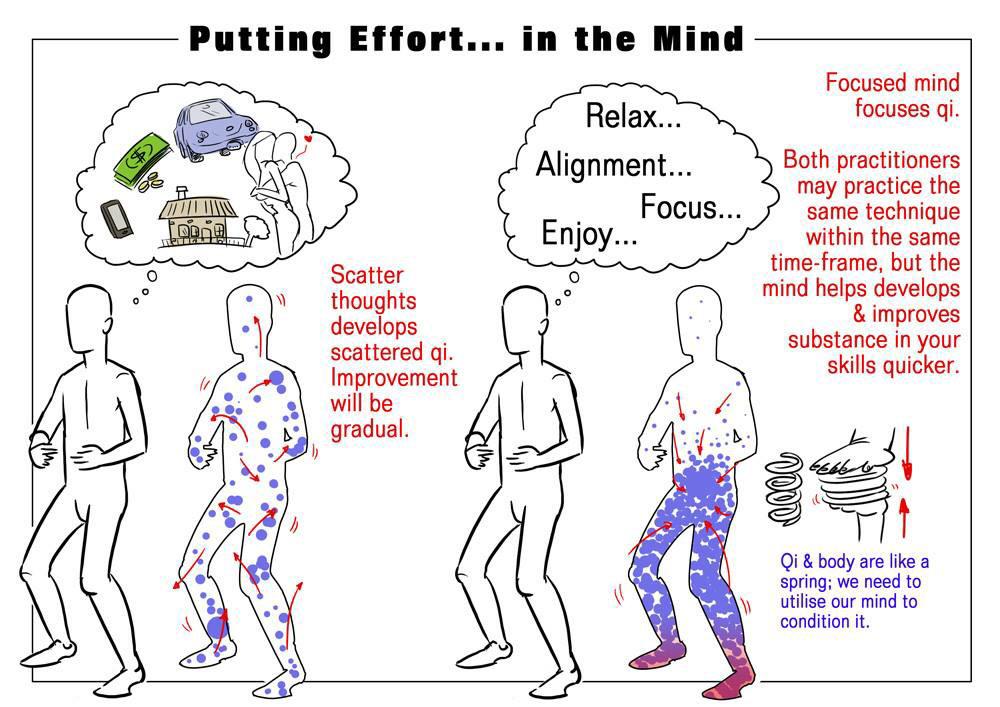
Now, first of all, if you think about all those statements being attributed to Qi, you can see that they're not really talking about Qi itself at all, but rather about how YOU process Qi.


 (It's not the Qi that's scattered, it's you)


It is technically correct, that from a 'practical' point of view, it doesn't immediately matter whether it's the Qi that's "bad" or your body that is "bad" due to your failure of cultivation and/or lack of Virtue.


However, in the bigger picture, there is an important difference! 

If people believe it's the Qi that's bad, they can go looking for magic potions and quick fixes and fake Wu or plastic new-age "taoists" who will do "energy cleanses" that will "fix their Bad Qi".
 

On the other hand, if they realize Qi is Qi, and the problem is THEMSELVES, they might understand that the only way to fix the problems are by their own discipline and virtue.
So that's a HUGE difference.

Sunday, March 21, 2021

Can Qi Really go "Stale"?


Qi is really just Qi. But at times it is useful in speaking about Qi, in the context of things like Qi Gong, cultivation practice, esoteric studies or traditional healing to describe particular interactions of Qi with our body or our consciousness through the use of metaphorical conditions. However, this has led over the  years to different systems or teachings in esoteric schools to end up using a variety of terms, like "positive qi", "negative qi", "Yin Qi" or "Yang Qi", "Natal Qi", "Active Qi" or "Stale Qi"; but all of these gradually came to be thought of as different "types" of Qi, which is inaccurate. 


As an example, let's consider the example of "stale Qi":

 There are two ways to understand Qi in any way that Qi could be said to be 'stale'. The term is a deceptive because it implies that it is the Qi that is bad or corrupted or in some sense different from normal Qi.

The first is in the sense of physical well-being, where if someone has failed to be natural for a long time, developing harmful physical habits that lead to physical tension, a failure to breathe naturally, tightness/restriction of the body in varied ways, then the circulation of Qi through the body is not open and fluid, and so Qi will tend to accumulate only in certain areas of the body and not others, leading to physical disharmony. Notice that it is not in fact a problem with Qi, or that Qi is any different, it is a problem with the body and its ability to be open and receptive and fluid in relation to Qi.

The second is in the sense of understanding Qi not only as life-force but as Will. Our will is directed to certain things. We put our will into certain things. This includes things that must be done in the immediate sense, like very ordinary things, and also things that we are trying to achieve in a bigger sense, but it also means anything we've intentionally or unintentionally invested ourselves in. This investment means that some of our will, our Qi, will be directed in certain ways, and normally this isn't a problem, it's perfectly normal.  But if we have invested our will into things that we cannot resolve, into things that are unreal, or things that are no longer real, our attention and our emotions (fear or desire) and our mind and our pain clinging to those things in spite of their unreality, then the Qi gets locked in to being invested in that. Part of our will is stuck there. 

That manifests also in the body, as tension (tension here meaning anything from physical rigidity to posture, to breathing, to other symptoms like sleeplessness or intestinal troubles, to serious disease). The Qi there is 'stale' because it is stuck clinging to something unresolved and that cannot ever be resolved in the usual way. Once again note that the problem is not with Qi, or that the Qi is different, but rather a problem that our mind is locking-in our Qi, limiting its fluidity because of our obsessions.

So the ways to resolve these sorts of problem are either by physical practice (Qi breathing) or by Virtue (through self-inquiry). The former uses the body to loosen the bonds of the mind, the latter uses awareness to loosen these bonds. Typically, a combination of both is best.

Wednesday, April 25, 2018

Do Kanye & Trump Really Have "Dragon Energy"?

Today, rap musician Kanye West caused some controversy on social media for coming to the defense of Donald Trump on Twitter, something that must be a surprise to many of his fans, and was clearly a surprise to a great many political commentators.

His Tweet was interesting because of the reason why he expressed sympathy for Trump: he stated that he and Trump "are both Dragon Energy". 


This was a  bit of an amusing surprise for me to read. And it's very likely that Kanye did not intend to refer (at least not consciously) to the ideas of the School of Yin and Yang or to Qi Gong terminology of the I Ching. But it leads to an amusing question: let's assume that IS what he meant... is he right? Do Kanye West and Donald Trump both have "dragon energy"?


In the terminology of Qi, different forms of Yin and Yang have traditional associations to different animals.

So for example,  the Mare is associated with the World trigram, the three Yin lines.
The Moon trigram with it's "fat middle" is associated to the boar. The Air/Wind trigram to the Tiger, with it's one-yin-line tail at the end of it's two yang-line body.

And the Heaven Trigram is the Dragon. The power of great Yang.


So if someone is full of "dragon energy" what would that say about them? Well, it is:

-Extremely forceful

-Creative

-Filled with confidence

-Prone to risk-taking

-Potentially arrogant

-Defiant of any opposition to their goals

-Unconcerned with blame or praise from others

-Unwilling to show fear or uncertainty

-Extremely effective at accomplishing their goals

-Boastful

-Brave

-Extremely determined in their beliefs

-Aggressive

-Rarely open to criticism

-Regal

-Ambitious to ascend in life

-Strong, and also concerned with the appearance of strength

-Assertive

-Favoring action over contemplation

-Favoring reason over feelings

-Unwilling to submit/surrender to anyone

-Insistent on their own self-expression

-A lover of life and life's pleasures

-A dreamer

-Interested in the Big Picture, less interested in minor details

-Tending toward intense relationships, demanding loyalty

-Protective of family and loved ones

-Tend to be spiritual but not conventionally spiritual


Dragon energy in this form is all Yang and no Yin, so unless it is counterbalanced by Yin people or Yin cultivation, it will tend to cause disharmony and instability. 


So, what do you think? Does it sound, based on what Dragon Energy is, that Kanye and Trump both have it?


And if so, is that a good thing?


Wednesday, February 8, 2017

How to Understand "Relaxation" in Yi Fa Qi Gong


This is a very useful video to understand some of what I mean with regards to 'relaxing' into Qi Gong practice. Although it's obviously being presented from the point of view of martial arts, it's coming from a tradition that makes some use of Qi Extension, and thus it relates to some of what we talk about in the Yi Fa Qi Gong practice.
 
Note that I'm not saying you need to do these stretches in particular (you could if you want to, but they're geared toward martial arts practice), I'm saying pay attention to what he's talking about just what 'relaxation' means.
 
People tend to tense up their muscles, while in Qi Gong the point is to keep the musculature relaxed while still holding an internal firmness. So I've found it's very important to remind people to relax while they practice; holding tension in the musculature makes it very ineffective for Qi circulation. But at the same time, this doesn't mean to be all floppy; the POSTURE is firm, the musculature is relaxed (and the breathing is relaxed as well).
There is a parallel in this when it comes to one's consciousness during the practice; you do not want to be mentally tense while you practice. You DO want to be in the Active Consciousness, but this means being very present in a very relaxed way!
 
Also note what he's talking about "mind" and "putting the mind into the body". When he says "mind" he's talking about what in Yi Fa Qi Gong we call "active consciousness". When you are really present in the active consciousness, your body is not tense, your mind is not tense, but you are fully connected in the body and so without any great effort other than that attention you are able to be in good control of your posture and movements.


Tuesday, October 18, 2016

Qi, Gong, Spirits, and Magick

 (The following is an excerpt from a teaching to a Yi Fa Society student, who had inquired about the role of spirits in the Yi Fa system, compared to the important role spirits play in western magick. Its relevance is mainly for students who are working at Level 2, but may be of interest to those in Level 1 of the Yi Fa Curriculum or to non-members curious about the relationship between the Yi Fa Curriculum, which is in essence a system of mysticism/magick inspired by Eastern cosmology, and the traditional systems of western magick in the hermetic tradition)


"First, I have to preface by saying that you should not under-estimate Qi.
Qi is only 'kind of weak' compared to Gong.
In fact, Qi can be used to do all sorts of things.
Qi, when it is applied to cultivation practice, is essentially a measurement of Will. If you consider in western magick just how important Will is, you also have an idea of just how important Qi is.

Gong, on the other hand, represent a measurement of one's "Enlightenment Quality".
It doesn't measure Will, it measures Consciousness.

The difference in the 'power' of these two is that Qi can change things in reality, while Gong can change reality itself. Qi is limited by the particular environmental conditions found in nature/reality at a given time; Gong is limited only by the laws that make up nature/reality.

Spirits, like humans, contain Qi and can manipulate Qi.
Like humans, they can also potentially receive Gong. Although it is usually impossible for them to do so without some form of human intervention.

Think of it like this: in western magick, planetary spirits, angels, demons, whatever you want to call it, have their own power. But they generally can't actually accomplish miraculous effects without the human intervention of the magician. In Buddhism and Hinduism you see the same: the power of the Buddha requires human intervention.

So the formula in western magick is that spirits (of whatever type) have power in their own domains, sometimes immense power, but to be able to make Change occur, it depends on human beings interacting with them. And yet, human beings can only EFFECTIVELY interact with them if they first have the 'Authority" to do so. That "authority" being either their own level of Enlightenment or the obtaining of authority through a divine hierarchy: for example, a (regular) magician trying to do evocation must first perform an Invocation of Adonai, Adonai himself is the link to YHVH; so first the magician goes up the hierarchy, through Adonai to YHVH, gets the authority, and then can summon and bind the demon by that authority.
An Adept, because of their level of attainment, has a kind of permanent authority, so they can do this with much less effort.
Note: for "Adonai" and "YHVH", you can also supplant with the current of THELEMA, and its entities/formulae in modern magick.

In the YI FA system it works much the same way.
So spirits can be summoned. They must be directed through the authority of the cultivator, that authority must come from the Taiji, through the authority of the YI FA current (which is coequal to the current of Thelema).
Spirits can then be of assistance.

Spirits could also receive gong, in theory, if connected in some long-term way to a cultivator; but this is usually not a good situation, because it is Gong that they are getting from in essence doing the practitioner's cultivation for them.  Thus it is Gong they get that the practitioner does not. This only happens when a practitioner is using a spirit in a bad way (as a short cut to their own cultivation), so you probably don't need to worry about it right now.  More information about this sort of thing is detailed in Level 3.

One of the key differences between the Yi Fa system and western magick is that western magick is far more externally focused.  Yi Fa recognizes the existence of and utility of spirits, but places internal cultivation and internal power first and foremost. Spirits can be used to try to achieve change that the one's own internal Qi cannot so easily accomplish, but this is something to do in those sorts of specific circumstances and not as a first option. Thus the Yi Fa system always puts your own consciousness and ability first and foremost.


(if you are interested in joining the Yi Fa Society and working its curriculum, which is a complete system of esoteric training, please contact me!)

Sunday, November 22, 2015

When, Where and How to Practice Qi Gong


There are many things that can affect your ability to process Qi, most of these internal. What in Qi Gong is often called your 'enlightenment level' (just how Conscious you are), your physical health, whether or not you are under stress, how many distractions there might be and whether you allow them to be distractions, your will (to "show up" for the practice and do it with your main consciousness), and of course the cultivation of Virtue.

And it is important to note that ALL phenomena are 'natural' phenomena from the perspective of Yi Fa, so there is no special advantage in and of itself between practicing on a mountaintop or practicing in the middle of a mall. But of course, that difference could cause differences in those internal conditions I already mentioned. If where you are is more appealing to you, changes your stress level, makes you more willing to show up, etc, it will put you in a better frame of practice. So the golden rule is: do Qi Gong where you feel most inclined to do it, if possible (but above all else, DO QI GONG, do it every day, regardless of whether circumstances are ideal).

There is one external difference that is more important than any other I have found: Qi Gong practice is much more effective if done in a space that has some kind of opportunity for circulation of air. So if you are doing Qi Gong in a place with all the doors and windows closed, it will be less effective. If you are doing it in a small room with the door locked it will be less effective than doing it even in a bigger room with a door to some other rooms open. Practicing in a big indoor space, or outdoors, is more effective than in a small enclosed space.

(the former is from a letter to a Yi Fa Society student.  If you are interested in personal training in Qi Gong and the whole system of internal alchemy worked by the Yi Fa Society, please contact me regarding membership)


Monday, September 28, 2015

Qi Breathing

Correct breathing is an essential part of Qi Gong.  The most fundamental practice in Yi Fa Qi Gong is not any of the movement exercises, but rather the regular practice of Qi Breathing.  Fortunately, Qi Breathing is very simple to learn and practice, and can be done at almost any moment throughout the day, allowing the student to cultivate and effectively circulate the Qi drawn into one's being during the practice of the formal exercises.   The essential secret to effective Qi Gong practice is regular Qi Breathing, not only during the practices but throughout the day at various times.


Even if you do not develop a regular practice of Qi Gong, Qi Breathing is a useful practice to do in any circumstance and lends itself to both physical well-being and to an enhancement of general consciousness.