Bagua

Bagua
Showing posts with label Yin and Yang. Show all posts

Sunday, March 21, 2021

Can Qi Really go "Stale"?


Qi is really just Qi. But at times it is useful in speaking about Qi, in the context of things like Qi Gong, cultivation practice, esoteric studies or traditional healing to describe particular interactions of Qi with our body or our consciousness through the use of metaphorical conditions. However, this has led over the  years to different systems or teachings in esoteric schools to end up using a variety of terms, like "positive qi", "negative qi", "Yin Qi" or "Yang Qi", "Natal Qi", "Active Qi" or "Stale Qi"; but all of these gradually came to be thought of as different "types" of Qi, which is inaccurate. 


As an example, let's consider the example of "stale Qi":

 There are two ways to understand Qi in any way that Qi could be said to be 'stale'. The term is a deceptive because it implies that it is the Qi that is bad or corrupted or in some sense different from normal Qi.

The first is in the sense of physical well-being, where if someone has failed to be natural for a long time, developing harmful physical habits that lead to physical tension, a failure to breathe naturally, tightness/restriction of the body in varied ways, then the circulation of Qi through the body is not open and fluid, and so Qi will tend to accumulate only in certain areas of the body and not others, leading to physical disharmony. Notice that it is not in fact a problem with Qi, or that Qi is any different, it is a problem with the body and its ability to be open and receptive and fluid in relation to Qi.

The second is in the sense of understanding Qi not only as life-force but as Will. Our will is directed to certain things. We put our will into certain things. This includes things that must be done in the immediate sense, like very ordinary things, and also things that we are trying to achieve in a bigger sense, but it also means anything we've intentionally or unintentionally invested ourselves in. This investment means that some of our will, our Qi, will be directed in certain ways, and normally this isn't a problem, it's perfectly normal.  But if we have invested our will into things that we cannot resolve, into things that are unreal, or things that are no longer real, our attention and our emotions (fear or desire) and our mind and our pain clinging to those things in spite of their unreality, then the Qi gets locked in to being invested in that. Part of our will is stuck there. 

That manifests also in the body, as tension (tension here meaning anything from physical rigidity to posture, to breathing, to other symptoms like sleeplessness or intestinal troubles, to serious disease). The Qi there is 'stale' because it is stuck clinging to something unresolved and that cannot ever be resolved in the usual way. Once again note that the problem is not with Qi, or that the Qi is different, but rather a problem that our mind is locking-in our Qi, limiting its fluidity because of our obsessions.

So the ways to resolve these sorts of problem are either by physical practice (Qi breathing) or by Virtue (through self-inquiry). The former uses the body to loosen the bonds of the mind, the latter uses awareness to loosen these bonds. Typically, a combination of both is best.

Thursday, August 22, 2019

What Story is the I Ching Telling You?


There's really only one story that actually matters: the story of the journey of transformation.  All good stories are variations on it.

All hexagrams of the I Ching have within them a story of transformation. Each one tells its own little story. And when you combine them with other hexagrams in permutations, it's telling another story.
And when doing a casting its doing a very specific little story of transformation with regard to the one question you might have at this time.  While the whole King Wen sequence tells one great big story.


There were two schools in the period after the School of Yin and Yang, after Confucius, up to the Han Dynasty. These schools were rivals, I've spoken of them before. From that school of inner alchemy, there was a division into two forms of interpretation: Image and Number, and Meaning and Principle.


Image and Number focused on the line structures, trigrams, positions of things, mathematics of the I Ching, the elements, the cosmology. All of that was the focus of the School of Image and Number.
The school of Meaning and Principle looked at it a different way, saying that what mattered was the spiritual/philosophical teaching in the I Ching and that this was found by considering and interpreting the text, rather than the image or the mathematics/cosmology.

I've commented on the imperfection of both of those schools before.

Regardless, the value of what came out of the school of Meaning and Principle was a different approach to looking at groups of hexes, not based on their structure of lines and trigrams, but in terms of the text and grouping various hexagrams based on their common themes.  In other words, to look at the stories they tell.

If you do this in combination with the structural elements of the hexagrams, this is the best way to apply your studies in I Ching structure and cosmology to a more grounded and human element of connecting to that personal story of what one must do on a journey of transformation.

Wednesday, April 25, 2018

Do Kanye & Trump Really Have "Dragon Energy"?

Today, rap musician Kanye West caused some controversy on social media for coming to the defense of Donald Trump on Twitter, something that must be a surprise to many of his fans, and was clearly a surprise to a great many political commentators.

His Tweet was interesting because of the reason why he expressed sympathy for Trump: he stated that he and Trump "are both Dragon Energy". 


This was a  bit of an amusing surprise for me to read. And it's very likely that Kanye did not intend to refer (at least not consciously) to the ideas of the School of Yin and Yang or to Qi Gong terminology of the I Ching. But it leads to an amusing question: let's assume that IS what he meant... is he right? Do Kanye West and Donald Trump both have "dragon energy"?


In the terminology of Qi, different forms of Yin and Yang have traditional associations to different animals.

So for example,  the Mare is associated with the World trigram, the three Yin lines.
The Moon trigram with it's "fat middle" is associated to the boar. The Air/Wind trigram to the Tiger, with it's one-yin-line tail at the end of it's two yang-line body.

And the Heaven Trigram is the Dragon. The power of great Yang.


So if someone is full of "dragon energy" what would that say about them? Well, it is:

-Extremely forceful

-Creative

-Filled with confidence

-Prone to risk-taking

-Potentially arrogant

-Defiant of any opposition to their goals

-Unconcerned with blame or praise from others

-Unwilling to show fear or uncertainty

-Extremely effective at accomplishing their goals

-Boastful

-Brave

-Extremely determined in their beliefs

-Aggressive

-Rarely open to criticism

-Regal

-Ambitious to ascend in life

-Strong, and also concerned with the appearance of strength

-Assertive

-Favoring action over contemplation

-Favoring reason over feelings

-Unwilling to submit/surrender to anyone

-Insistent on their own self-expression

-A lover of life and life's pleasures

-A dreamer

-Interested in the Big Picture, less interested in minor details

-Tending toward intense relationships, demanding loyalty

-Protective of family and loved ones

-Tend to be spiritual but not conventionally spiritual


Dragon energy in this form is all Yang and no Yin, so unless it is counterbalanced by Yin people or Yin cultivation, it will tend to cause disharmony and instability. 


So, what do you think? Does it sound, based on what Dragon Energy is, that Kanye and Trump both have it?


And if so, is that a good thing?


Tuesday, January 16, 2018

On The Gender of the Eight Trigrams


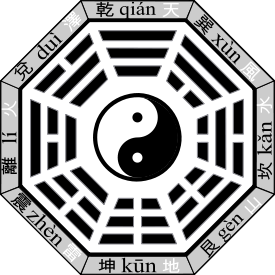
The 64 6-line Hexagrams of the I Ching are built on paired combinations of the 8 3-line trigrams (the bagua).  Thus, as the hexagrams represent all phenomena in the material world, the trigrams represent the eight fundamental elements, four terrestrial and four celestial elements.


These elements are equivalent to the four classical elements in Western esoteric symbolism. They are in essence a doubled-up version (with terrestrial and celestial/spirit equivalents) of Earth, Air, Water, and Fire.


However, there is one complicated detail about these elements versus their western equivalent that some students have brought up: in both systems, there is a traditional attribution of 'genders' to the elements. But these genders do not appear to 'match up'. Let's review the basics:

In BOTH Western and Eastern symbolism, there are fundamental Masculine/Feminine forces: Chokmah/Binah, Animus/Anima, Shiva/Shakti, Yang/Yin, etc.

In Western symbolism, Earth and Water are feminine, Air and Fire are masculine.

In Chinese symbolism:
Earth/Mountain is masculine
Fire/Thunder is masculine
Moon/primordial-Water is masculine
Heaven is masculine

Air/Wind is feminine
Water/Lake is feminine
Sun/primordial-fire is feminine
The World is feminine


Before continuing, you should note that there is a connection between the physical image of the trigrams and their traditional 'gender': all the 'masculine' trigrams require an odd number of brush-strokes to draw, while all the 'feminine' trigrams require an even number of brush-strokes to draw.  But the various masculine trigrams and the various feminine trigrams also have another thing in common with each other, which we will bring up below. 

So now, let's focus on what is clear: in both systems of esoteric cosmology, there is a force far more fundamental than the level of elements that gets identified as the fundamental Masculine and Feminine duality. These are Yang (masculine) and Yin (feminine).

And of course, even this is not literally about 'gender' in the sense of which we tend to think of it now. Rather, they embody all the notions of duality itself; the important thing about this idea from a cosmological point of view is that it talks about all the qualities that a product of the separation from a single indivisible state of Oneness. All of our material reality is produced by this notion of the division into dualism.

To explain: you can't actually define anything positively. All definition, at its most basic level (that is, when you try to get the definitions of definitions of definitions) comes down to defining things by what they are not. This is because our entire process of thought is based on dualistic thinking. There is white and black, hot and cold, moist and dry, passive and active, positive and negative, etc.
It is only at the highest levels of awareness, and not in the level of phenomena, that this can be transcended, through the mystical process described as the Union of Opposites.

So from the esoteric point of view, the gender consideration of masculine and feminine is really about Dualism.

When we get down beyond the level of yin and yang, we are adding more elements of complexity. So Gender at the level of yin and yang is simple: Yin is everything we can define as archetypal female and Yang is everything we can describe as archetypal masculine.

At the level of elements, the reason for the gendering of elements is something more complex.  And here we get to the reason for the difference in the genders of the elements in Western and Chinese symbolism: the complex quality that the former chooses to focus on is different than the complex quality that the latter chooses to focus on.

With the Western elements, the 'male' elements have the quality of active inherent motion, while the 'female' elements have the quality of inherent stillness.

Earth and Water may move, in an earthquake or a rockslide or down-river or pouring down a sink, but this is only in reaction to what is around them: water and earth are passive, they sink down until they can reach a point of rest. Thus, they reflect the quality of Passive or Receptive nature that is attributed to the Feminine. They are also tangible, of matter, they rest in the world.

Fire and Air, however, are in motion. They rise. They only exist in movement. If air has no movement it has no qualities at all (at least, from the classical perspective) and has become foul and deathly. If fire has no movement it is extinguished. Thus they reflect that quality of Active and Creative that is attributed to the Masculine. They are also intangible, you can't actually hold on to them, they have no matter.


In the Chinese system, however, the quality being looked at is not motion and stillness, which is so important to the Yang and Yin duality, but rather the qualities of "strength" and "softness".

The Mountain, the Thunderbolt/fire, The darkness of the Moon (or the deep dangerous waters of the abyss), and the power of Heaven are all considered to be 'strong' forces.

The gentle Airy breeze, the still Lake, the warm clinging light of the Sun, and the receptiveness of the World are all considered to be "soft" forces.


So both classifications of these are examples of how to classify duality, but they focus on different aspects of duality.  This is because the purely Masculine and purely Feminine are absolutes. They do not exist anywhere in material reality; where they get closest is in Heaven and The World, but in all aspects at this dimension of reality, all phenomena contain a combination of Yin and Yang. They are a mix of the forces we call 'masculine' and 'feminine'. Depending on which aspects of the male and female you want to observe, there are thus different ways to categorize them.


Wednesday, September 20, 2017

An Explanation of The Generation of Changing Lines

In the system of the yarrow method of I Ching casting, when you have two small piles of yarrow and one large pile, that is a Yin line (the Yin being the 'small' piles), and when you have two large piles and one small pile, that is a Yang line (the Yang being the 'large' piles).

So some students of the I Ching have expressed confusion as why three small (yin) piles would be a Yang changing into Yin, or conversely three large (yang) piles would be a Yin changing into Yang.


Imagine the image of the Taiji:


It is Yin and Yang, intermingling. Within the yin there is a centerpoint of yang; and within the yang a centerpoint of yin.

So at the very core of Yin is the most yin of anything possible; it is so overflowing with yin, that it takes on the nature of Yang.
Likewise at the very core of Yang is the most yang of anything possible; it is so overflowing with yang that it takes on the nature of Yin.

The former is in fact Yang that is inevitably transforming into Yin, that is the only direction it can go.
Likewise, the latter is Yin that is inevitably transforming into Yang.

So this is why in the casting, when you have three small (yin) piles, it is manifested as a Yang that is becoming a Yin.
And when you have three large (yang) piles, it is manifested as a Yin that is becoming a Yang.

That is the reason.
And the reason is reflected in the probabilities of the casting method, because these forces are not equal in nature; in nature Yin is more stable, so it is less common for Yin (the stable but weak) to become Yang (volatile but strong), than for Yang (strong, but volatile) to weaken into the more stable Yin.


"Weak but stable" are the valleys of space-time, "strong but unstable" are the peaks.

Thursday, June 22, 2017

Power and Success


To get power, you have to make room to receive it.
Power is something obtained when you are open to receiving, not when you are aggressive.
Only by being below can you give space for what is above to enter; if you try to make yourself tall it can't.

Power doesn't come from tension, tension has no power.
Power comes from a deep looseness, where energy isn't being all expended in tension.
That looseness allows flexibility, and can be in-tensified to create force when needed for a specific purpose.
A state of tension has no room to become more intense, has no reserves to apply force anywhere else.

To get power, you have to submit.
Then you can impose, and thus obtain success.

Friday, June 16, 2017

Video: The Power of the I Ching

Today's video takes a look at the underlying structure of the I Ching, and why it works.


If you are interested in more teachings and receiving information that goes deeper into the structure of the I Ching, the nature of space-time, and personal cultivation, please don't hesitate to contact me about joining the Yi Fa Society.

Wednesday, August 17, 2016

The Relationship Between "Spritual" and "Reality"

There is a great spiritual difference between spiritual teachings and religions that place the unmanifested above the manifested, and those that do not.  Just as there are materialistic philosophies which deny anything 'spiritual', there are also anti-materialist belief systems that deny the material in favor of something they choose to imagine as 'spiritual', separate from the material.

In ancient China, all three concepts existed.  There were strictly materialist philosophies that denied anything but the manifest, the "Yi-fa".  There were likewise many movements that wanted to envision the universe as a universe of immaterial 'spirit' and that the manifested world was either an illusion or a corruption, something inferior to the pure and unsullied 'spiritual world'.

But if you study the I Ching and the teachings of the great Sages, it becomes evident that neither of these are a correct reflection of reality.

This same conflict existed in many other places and times, with other names; certain "gnostic" sects in the west claimed that our world was nothing but an illusion.  The institutional forms of Buddhism made similar claims, many of them ascribing a higher position to some 'spiritual' world that the Buddha himself denied.

In The Magician's I Ching, I have detailed the story of the debate between Zhang Shi and Zhu Xi, and Zhu Xi's quest to achieve enlightenment as to the true nature of reality, and how to reconcile the difference between the unmanifested (Wei Fa) and the manifested (Yi Fa).  It is unsurprising that after coming to realization, Zhu Xi would strongly advocate the study and practice of the I Ching, because within it, it uncovers the truth of this relationship.

Some would-be mystics want to conceive of the nature of reality as a kind of top-down hierarchy where the lowest and least important level of reality is the manifested world.  But consider the I Ching: a hexagram contains, within it, the trigrams. Trigrams contain, within them, the Yin and the Yang.  Within Yin and Yang are found the Taiji (the undivided polarity). Within the Taiji is the the Wuji (the boundless), and within that boundlessness is Wu (emptiness).

Without trying to confuse scientific concepts with mystical ones, this can't help but bring to mind the nature of physical reality as we understand it today: how within objects there are molecules, those are composed of atoms, atoms are composed of protons and electrons, within those there are quantum particles, and inside all of this is empty space. Reality is not top-down, it is a whole, and that whole has layers, more fundamental and basic layers, and more complex outer layers.

This is the functioning of reality, and it is essential to understand if you are going to practice a real system of cultivation (because any spiritual practice not based on reality will not get you very far)!  The Manifested (Yi Fa) and the Unmanifested (Wei Fa) must of necessity both exist, they are both real, but the only place where the unmanifested can possibly exist is within the Manifested.  Wei Fa is not 'outside' or 'beyond' Yi Fa, it is only real within Yi Fa.

This is important to spiritual practice, because it means that Wei Fa, for the practitioner, can only be reached through the Yi Fa. You can't reject the body, reject the world, reject reality, and go off into some spiritual wonderland that is somehow beyond all that, because there is nothing to connect to there. You cannot find the Unity of all things by rejecting any thing. You have no tools to connect to the truly 'spiritual' if you ignore your body, your mind, your world, and your interactions with the world. This place, this world, our bodies, our awareness, all the things that exist in the manifested reality are the alchemical laboratory of our self-transformation. Without them, you can go nowhere. 

Wednesday, August 3, 2016

Understanding the Qualities of Yin and Yang


Why does Yin turn into Yang, and Yang turn into Yin?

Yang is forceful and powerful but inevitably exhausts itself. Yin is passive and accepting and through accepting gradually builds itself up.
(When Yang exhausts itself it will become Yin, when Yin builds itself up enough it will become Yang)

Yang is a "strong" power, but this means that it is more unstable. It is easier for it to change into Yin.
Yin is a "weak" power, but this means that it is very stable, it takes a lot for it to change to Yang.
This is also why it is easier in our reality for something strong to become weak than for something weak to become strong (the law of entropy).
Hence, Yin only becomes Yang when it is so totally 'full' of Yin that it cannot help but actually transform. 
And when Yang becomes 'too Yang', it will sooner or later break down into Yin.