Bagua

Bagua

Wednesday, January 4, 2017

Five Phases and Eight Elements


There's frequently some confusion in those who study Chinese mysticism/magick, in that there are eight trigrams in the I Ching, but in the greater system of esoteric teaching there is also something that is often defined as the "five elements". The initial and superficial similarity between this and the five classical elements of western esotericism (earth, air, water, fire and spirit) cause a lot of confusion.

Regarding the "5 elements": the problem that has caused this confusion relates to the use of the term 'elements'. Because what we usually call in English the 'five Chinese elements' are NOT in fact 'elements' in the sense of the five elements in western occultism!


The '5 Chinese elements' are actually five 'phases' in the cycle of generation to putrefaction.


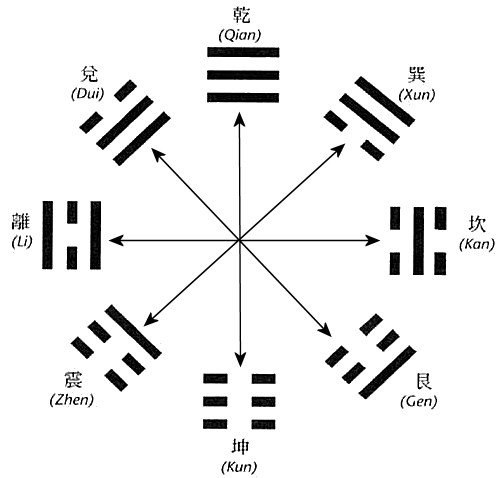
The equivalent of the five elements of western occultism (earth, air, water, fire and spirit) are the Eight Trigrams.  The eight trigrams are divided in two parts: the four terrestrial trigrams correspond to the elements of Earth, Air, Water and Fire; while the four celestial trigrams correspond to Spirit (you could say "spirit of earth", "spirit of air", "spirit of water" and "spirit of fire").


Then, the 5 chinese elements (the 'wuxing': wood, fire, earth, metal and water), which were most likely first developed in the alchemical teachings of the School of Yin and Yang (around 500 years after the Zhouyi text, the core of the I Ching, was written), correspond to the western 'alchemical elements' (Salt, Sulfur, Mercury). And likewise to the 3 gunas in Indian mysticism.


There are five of these, rather than three, because in the Wuxing system you have three process states (Wood, Earth, and Metal), and two transitory states (Fire and Water).  The process states represent Generation, Plateau, and Decline, while the transitory states represent the moment of peak Flowering and the moment of fullest Barrenness (that is to say, the peak-state and the nadir-state). 

Thus, while the Five Phases look similar to the Five Western Elements, it is in fact representing a totally different esoteric concept, much closer to that of the "alchemical elements" of western occultism.  And it is the Eight Trigrams which are the equivalent of the elements of western occultism.


So you see similar concepts, presented in different ways. Like different languages to describe similar concepts.

This is because the thing being studied is real; it is based on the study of reality, the natural universe, and the universal human condition. So the findings will be the same. But the expression will be different because of differences of distance, history and culture. 

This is discussed a bit further in teachings of Levels 2 and up of the Yi Fa Society.

Wednesday, December 28, 2016

I Ching Question: Why is Heaven Cold and the World Warm?

I am often asked questions regarding the I Ching, about specific hexagrams, and sometimes also the trigrams. This has been particularly true since the publication of The Magician's I Ching or the creation of the popular Facebook Group related to it.

One I have been asked more than once is on the subject of the various attributes of the Trigrams.  And of these, maybe one of the most common questions is why it is that the Heaven trigram is called 'cold', while the World is called 'hot'.


Westerners I think tend to imagine Heaven, being masculine, is warm; and Earth, feminine, is cold.

But in the traditional attributions of the Trigrams, it is very clearly laid out: Heaven is 'light' and 'cold', while Earth (being womb-like) is 'dark' and 'warm'.


If you imagine Heaven, think of it as the highest greatest peak, the extreme of space. It thrusts outward, far and high. It is shining with light. But it is exposed, out there. The highest peaks are cold.

On the other hand, imagine the World as deep, receptive, it is as low as possible, it is the ground and under the ground. It is dark like a cave, or like a womb. And in these depths is found warmth. 


This also has to be understood in the context of the other two Celestial Trigrams: Sun and Moon.

Sun is fire, bright and hot.

Moon is water, dark and cold.


Thus, you can see how the four celestial elements balance each other out: two are bright, two are dark. Two are warm, two are cold.


Monday, December 19, 2016

Zhuge Liang and the Stone Maze

While Zhuge Liang did not follow the same teachings as the Yi Fa descends from, he was a true master of the I Ching.  Liang was a famous general and prime-minister during the period in Chinese history known as the "Three Kingdoms" period, after the fall of the Han dynasty, when China split into three warring states in the early part of the 3rd century AD.  He was the Prime Minister of the state of Shu, one of the three Kingdoms. He was also famed as one of the greatest strategists of all Chinese history, comparable to Sun Tzu (who is more famous in the west).


In the stories relating to the wars between the three kingdoms, there is a famous account of Zhuge Liang making use of the power of the I Ching in magick to confound his enemies.  In of the many military campaigns, Liang's King, Liu Bei, was defeated in battle against an enemy general. His army retreated toward a famous temple-complex called Baidicheng, where Zhuge Liang was waiting. While the troops escaped, Liang arranged a set of stones into 64 piles, of about 5ft in height each. The pattern he arranged them in was corresponding to the arrangement of the eight trigrams of the I Ching. 

When the enemy general arrived, he felt the presence of heavy Qi in the area. He suspected a trap but saw only the strange field of stones. He chose to enter it with his men, thinking it some kind of cheap trick.

But once they'd entered, they suddenly found that the stones seemed like vast mountains. The mists of the temple seemed like a storm of cloud and dust. The men were soon totally bewildered, like in a maze.

They would have perished there, had it not been for an old man who appeared in the maze, Liang's father-in-law. He guided the general and his men out, explaining that Liang had created the maze with his understanding of the eight trigrams and the mysteries of the elements, and that only through understanding could one make one's way through it.  The enemy general, realizing that Zhuge Liang's superior wisdom was unbeatable, chose to halt and turn back from his invasion of the Shu kingdom.

This story is meant to be allegorical, about the maze-like qualities of the contemplation of nature and the eight trigrams and 64 hexagrams, and the gifts that it's contemplation can provide.
However, it is also not solely allegory. The Stone Maze was a real place, found at Baidicheng, where remnants of it had survived all the way until modern times, and had been visible until the area was flooded by the construction of the Three Gorges Dam.

Friday, December 9, 2016

More on the Cultivation of Virtue


Virtue ("De"), in the context of the Yi Fa work, should not be mistaken for some kind of an idea of absolute morality, or an abstract and impractical set of ironclad religious rules.

Virtue involves the encouraging of a set of qualities, embodied as Yuan Heng Li Zhen, of the growth of those qualities as a substance within one's being.  To encourage and cultivate, through actions, Union, Discipline, Harmony, and Truth. 

What it is really about is being able to act in a way that is:
a) connected to the rest of the world (not shut inside yourself)
b) able to focus and be effective (not dithering or lost in the mind or distracted)
c) balanced and harmonious within yourself and on the outside (as opposed to being divided inside, and wavering from totality on the outside)
d) dealing with things as they really are, right now (and not driven by fantasies or desires or frustrations/fears of the past)

So how do you work these things?
a) by working on connecting to the world and engaging in it
b) by working on a disciplined routine in your activities, including a spiritual discipline.
c) by working on putting an emphasis on those parts of yourself and your life that you are weaker in, rather than hiding only in the ones you are stronger at. Also, by meditation.
d) by committing yourself to honesty and sincerity, and with dealing with things in life as they are rather than running away from them.

Friday, November 25, 2016

Four Virtues, Four Approaches to the I Ching


In the study of the I Ching through the Yi Fa Society, a great deal of emphasis is put on the cultivation of Virtue ("De").

Virtue is here symbolized by the first four words of Hexagram #1 of the I Ching: Yuan Heng Li Zhen.  These words mean "Sublime Celestial Forces in Motion".  But they are also representative of the four facets of Virtue emphasized in Yi Fa cultivation: Union, Discipline, Harmony, and Truth.

These four concepts are also esoterically connected to the sixiang, the four bigrams of two lines which exist at a more primordial cosmological level to the eight trigrams. In esoteric symbolism these are represented by the icons of an Azure Dragon, a Black Turtle, a Vermillion Bird, and a White Tiger. These symbols are further explored in the higher levels of the Yi Fa Curriculum.


Reflected in the concept of these four cardinal facets of Virtue, you can also understand that there are four key approaches to understanding and interpreting the I Ching. These are Image, Number, Meaning, and Principle.

Historically, during the Han era there were two rival schools of I Ching study, the "Image and Number" school, and the "Meaning and Principle" school. Later schools under the inspiration of Yidao masters like Shao Yong and Zhu Xi reintegrated these into unified study.

"Image" involves studying the structure of the I Ching hexagrams and their component trigrams themselves, and the images these evoke. "Number" involves a study of the mathematical systems of the I Ching and their numerical structures. "Meaning" involves an interpretation of the textual descriptions of the Hexagrams and their lines. And "Principle" involves contemplation on the philosophical significance of the text in terms of it's significance for attaining to the Superior Individual.

With the four facets of Virtue, there can be times when emphasizing a certain facet can be important, but it is ultimately essential to cultivate all four facets if one is to achieve higher-level attainment.  Likewise, with the study of the I Ching, it can be useful at certain times to engage with in-depth specific study of one of the four approaches to the I Ching, it is ultimately necessary to engage in all four methods of study to gain a full and profound understanding of the I Ching's mysteries.

Tuesday, November 15, 2016

The Curriculum of the Yi Fa Society, Level 3

Each level of the Yi Fa Society has its own curriculum, with new material presented for the student's growth, practice and study.  Previous entries already detailed the Curriculum of Level 1, and Level 2.

The Curriculum of Level 3, in brief, consists of the following points:

1. The "Great Book of Yi Fa": a 95-page "secret text", this book elaborates on some of the mysteries already revealed about the philosophy of Yi Fa, the practices of Yi Fa Qi Gong, and the great work of Enlightenment (personal and universal).

2. The Guide to the Taijitu:  this short text consists of an explanation of the Taijitu, the I Ching cosmology's equivalent of the Qabalistic Tree of Life (though it is in fact older than the Tree of Life), and how the different dimensions of manifested reality unfold.

3.  The Level 3 Yi Fa Qi Gong exercise. This is a secret exercise taught only to members of level 3 of the Yi Fa Society program.

4.  The Zhong Yong: a 9-page text on cosmology, philosophy and virtue, revealing the nature of the Middle Pillar.

5. An exercise for understanding the Image of the Hexagrams.

6. The basic instruction on the techniques of Qi Extension.


These advanced teachings are only available to those students who are members of the Yi Fa Society and complete the Level 1 & 2 curriculum.

If you are interested in membership in the Yi Fa Society, please contact me!

Wednesday, November 9, 2016

On Contemplating The Illusion of Human Control


Everyone on earth
feels like they don't know what they're doing with their life
feels like they are out of control
feels like they're wearing a mask

That is because it's true.
No one knows what they're doing with their life
no one is in control of their life
everyone is wearing a mask to be able to speak to others

The Enlightened one is not
the guy who knows
the guy who is in control
the guy who has no mask

The Enlightened one is the guy who realizes
there is no way to know what you're doing
you just have to go with it
there is no way to be in control
you just have to jump
there is nothing behind the mask
but if you see this you can wear any mask you like

People grasp at the Tao
like a falling man grasping for a parachute

But the Tao isn't a parachute
It's the sky

The bad news is
you are falling and there is no rescue
you can fight to slow your descent but you can't stop
there is nothing to grab on to.
You can glide a little but you cannot fly.

the good news is
There is no ground.