In this latest video, I give you some guidelines as to how you should study the text and structure of the I Ching to maximize your ability to understand it!
Bagua

Showing posts with label divination. Show all posts
Showing posts with label divination. Show all posts
Tuesday, October 13, 2020

Saturday, March 14, 2020
Time and the I Ching
What is the nature of Time? The I Ching seeks to explain that.
This is important for understanding your own spiritual cultivation, as well as to understanding how Divination works, and why!
Wednesday, July 10, 2019
The Time Travel of the I Ching
Enter the stream of the I Ching through its symbols.
The I Ching shows that time is like a forest, full of change.
The present is just the place you are at in the forest.
All the steps you took through this forest up until now have put you on this point in the path.
The direction they lead you in points toward where on the path you are heading; this is the future.
If you want to change the future, change it before it happens.
If you want to change the past, change your response to the choices you made in the past.
Saturday, January 5, 2019
Can You Use the I Ching for "Trivial Purposes"?
I have often had students ask me whether it's proper to use the I Ching for 'trivial' questions.
The question usually comes from the defining of certain types of questions as important, and others as unimportant. Sometimes it involves the notion that the I Ching should only be used for questions of Spiritual importance, or deep profound life-decision questions about one's purpose or higher self.
So I am asked, for example, if it is acceptable to ask about lost keys or some problem at work or how things will go at a football game, etc.
So my perspective is that this is absolutely acceptable to do; but I think what we need to define is the difference between something being "mundane" and something being actually "trivial", in the context of the I Ching.
The point isn't that the I Ching can't be used for everyday ordinary things. In fact, the I Ching can be greatly useful for mundane questions. You can use it for everyday subjects, even minor questions or doubts, or nearly-inconsequential problems.
However, where you can't use it is for something that's "trivial" in the sense of being a question you don't really care about.
That's true whether the question is about something very mundane or something of great cosmic, spiritual or life significance.
This is the secret of understanding whether a question is trivial or not: it's not about the subject matter but about whether you have anything actually invested in the subject matter.
If you don't have a sense of the question actually mattering to you, then you should not do an I Ching casting about it.
Note: the idea that "you shouldn't do it" is not in the sense that it would somehow 'dishonor' the I Ching or that it is some kind of spiritual taboo or will cause bad karma or anything along those lines. It's simply that you shouldn't do it because if you don't have some kind of of sense of investment in the question beyond mere curiosity, the casting won't actually work for you.
You need to have some level of caring about the question asked beyond just mere curiosity. It has to matter to you a little more than that, whether it's at the level of something where you just have a strong feeling of wanting an answer even if the casting won't have any real consequence, all the way to "this casting is a matter of life and death". As long as you have investment, as long as there's skin in the game, regardless of the scale or whether the question is incredibly mundane or cosmically profound, the casting will be able to function.
Otherwise, the casting really will be "trivial".
The question usually comes from the defining of certain types of questions as important, and others as unimportant. Sometimes it involves the notion that the I Ching should only be used for questions of Spiritual importance, or deep profound life-decision questions about one's purpose or higher self.
So I am asked, for example, if it is acceptable to ask about lost keys or some problem at work or how things will go at a football game, etc.
So my perspective is that this is absolutely acceptable to do; but I think what we need to define is the difference between something being "mundane" and something being actually "trivial", in the context of the I Ching.
The point isn't that the I Ching can't be used for everyday ordinary things. In fact, the I Ching can be greatly useful for mundane questions. You can use it for everyday subjects, even minor questions or doubts, or nearly-inconsequential problems.
However, where you can't use it is for something that's "trivial" in the sense of being a question you don't really care about.
That's true whether the question is about something very mundane or something of great cosmic, spiritual or life significance.
This is the secret of understanding whether a question is trivial or not: it's not about the subject matter but about whether you have anything actually invested in the subject matter.
If you don't have a sense of the question actually mattering to you, then you should not do an I Ching casting about it.
Note: the idea that "you shouldn't do it" is not in the sense that it would somehow 'dishonor' the I Ching or that it is some kind of spiritual taboo or will cause bad karma or anything along those lines. It's simply that you shouldn't do it because if you don't have some kind of of sense of investment in the question beyond mere curiosity, the casting won't actually work for you.
You need to have some level of caring about the question asked beyond just mere curiosity. It has to matter to you a little more than that, whether it's at the level of something where you just have a strong feeling of wanting an answer even if the casting won't have any real consequence, all the way to "this casting is a matter of life and death". As long as you have investment, as long as there's skin in the game, regardless of the scale or whether the question is incredibly mundane or cosmically profound, the casting will be able to function.
Otherwise, the casting really will be "trivial".
Wednesday, September 20, 2017
An Explanation of The Generation of Changing Lines
So some students of the I Ching have expressed confusion as why three small (yin) piles would be a Yang changing into Yin, or conversely three large (yang) piles would be a Yin changing into Yang.
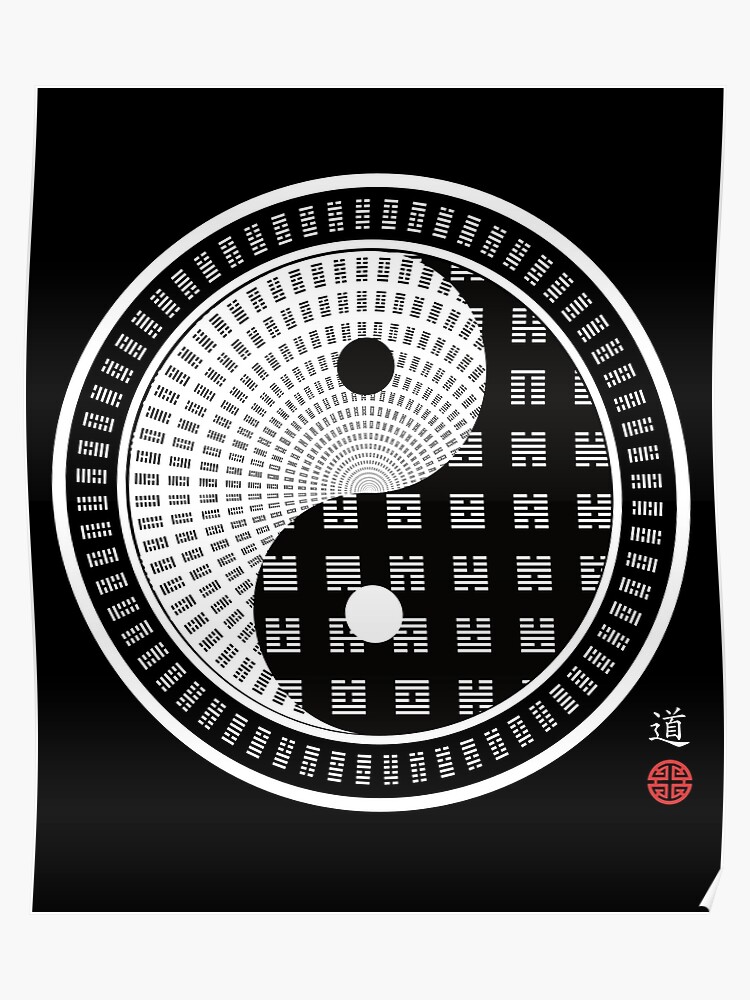
Imagine the image of the Taiji:

It is Yin and Yang, intermingling. Within the yin there is a centerpoint of yang; and within the yang a centerpoint of yin.
So at the very core of Yin is the most yin of anything possible; it is so overflowing with yin, that it takes on the nature of Yang.
Likewise at the very core of Yang is the most yang of anything possible; it is so overflowing with yang that it takes on the nature of Yin.
The former is in fact Yang that is inevitably transforming into Yin, that is the only direction it can go.
Likewise, the latter is Yin that is inevitably transforming into Yang.
So this is why in the casting, when you have three small (yin) piles, it is manifested as a Yang that is becoming a Yin.
And when you have three large (yang) piles, it is manifested as a Yin that is becoming a Yang.
That is the reason.
And the reason is reflected in the probabilities of the casting method, because these forces are not equal in nature; in nature Yin is more stable, so it is less common for Yin (the stable but weak) to become Yang (volatile but strong), than for Yang (strong, but volatile) to weaken into the more stable Yin.
"Weak but stable" are the valleys of space-time, "strong but unstable" are the peaks.
Thursday, March 9, 2017
What to Know Before You do an I Ching Casting
The I Ching can be used to for divination about literally any subject. It is said that it covers all possibilities within the "world of 10000 things" (the manifested reality in which we exist). So it's not just for thinking about very profound or advanced 'spiritual' questions. It's also not just for thinking about very mundane and ordinary subjects (romance, relationships, family, money, business, etc). It can be equally effective for any of these things!
And yet, some I Ching castings end up working 'better' for the caster than others. Why is that?
First, of course, is the level of training and understanding one has in working with and interpreting the I Ching. The more you study it, and the more you consider its form, its text, its whole system, the better you'll get at using it. That part is pretty obvious (even though for some reason, many people never bother to go beyond the most basic level of understanding with it, even if they use it a lot; I've met some people who have used the I Ching fairly regularly for years and never even actually read the whole text!).
But whatever your level of training and understanding with the I Ching, there is also the fact that sometimes you will do castings that will seem to 'work' really well, providing you clear understanding of the question you are asking, and at other times, it will seem like the answer you get doesn't 'work' for you at all (in the sense that you aren't able to get a clear answer, or that what you get in the casting doesn't seem to be right).
Here are things you need to keep in mind when you are considering doing an I Ching casting about a question:
1. What is the level of Necessity for the casting? Is this something that you do not have a clear idea about without casting for it? Is there a strong emotional sense of intensity to seek out the answer?
2. Do you have the sense that there is something you may be missing, that you hope the I Ching could clarify?
3. How likely are you to interpret the casting objectively?
4. How open will you be to proceeding with the advice the I Ching may present to you?
None of these are points that should necessarily be taken as reasons not to do a casting. But they should give you an idea of whether you're really at the right spot to do the casting or not, and sometimes they may lead you to change your attitude about the casting you are about to perform, before you engage in it.
The more intense the necessity is for a casting, the more likely that it will be fruitful.
The more clear you are about what it is you are needing from the casting, the more accurate the casting is likely to be.
The more you prepare yourself to be objective in your analysis of the casting, the more likely that you will not mislead yourself in your interpretation.
And the more serious you are about following through with the advice given by the I Ching, the more likely that the casting will provide concrete, direct and meaningful advice.
Sunday, January 15, 2017
The Importance of Sincerity in I Ching Practice
Sincerity is essential to effective practice.
The I Ching is interesting in how it has various ways to make it harder for you to lie to yourself, but it is not fool-proof in that regard, since someone who really wants to get a result that just tells him what he wants to hear will find ways to 'cheat' to do it.
In the Magician's I Ching Facebook Group, there had been a discussion on the question about whether a casting could ever be wrong.
It was argued that it could not.
I would definitely agree: an I Ching casting, if performed correctly, will not be wrong.
Technical error or imperfect methods can make it less accurate.
But that aside, the problem is in two things: the question before the casting, and the interpretation after the casting.
If you are asking the wrong question, or asking a question in an imperfect way, the I Ching's result could be wrong (de facto, rather than de jure; it will be the right answer to the wrong question in the first place).
If you ask the right question but lack either the ability or the will to interpret it correctly, then we will be unable to make use of the (correct) answer.
Friday, November 25, 2016
Four Virtues, Four Approaches to the I Ching
In the study of the I Ching through the Yi Fa Society, a great deal of emphasis is put on the cultivation of Virtue ("De").
Virtue is here symbolized by the first four words of Hexagram #1 of the I Ching: Yuan Heng Li Zhen. These words mean "Sublime Celestial Forces in Motion". But they are also representative of the four facets of Virtue emphasized in Yi Fa cultivation: Union, Discipline, Harmony, and Truth.
These four concepts are also esoterically connected to the sixiang, the four bigrams of two lines which exist at a more primordial cosmological level to the eight trigrams. In esoteric symbolism these are represented by the icons of an Azure Dragon, a Black Turtle, a Vermillion Bird, and a White Tiger. These symbols are further explored in the higher levels of the Yi Fa Curriculum.

Reflected in the concept of these four cardinal facets of Virtue, you can also understand that there are four key approaches to understanding and interpreting the I Ching. These are Image, Number, Meaning, and Principle.
Historically, during the Han era there were two rival schools of I Ching study, the "Image and Number" school, and the "Meaning and Principle" school. Later schools under the inspiration of Yidao masters like Shao Yong and Zhu Xi reintegrated these into unified study.
"Image" involves studying the structure of the I Ching hexagrams and their component trigrams themselves, and the images these evoke. "Number" involves a study of the mathematical systems of the I Ching and their numerical structures. "Meaning" involves an interpretation of the textual descriptions of the Hexagrams and their lines. And "Principle" involves contemplation on the philosophical significance of the text in terms of it's significance for attaining to the Superior Individual.
With the four facets of Virtue, there can be times when emphasizing a certain facet can be important, but it is ultimately essential to cultivate all four facets if one is to achieve higher-level attainment. Likewise, with the study of the I Ching, it can be useful at certain times to engage with in-depth specific study of one of the four approaches to the I Ching, it is ultimately necessary to engage in all four methods of study to gain a full and profound understanding of the I Ching's mysteries.
Monday, September 5, 2016
What is a Divination System?
There's a difference between a common fortune telling device and a divination system. To elaborate, let's say you put together a bunch of random words on cards, or you made up a system of interpreting google searches, or some other system where the input was completely random, so the meaning could be entirely and totally whatever meaning the 'reader' chose to gave it. That is not the same as the I Ching (or other systems of divination, like Tarot or Runes, etc.).
In a system of divination what you have are symbols and messages that are NOT random, but also do not have a single meaning. They have multiple layers of meaning, which you must then interpret and determine how to apply it to your question.
Systems of divination are based on some kind of Cosmology (a map of the universe, and/or of space and time). So, how much you know about the context of the system (its structure and mechanics) and the meaning and principles behind the symbols or messages being used will help determine how accurately you apply it. There ARE 'multiple meanings', but meaning is not random, and thus things like how the system is presented/taught, how deeply you have studied it, and how good your sense of general awareness are will affect the usability of the system for divination.
The I Ching's usability for divination wouldn't really matter to people who are ONLY interested in it out of academic curiosity or otherwise have no intention of using it. But to everyone else, and especially to those using it within a system of spiritual practice, this issue does matter. If it didn't matter, then we could all save a lot of time by just doing fortune-telling with bottlecaps or baseball cards.
Sunday, April 10, 2016
"Form and Meaning" vs. "Image and Number"
Since early in the history of the I Ching, there has been a division among I Ching thinkers and practitioners between two ways to approach the system: there is the "image and number" aspect, and the "form and meaning" aspect.
"Image and number" refers to looking at the I Ching as an esoteric teaching based on numerology, sacred mathematics, predictive systems and a method of structural analysis of ourselves and cosmology. On the other hand, in the "form and meaning" aspect, the emphasis is placed on the philosophical and allegorical value of the I Ching; in how it functions as a life-teaching, as a guide to a variety of human functions. So the "image and number" school looks at how the I Ching teaches us the esoteric mysteries of the universe, and the prediction of the future; while the "form and meaning" school emphasized how the I Ching teaches us everything from self-improvement, to leadership, to how to relate to others, and the development of personal and social virtue.
Both perspectives are imperfect. The "image and number" perspective is often prone to getting lost in numerological nonsense, and does not focus on Virtue. But the "form and meaning" perspective tends to be ungrounded, ignoring the cosmological basis of the I Ching that justifies not just what to do, but why it is legitimate to do do these things. Also, the "form and meaning" teachings often end up being based on speculation or on projecting outside interpretations onto the I Ching: expressing a Taoist understanding of I Ching, or a Buddhist understanding of I Ching, or a Confucian understanding of I Ching, or a psychological understanding of I Ching, or a new age understanding of I Ching, etc. But in doing so they lose sight of the primacy of the I Ching itself.
The real answer is to use the aim of the Form & Meaning school, while using some of the methods of the Image & Number school. The I Ching itself must be in the center of any interpretation of the I Ching! And it must be understood as a teaching system for attaining the Superior Individual.
It does so through a set of images and mathematical structures, which demonstrate a solid quality of the nature of change and time. This is the very Real foundation of the I Ching; not in projection but in operative Truth. The lines and messages of the I Ching in turn teach the philosophical processes necessary to use those symbols to distance one's self from the Inferior Person and approach the Superior Individual.
In many ways, the core concept of the Image and Number school was to treat the I Ching as a system of divination; and the core concept of the Form and Meaning school was to treat the I Ching as a philosophy and guide to Enlightenment. But a divination system that doesn't serve as a system for self-transformation and guide to enlightenment just goes around in circles; and a philosophical teaching about Enlightenment that has no practical construct of cosmological understanding cannot begin to change the person (that is, if you do not have a METHOD by which to 'do' the teaching, the teaching is left to be only an intellectual distraction). So we need to apply the method of divination to the aim of enlightenment.
Monday, January 11, 2016
How Different Levels of Divination Technologies Work
Someone had commented once, on the issue of challenges to the I Ching, specifically that the I Ching is really not different from using a Magic 8-Ball.
The thing is, the way a lot of people use it, the I Ching isn't any better than a magic 8-ball!

There are different forms of divination; you have the Simple Oracle, at the lowest level. This is where you can just flip a coin, shake a magic 8-ball, open a book to a random page. In terms of the Technology of Divination, this is something that works only on the basis of being just an aid (a catalyst, really) for your own intuition. Divination through coin-flipping or bibliomancy or baseball cards for that matter would all be based purely on your intuitive reaction to what is being done, it adds nothing by itself, and so really the method you use is interchangeable with any other in that case.
The thing is, more sophisticated divination technologies are often used by people as though they were Simple Oracles. Anyone who says they're an "intuitive reader" of the tarot cards, and just draws a bunch of cards, has no previous study of their structure or symbolism, and only 'reads' them by looking at the pictures and asking themselves what they think it means, are just using the Tarot as a Simple Oracle. If you do the same with the I Ching, again you are using it only as a simple oracle (though being a textual rather than purely visual divination system, it has some safeguards against that). If you use Tarot or I Ching in this way, it is LITERALLY NO DIFFERENT than using a magic 8-ball.
The next higher level are divination systems that have some form of metaphysic; that is, a set of symbols that are meant to reflect a model of reality. The Tarot, Runes, and I Ching all have this, as does Western, Indian and Chinese Astrology; but so do many other simpler systems (if you got four cards and said "these are earth, air fire and water", that would already be a metaphysical divination system). These depend on you actually having some kind of knowledge of what that symbolism is; so if you use Tarot or Runes or I Ching but do no study at all of the symbolism of its component parts, you are still in fact using these as if they were simple oracles (though you can argue that the inherent 'collective unconcsious' impact of the symbols themselves, even if you don't understand them at all, might still make them slightly better at being simple oracles than if you tried to divine with baseball cards or bottle caps).
They differ from simple oracles in that when you use them you are now doing TWO things: you are still tapping into your personal intuition, but you are now ALSO tapping into the archetypal symbolism of the metaphysics being used in the system. This allows you to receive insights into the nature of reality that come out of something other than your own self.
The highest level of divination technology are systems that have not only a metaphysical but also a Transcendental element to them. These systems not only show you a model of reality, they also contain a framework (either inherent or evolved out of the symbolism) that puts your divination work in the context of what western magick calls "The Great Work"; or what in the east is sometimes referred to as the Buddha Path. That is, the work of self-transformation, not just to make the right decision but to seek to transcend one's own self/ego and attain permanent states of higher consciousness. You are using the system not just in isolation as a thing you do, but as a part of a bigger set of spiritual disciplines intended to bring about transcendence. Only some of the Metaphysical Systems are also Transcendental Systems of divination. The Tarot and the I Ching are both examples of this; the Tarot being a system that depicts a journey (through the Major Arcana) from Initiation to Enlightenment, and the I Ching having the potential (from the addition of the Confucian commentaries onward) to understand every oracle as a guide to embodying the Superior Individual; that is, going from the "inferior man" to the "superior man".
Since the transcendental systems are almost always the same as the metaphysical systems (that is, not all metaphysical systems can be transcendental, but all transcendental systems also have a metaphysical aspect), the real difference in them is in how you are using them. If you are using a divination tool only as an aid to your own intuition, then you are using a simple oracle; if you are using a divination tool to tap into something bigger than yourself in order to get an answer that would be beyond you, you are using a metaphysical oracle. If you are doing the above within the framework of a full spiritual discipline, of spiritual practice meant to expand your consciousness and lead to self-transformation, and you are interpreting the oracle in the context not of "what answer will most benefit me materially/emotionally/etc.?" but in the context of "what answer will be the best choice for that path of enlightenment?" (or in I Ching, we could say "how can I embody the Superior Individual?"), then you are using a transcendental oracle.
And because each by definition encompasses the previous, we can understand each level of divination to be more effective than the prior one.
It is better to use an oracle AND seek to understand its system, than just to use it intuitively. It is better to use an oracle system as a process of engaging the symbolism to aid in your self-transformation than to use it only in isolation.
Wednesday, October 21, 2015
Determining the "Present" in an I Ching Casting
An excerpt from The Magician's I Ching:
In I Ching tradition, the number of changing lines you have affects what should be read. Depending on the number of changing lines, the "present" or "central incipiency" of a casting varies. Everything that comes before that "present" is a reflection of previous developments (that are still influencing the present moment), and everything that comes after are "incipiencies" that have not yet manifested, that is, later developments.
Determine the changing lines you have:
-No Changing Lines: the Main Hexagram Text is central, and should be the only part read.
-1 Changing Line: the single changing line is the "present". The Main text and the main text of the resulting hexagram are broad themes of the prior and later developments.
-2 Changing Lines: the UPPER of the two changing lines is the "present".
-3 Changing Lines: the MIDDLE changing line is the "present".
-4 Changing Lines: in this case you should read the main text of the hexagram, the four changing lines of that hexagram AND the two unchanging lines of the resulting hexagram (so if you have a hexagram with lines 1-4 being 'changing lines'; you should read those four, plus lines 5 and 6 of the new hexagram). Of these, the LOWER of the two resulting hexagram lines is the "present".
-5 Changing Lines: As above, read the main text, all 5 changing lines, and the single line of the resulting hexagram that was not changed. The single unchanging line from the resulting hexagram is the "present".
-6 Changing lines: read the main text, all six moving lines, and the resulting text. The resulting hexagram text is the "present".
Thursday, October 8, 2015
How to Interpret an I Ching Casting: Part 2
In I Ching tradition, the number of changing lines you have affects what should be read, and allows you to determine which particular part of the overall reading represents the “centre”, that part of the casting that marks the present or the most urgent thing to attend to (with all that comes before that “centre” being previous developments, and all that comes after being later developments).
In the reading, if you have: Then read:
-No Moving Lines: then read the Main Hexagram Text only.
-1 Moving Line: then read the Main Hexagram Text, the Moving Line, and the Future Hexagram Text, and the Moving Line is the “centre”.
-2 Moving Lines: then read the Main Hexagram Text, both Moving Lines, and the Future Hexagram Text; and the UPPER Moving Line is the “centre”.
-3 Moving Lines: then read the Main Hexagram Text, all three Moving Lines, and the Future Hexagram Text; and the MIDDLE Moving Line is the “centre”.
-4 Moving Lines: then read the Main Hexagram Text, the four Moving Lines, the Future Hexagram Text and the two lines from the Future Hexagram that were unmoving (for example, if you get a hexagram with lines 1-4 moving; then you will read lines 5 and 6 of the Future Hexagram). Of these, the LOWER Future Hexagram Line is the “centre”.
-5 Moving Lines: then read the Main Hexagram Text, all five Moving Lines, the Future Hexagram Text, and the unmoving Future Hexagram Line; and the single unmoving Future Hexagram Line is the “centre”.
6 Moving Lines: then read the Main Hexagram Text, all six Moving Lines, and the Future Hexagram Text; and the Future Hexagram Text is the “centre”.
Naturally, all of the above describes the basic way you would read an I Ching casting, and it is how you begin. However, as you develop there are other aspects you are doing to want to look at, but it is not good to overburden yourself at the beginning. Make certain that you have a firm grasp of the fundamental method before delving into other details. Later on, you may want to look at and contemplate the structure of the hexagrams you cast: look at the lines, which line is where, understand why that makes certain things good or bad. Look at and contemplate the image evoked by the component trigrams (both the “official” one described in the book and other ways you could imagine those two elements combining to create an image). You will also want to look at the Nuclear Hexagrams involved, as well as the opposite, overturned and reversed hexagrams; there may be more information on this later.
If you want more information and guidance to performing an I Ching casting, please consider purchasing the book "The Magician's I Ching".
Wednesday, October 7, 2015
How To Interpret an I Ching Casting: Part I
Once you have generated a hexagram with a casting (whether its by the yarrow stalk, three coins, my own 'four staves' or some other method) you must then interpret the casting.
The way to do this is first, look up the hexagram generated in the I Ching (most I Ching books have a master table that lets you easily look up the hexagram number based on its component Trigrams).
Once you have looked it up, read FIRST the general main description of the Hexagram.
Second, read any "changing lines" that were generated by your casting. Read only those lines, do not read the oracles for the lines that were not changing lines.
In terms of interpretation, as a rule of thumb, if the changing line/lines seem to contradict the oracle in the main text use the oracle of the lines. The lines deal with the specifics of your particular moment in the process of that hexagram, while the main text deals with the bigger "panoramic" view of the hexagram's theme.
You can also read, if you are using a translation that has them, the image description and Confucian commentaries for that hexagram.
Then, after that, take all the changing lines and change those lines into their opposite: so any broken changing lines become solid lines, and any changing solid lines become broken lines. This generates a brand new hexagram, the "future hexagram". Look it up, and read only the main text description. This provides you with an oracle as to what the present situation is in the process of evolving into.
These are only very basic simple instructions. Later on, I'll try to write more detailed instructions as to how to interpret a casting.
Friday, October 2, 2015
The Significance of Line Positions in a Hexagram
I think that when it comes to the interpretation of line positions, there are clearly certain significant general rules. Yang is, on the whole, better than Yin; getting a solid line is usually more promising than getting a broken line. However, the lines of the hexagrams are affected by both their position on the hexagram (ie. a yin line in number 2 is more likely to be positive than a yin line in number 3 or 5), and the nature of the lines in other positions (ie. a yin line in number 2 is more likely to be positive if it is surrounded by strong yang lines; or if there is a solid yang line in number 5).
The overall positions of the lines seems to have more influence than the trigrams that compose the hexagram, when it comes to determining if any given line is auspicious or not; but the trigrams do still exert their influence. The overall image they create can affect the line concepts; and certain trigrams (like Kan, which symbolizes the lunar Moon force even though most English versions of the I Ching call it "Water"), tend to have stronger influences than others (Kan also represents "a pit", and so its seen as a serious malefic force unless its very well-dignified).
Wednesday, September 30, 2015
The "Point" of the I Ching
One of our members asked:
"the complete "point' of the i ching ( i mean in a Very Broad sense) is to bring us where or what state finally? It is an ancient tool and gift from Masters, could take lifetimes of study and still get new things... but what is the 'culmination' persay when it comes to lifetimes of learning to live with and use and appreciate the i ching as practicers and devotees (and i am of the least of those) then what is our Release... "
What I would say is this: the I Ching is first and foremost a tool to help us live our lives in the present; and to understand reality better. It lets us understand our reality at this physical level (of what you could call our "daily lives") and to understand the flow of Time and Space in relative dimensions that exist below the surface of that.
So as you grow in understanding of that, you gain in Awareness, your perceptions expand, your consciousness grows. And the I Ching does this through a system that isn't about trying to abandon or ignore our surface reality. This is a very important point. I will write more about this here, probably, and I talk about it explicitly in the book I'm working on; it is based on a spiritual concept called "yi-fa", which could be called "the Law of Change". It says that the best way to understand our "unmanifested reality" is by engaging in the manifested world.
--There's a similar teaching to this in the Book of the Law, when it states "The Khabs is in the Khu, not the Khu in the Khabs" (AL I:8)--
But the teaching of the I Ching (and the concept of Yi-Fa) also has an instruction that works on the personal rather than the universal level. This is the concept of the "Superior Individual". So the I Ching provides a framework of lessons for how to go from being a disconnected person into becoming someone who "embodies Heaven", who is Connected to this Reality. In each hexagram of the I Ching there is a hidden lesson about what we call the "Great Work", about how to develop what the I Ching calls "Virtue", which is not the standard term of that word as something like 'good behaviour', but rather the development of spiritual qualities within you that give you a kind of magical power, the power to Connect with "Heaven" (that is, with fundamental reality).
But in terms of an end-point, there really isn't one. The I Ching, like other profound mystical teachings, ultimately expresses reality as a "Spiral"; there really isn't an end to anything as such, there's no point where suddenly you say "I'm done now, I'm perfect". But it's not just a circle either; it's not that you don't change, and there are important stages along the way. You grow, you end up fulfilling more of your potential, your birthright as a human being. In any case, if there is an end, I have not found it nor seen any hint of it. Lots of things end, including us (our lives end, stages in our lives end) but there's no big final state where Change stops.
That's the fundamental teaching of the I Ching: it is named "The Book of Changes" because it explains that the fundamental truth of reality is Change.
Tuesday, September 29, 2015
I Ching: The Four Staves Casting Method
This is a new method I have devised for myself, after having felt dissatisfaction with the imperfect mirroring of change from the more popular “three coin” method, while at the same time finding the complexities of the traditional counting method using 50 yarrow stalks to be often too impractical. While it is called “four staves” and my own preference is to use four wooden sticks, you could in fact use any four two-sided objects; these can be coins, or flat sticks, or anything else, where the two sides are distinguishable from one another (coins with a "head" and "tail", for example, or sticks that have a mark on one side). In my own case, I use four carpenter's pencils (which are two-sided) and have marked one side of each with a black line to delineate the “Yang” side.
To perform a reading, begin with the ritual procedure delineated in the Magician's I Ching.
You should be prepared with paper and pen, to note the results, and then you toss the devices. For simplicity's sake, assume one side of the device is the “yang” side, and the other is the “yin” side; If you are using something other than coins, its a good idea to mark only one side to allow for quick and easy distinction as to which side is which.
When you throw the devices, you have to see how they each came up:
If all four come up Yin, the result is a broken changing line. Draw a split line and put a mark or an “x” next to it, to note it is a changing line.
If three come up Yin (and one yang): the result is a broken line. Draw a split line.
If they are tied (2 and 2) you have to look at the one that fell furthest to your left:
if that one is a Yin: the result is a broken line (draw a split line)
if that one is a Yang: the result is a solid changing line (draw it and put a mark or an “x” next to it, to note that it is a changing line)
If three come up Yang (and one Yin), OR if all four come up Yang: the result is a solid line. Draw a straight line on your page.
As usual, you do this six times to generate the hexagram.
The reason this method is preferable to the “three coin method” is that in that latter method there is an equal chance of getting a solid or broken line; and an equal (lesser) chance of getting a solid changing or broken changing line. But in the “Four Staves” method it is most rare to get a broken changing line (1/16 chance); slightly less rare to get a solid changing line (3/16); less rare still to get a solid line (5/16), and most common of all to get a broken line (7/16).
These odds match those of the oldest method of I Ching divination, the complicated counting method of 50 yarrow stalks. The odds with that method are almost exactly the same as in this method. And it is important because this method more accurately reflects the probabilities of Change. It is more probable in reality that something be in a state of weakness than in a state of strength; and more probable that something strong will weakening, than something weak strengthening.
This is the nature of reality; so by using this method you get the most accurate approximation of the laws of nature.
Subscribe to:
Posts (Atom)