Bagua

Bagua
Showing posts with label Yuan Heng Li Zhen. Show all posts

Monday, January 4, 2021

On the Significance of Yuan Heng Li Zhen

 The opening words of the I Ching's core text are "Yuan Heng Li Zhen", which is typically translated as "Sublime celestial forces in motion". 

When you think of the "celestial force" that is Time itself, you can understand immediately that this first line, the main text description of Hexagram #1, is also an apt description of what the entire I Ching is all about, and it has been treated that way by many scholars and adepts of the I Ching throughout history. As more commentary has been made of Hexagrams 1 & 2 than any of the others, it can also be said that more commentary has been made on those four words than any other words in the entire I Ching.

 These words do not appear on in Hexagram 1, however. They are also spread out, often in pairs (Yuan heng, or li zhen) throughout the I Ching core text.  Separately, "Yuan heng" means a broad or easy path, or also, a ritual or sacrificial rite. While "Li zhen" means a favorable auspice, clearly a common phrase in the context of divination. 
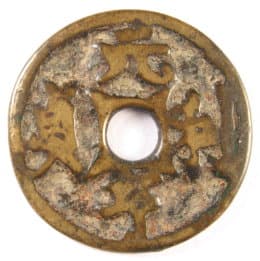

A Chinese coin-shaped talisman inscribed with Yuan Heng Li Zhen


In the Yi Fa teaching, a great deal of emphasis is put on those words as representative of the four facets of Virtue: Union/Love, Discipline, Justness/Harmony, and Truth/Reality. 

The description of Yuan Heng Li Zhen as being these four virtue facets originates with the Wenyan Commentary, which dates back to before the Han Dynasty. Here is a quote of that commentary from one translation:

 "What is called "the great and originating" (yuan 元) is [in man] the first and chief quality of goodness; what is called "the penetrating" (heng 亨) is the assemblage of excellences; what is called "the advantageous" (li 利) is the harmony of all that is right; and what is called "the correct and firm" (zhen 貞) is the faculty of action."

Here "goodness" is Love/Union, "the Assemblage of excellences" is the process of Discipline, Li is already translated here as Harmony, and the "Faculty of Action" is Truth or Reality, that is to say the perceptual faculty that allows us to take action.

Yuan Heng Li Zhen is also a reference to cycles:

Yuan - sublime, the head. The beginning. Spring
Heng accomplishment, prosperous. Summer
Li beneficence, harvest, autumn.
Zhen determination, endurance, winter

Thus Yuan symbolizes the beginning of all things, Heng their growth, Li their further development, and Zhen their maturity.  This concept of the four words connecting to the cycles of growth and the four seasons was particularly elaborated by Cheng Yi, the Song dynasty sage and friend of Shao Yong. 


These words are also used in some esoteric contexts as a mantra, and also as words of invocation for ritual purposes. In fact, just as the four words can be used to describe the pattern or process of natural or seasonal cycles, they can also be used to describe the STEPS of a ritual.

In this sense, "Yuan" symbolizes the invocation, calling down what is above, for the sake of Union.

"Heng" symbolizes the correct performance of the ritual, with Discipline.

"Li" means receiving a response from the forces you have called upon; that is to say, your ritual bringing you into Harmony with the universe.

And "Zhen" means applying that response or change in yourself, embodying Truth in the real world.


Tuesday, April 4, 2017

Why "Plum Blossom" I Ching Numerology?


The macrocosmic changes of the I Ching, those that exist on a cosmic as opposed to a personal scale, can be deciphered through the use of Shao Yong's Plum Blossom Numerology.

 Generally, this particular name is attributed to a story that Shao Yong realized this system in a flash of insight while observing a Plum Blossom.


However, some people in the West might not realize the depth of symbolism the plum blossom has in Chinese culture.

In Chinese cultural art and poetry, the plum blossom is associated with moral fortitude, with perseverance, and with auspicious good fortune. 


It is, in fact, taken as a symbol for the Superior Individual. It has these qualities because of it's beauty and ability to endure even in harsh climates, and its self-reliance in needing very little care.

The Plum Blossom was in fact associated with four qualities, which could be summarized as "yuan", "heng", "li" and "zhen"; the same four words which commence the I Ching, and which embody Virtue among spiritual cultivators.


In the plum blossom, these four words are associated with the four stages in the plum blossom's growth, and the cycle of the seasons:
Yuan: it is born in union with the new year.
Heng: when it blooms this marks the time of steady gain
Li: in its seeding time, there is harmonious bounty
Zhen: in its time of wilting it is the time of contemplation


Thus, the symbol of the Plum Blossom is not just a product of some coincidence, but an ideal image to represent the macrocosmic changes embodied by Shao Yong's numerological system.

At the same time, this sheds light on the significance of Yuan Heng Li Zhen in the larger context of the I Ching as well. As the first four words of the I Ching's text, and a summary of the entirety of the I Ching, the imagery associated with the plum blossom expresses how "Yuan Heng Li Zhen" is a depiction of the entire process of Time, from beginning to end.

Friday, December 9, 2016

More on the Cultivation of Virtue


Virtue ("De"), in the context of the Yi Fa work, should not be mistaken for some kind of an idea of absolute morality, or an abstract and impractical set of ironclad religious rules.

Virtue involves the encouraging of a set of qualities, embodied as Yuan Heng Li Zhen, of the growth of those qualities as a substance within one's being.  To encourage and cultivate, through actions, Union, Discipline, Harmony, and Truth. 

What it is really about is being able to act in a way that is:
a) connected to the rest of the world (not shut inside yourself)
b) able to focus and be effective (not dithering or lost in the mind or distracted)
c) balanced and harmonious within yourself and on the outside (as opposed to being divided inside, and wavering from totality on the outside)
d) dealing with things as they really are, right now (and not driven by fantasies or desires or frustrations/fears of the past)

So how do you work these things?
a) by working on connecting to the world and engaging in it
b) by working on a disciplined routine in your activities, including a spiritual discipline.
c) by working on putting an emphasis on those parts of yourself and your life that you are weaker in, rather than hiding only in the ones you are stronger at. Also, by meditation.
d) by committing yourself to honesty and sincerity, and with dealing with things in life as they are rather than running away from them.

Friday, November 25, 2016

Four Virtues, Four Approaches to the I Ching


In the study of the I Ching through the Yi Fa Society, a great deal of emphasis is put on the cultivation of Virtue ("De").

Virtue is here symbolized by the first four words of Hexagram #1 of the I Ching: Yuan Heng Li Zhen.  These words mean "Sublime Celestial Forces in Motion".  But they are also representative of the four facets of Virtue emphasized in Yi Fa cultivation: Union, Discipline, Harmony, and Truth.

These four concepts are also esoterically connected to the sixiang, the four bigrams of two lines which exist at a more primordial cosmological level to the eight trigrams. In esoteric symbolism these are represented by the icons of an Azure Dragon, a Black Turtle, a Vermillion Bird, and a White Tiger. These symbols are further explored in the higher levels of the Yi Fa Curriculum.


Reflected in the concept of these four cardinal facets of Virtue, you can also understand that there are four key approaches to understanding and interpreting the I Ching. These are Image, Number, Meaning, and Principle.

Historically, during the Han era there were two rival schools of I Ching study, the "Image and Number" school, and the "Meaning and Principle" school. Later schools under the inspiration of Yidao masters like Shao Yong and Zhu Xi reintegrated these into unified study.

"Image" involves studying the structure of the I Ching hexagrams and their component trigrams themselves, and the images these evoke. "Number" involves a study of the mathematical systems of the I Ching and their numerical structures. "Meaning" involves an interpretation of the textual descriptions of the Hexagrams and their lines. And "Principle" involves contemplation on the philosophical significance of the text in terms of it's significance for attaining to the Superior Individual.

With the four facets of Virtue, there can be times when emphasizing a certain facet can be important, but it is ultimately essential to cultivate all four facets if one is to achieve higher-level attainment.  Likewise, with the study of the I Ching, it can be useful at certain times to engage with in-depth specific study of one of the four approaches to the I Ching, it is ultimately necessary to engage in all four methods of study to gain a full and profound understanding of the I Ching's mysteries.