Bagua

Bagua

Tuesday, March 20, 2018

"Incipiencies": More on How the I Ching Works


Incipiency is a concept inherent in the I Ching, because it is inherent in space-time. But the term (it's explanation, and centrality to I Ching studies) is largely attributable to the master Zhu Xi.


It emerges out of the question of "how does the I Ching tell the future"? The answer is: it doesn't. The I Ching measures the present, this moment. But you have to imagine this moment as a set of interconnecting streams from trillions of previous choices, from events that took place yesterday, the day before that, 50 years ago, 4000 years ago, 12 million years ago, etc. Each choice both sealed off a whole bunch of possible futures, and created a cascade of effects that would have a possibility of happening in the future. And in the present moment, we have the culmination of that weight of trillions of trillions of circumstances.

With me so far?

So, if we understand that, we also understand that the future is observable in the present moment; by looking at those past streams, where they can and cannot lead, which of them cannot be altered at this time (unchanging lines) and which of them could be (changing lines). The future exists as a kind of seed already in the present. It is not here but the ingredients for it are all here.

In I Ching study there's a saying that goes something like "you cannot change something once it has happened. If you want to change something, you need to change it before it happens".

The changing lines reflect those incipiencies, the malleable spots in the present moment in Space Time, where you can make a choice, you can drop a new pebble in the stream of space-time to alter the current and change the course of the future.

Wednesday, March 7, 2018

"Synchronicity" and the I Ching

Many people in the west try to claim, in answer to the question of how the I Ching works, that it is through "synchronicity".  This was a term used by the psychologist C.G. Jung (who was a great admirer of the I Ching, and tried to explain its function through the lens of his psychological theories), and was later bastardized for common use by the new-age movement.

(Jung, giving a questioning glance at New Age woo)


Synchronicity, as it is most often used by people involved in applying the term to the I Ching, supposes that "random" events, random convergence, random meaning, all just comes together as little more than some sort of "coincidence on steroids" (as one of my Yi Fa Society students put it).

It is a way you can feel like something has meaning, but you still don't have to really challenge your ideas beyond the assumption it's all just random chance.

It allows you to 'cop out' in various ways:

-to chicken out of needing to take a casting seriously if you decide you don't like what it's saying

-to chicken out of considering your own deeper consciousness ("I just look for synchronicity and let the universe guide me!!")

-to chicken out of exploring the vaster significance of the I Ching's expression of space-time

-to chicken-out of having to move beyond our 20th/21st century post-modern Baby-Boomer western paradigm

This Western Paradigm is the one that says things like "spirituality is just some kind of primitive superstitious psychology", or "you are the center of the universe so of course the universe will send you personally unique personal messages when you toss some coins around, because of how special you are", or "there is no actual reality, all that matters is what you're feeling and what you imagine"!


But in fact, profound study of the I Ching shows that nothing at all is really "random".  All events are caused by Incipiencies: the quality of previous events in space-time synthesizing to plant the seed of future events in space-time. As a certain Canadian philosopher once said: "Fate is just the weight of circumstances".   Every event consists of a moment (represented by the Hexagram) that is the product of literally TRILLIONS AND TRILLIONS of previous choices made, that weigh down on that moment to make it THAT moment and no other possible moment.

Within that moment, there are only a certain number of malleable points, where one can act to create a new Incipiency that will work to shift the movement of time in the future. These are represented in an I Ching hexagram by the Changing Lines.

So Incipiency is like the "Gravity" of Time.

If you understand this, then you'd get that "synchronicity" as a notion has nothing to do with the structure of the I Ching.  Or, for that matter, with reality, except in the sense that you can take any coincidence and apply meaning to it, sometimes to good purpose.

Tuesday, February 27, 2018

Scaling Yongjia's Green Crag Mountain

Scaling Yongjia's Green Crag Mountain

(An I Ching poem, by Xie Lingyun, 4th century poet)


With provisions packed and a thin staff,
I walked a winding path, and scaled to a hidden place,
I went upstream and went beyond the trail.
I reached the peak, but had not yet found harmony.
The gentle rivulets frosted in winter beauty.
Strong bamboo glistened with frost.
The stream wound along, often losing its direction.
The forest was vast, the mountains deep.
I looked west anticipating the moonrise;
I glanced east, observing the light of sunset.
I walked on until night, having marched from dawn to dusk.
Even the most hidden places have become known to me.
The top line of Gu (#18): serve no king or prince.
The second line of Lu (#10): right pushing brings good luck.
A Hermit will always walk peacefully.
His great Virtue is incomparable.
How far is the distance from "yes" to "no"?
In stillness, I dedicate myself to Union.
As Harmony and Truth combine,
Only then can one begin to Repair.

Tuesday, January 16, 2018

On The Gender of the Eight Trigrams


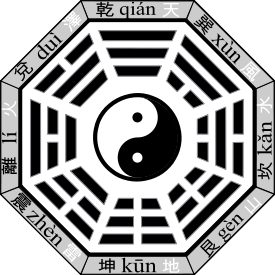
The 64 6-line Hexagrams of the I Ching are built on paired combinations of the 8 3-line trigrams (the bagua).  Thus, as the hexagrams represent all phenomena in the material world, the trigrams represent the eight fundamental elements, four terrestrial and four celestial elements.


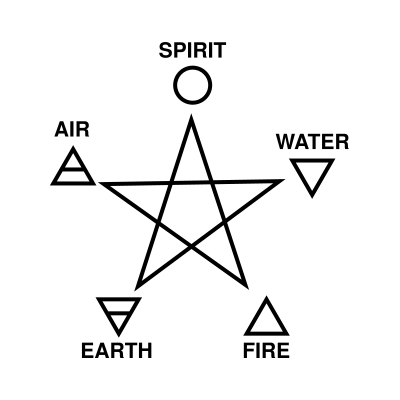
These elements are equivalent to the four classical elements in Western esoteric symbolism. They are in essence a doubled-up version (with terrestrial and celestial/spirit equivalents) of Earth, Air, Water, and Fire.


However, there is one complicated detail about these elements versus their western equivalent that some students have brought up: in both systems, there is a traditional attribution of 'genders' to the elements. But these genders do not appear to 'match up'. Let's review the basics:

In BOTH Western and Eastern symbolism, there are fundamental Masculine/Feminine forces: Chokmah/Binah, Animus/Anima, Shiva/Shakti, Yang/Yin, etc.

In Western symbolism, Earth and Water are feminine, Air and Fire are masculine.

In Chinese symbolism:
Earth/Mountain is masculine
Fire/Thunder is masculine
Moon/primordial-Water is masculine
Heaven is masculine

Air/Wind is feminine
Water/Lake is feminine
Sun/primordial-fire is feminine
The World is feminine


Before continuing, you should note that there is a connection between the physical image of the trigrams and their traditional 'gender': all the 'masculine' trigrams require an odd number of brush-strokes to draw, while all the 'feminine' trigrams require an even number of brush-strokes to draw.  But the various masculine trigrams and the various feminine trigrams also have another thing in common with each other, which we will bring up below. 

So now, let's focus on what is clear: in both systems of esoteric cosmology, there is a force far more fundamental than the level of elements that gets identified as the fundamental Masculine and Feminine duality. These are Yang (masculine) and Yin (feminine).

And of course, even this is not literally about 'gender' in the sense of which we tend to think of it now. Rather, they embody all the notions of duality itself; the important thing about this idea from a cosmological point of view is that it talks about all the qualities that a product of the separation from a single indivisible state of Oneness. All of our material reality is produced by this notion of the division into dualism.

To explain: you can't actually define anything positively. All definition, at its most basic level (that is, when you try to get the definitions of definitions of definitions) comes down to defining things by what they are not. This is because our entire process of thought is based on dualistic thinking. There is white and black, hot and cold, moist and dry, passive and active, positive and negative, etc.
It is only at the highest levels of awareness, and not in the level of phenomena, that this can be transcended, through the mystical process described as the Union of Opposites.

So from the esoteric point of view, the gender consideration of masculine and feminine is really about Dualism.

When we get down beyond the level of yin and yang, we are adding more elements of complexity. So Gender at the level of yin and yang is simple: Yin is everything we can define as archetypal female and Yang is everything we can describe as archetypal masculine.

At the level of elements, the reason for the gendering of elements is something more complex.  And here we get to the reason for the difference in the genders of the elements in Western and Chinese symbolism: the complex quality that the former chooses to focus on is different than the complex quality that the latter chooses to focus on.

With the Western elements, the 'male' elements have the quality of active inherent motion, while the 'female' elements have the quality of inherent stillness.

Earth and Water may move, in an earthquake or a rockslide or down-river or pouring down a sink, but this is only in reaction to what is around them: water and earth are passive, they sink down until they can reach a point of rest. Thus, they reflect the quality of Passive or Receptive nature that is attributed to the Feminine. They are also tangible, of matter, they rest in the world.

Fire and Air, however, are in motion. They rise. They only exist in movement. If air has no movement it has no qualities at all (at least, from the classical perspective) and has become foul and deathly. If fire has no movement it is extinguished. Thus they reflect that quality of Active and Creative that is attributed to the Masculine. They are also intangible, you can't actually hold on to them, they have no matter.


In the Chinese system, however, the quality being looked at is not motion and stillness, which is so important to the Yang and Yin duality, but rather the qualities of "strength" and "softness".

The Mountain, the Thunderbolt/fire, The darkness of the Moon (or the deep dangerous waters of the abyss), and the power of Heaven are all considered to be 'strong' forces.

The gentle Airy breeze, the still Lake, the warm clinging light of the Sun, and the receptiveness of the World are all considered to be "soft" forces.


So both classifications of these are examples of how to classify duality, but they focus on different aspects of duality.  This is because the purely Masculine and purely Feminine are absolutes. They do not exist anywhere in material reality; where they get closest is in Heaven and The World, but in all aspects at this dimension of reality, all phenomena contain a combination of Yin and Yang. They are a mix of the forces we call 'masculine' and 'feminine'. Depending on which aspects of the male and female you want to observe, there are thus different ways to categorize them.


Thursday, December 21, 2017

Magic as a Human Tool

In my latest video, I look at forms of esoteric or magical systems, like the I Ching, as a form of human tool or technology (by technology I do not mean a 'machine', I mean some kind of technique, system, or method used in the accomplishment of human objectives; for example, mathematics is a type of technology).

Check it out:


If you're interested in more of this kind of contemplation, please get in touch with me about joining the Yi Fa Society!


Friday, December 8, 2017

Understanding Incipiencies


Sometimes great change, disaster or windfall, appears to happen suddenly.

This is an illusion of perception.

The moment where change seems to be happening with great speed is in fact long after the seeds of that change were planted.


The sage can look back and see many conditions, little developments, without which that great change could never have taken place.

All change actually starts with a series of smaller incipient events; often these will not even resemble or seem to have anything to do with the great change they can lead to.

Thus, the skilled practitioner can learn how to observe these earlier conditions, and make great changes eventually happen (or prevent them) with very little effort.

This is the power that a profound study of the I Ching grants: to be able to see the process of time, and how to change things before they happen.

Thursday, November 16, 2017

I Ching Commentary - Hexagram #10 "Stepping"

Here is the youtube video for the newest in my commentaries on the I Ching, on the subject of the 10th Hexagram, "Stepping".


Members of the Yi Fa Society get access to additional I Ching video and text commentaries that go into more depth on the symbolism and divination uses of the I Ching's Hexagrams. If you are interested in joining the Yi Fa Society, please get in touch.