Bagua

Bagua
Showing posts with label Union. Show all posts

Monday, January 4, 2021

On the Significance of Yuan Heng Li Zhen

 The opening words of the I Ching's core text are "Yuan Heng Li Zhen", which is typically translated as "Sublime celestial forces in motion". 

When you think of the "celestial force" that is Time itself, you can understand immediately that this first line, the main text description of Hexagram #1, is also an apt description of what the entire I Ching is all about, and it has been treated that way by many scholars and adepts of the I Ching throughout history. As more commentary has been made of Hexagrams 1 & 2 than any of the others, it can also be said that more commentary has been made on those four words than any other words in the entire I Ching.

 These words do not appear on in Hexagram 1, however. They are also spread out, often in pairs (Yuan heng, or li zhen) throughout the I Ching core text.  Separately, "Yuan heng" means a broad or easy path, or also, a ritual or sacrificial rite. While "Li zhen" means a favorable auspice, clearly a common phrase in the context of divination. 
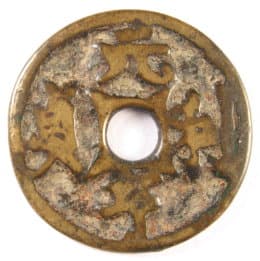

A Chinese coin-shaped talisman inscribed with Yuan Heng Li Zhen


In the Yi Fa teaching, a great deal of emphasis is put on those words as representative of the four facets of Virtue: Union/Love, Discipline, Justness/Harmony, and Truth/Reality. 

The description of Yuan Heng Li Zhen as being these four virtue facets originates with the Wenyan Commentary, which dates back to before the Han Dynasty. Here is a quote of that commentary from one translation:

 "What is called "the great and originating" (yuan 元) is [in man] the first and chief quality of goodness; what is called "the penetrating" (heng 亨) is the assemblage of excellences; what is called "the advantageous" (li 利) is the harmony of all that is right; and what is called "the correct and firm" (zhen 貞) is the faculty of action."

Here "goodness" is Love/Union, "the Assemblage of excellences" is the process of Discipline, Li is already translated here as Harmony, and the "Faculty of Action" is Truth or Reality, that is to say the perceptual faculty that allows us to take action.

Yuan Heng Li Zhen is also a reference to cycles:

Yuan - sublime, the head. The beginning. Spring
Heng accomplishment, prosperous. Summer
Li beneficence, harvest, autumn.
Zhen determination, endurance, winter

Thus Yuan symbolizes the beginning of all things, Heng their growth, Li their further development, and Zhen their maturity.  This concept of the four words connecting to the cycles of growth and the four seasons was particularly elaborated by Cheng Yi, the Song dynasty sage and friend of Shao Yong. 


These words are also used in some esoteric contexts as a mantra, and also as words of invocation for ritual purposes. In fact, just as the four words can be used to describe the pattern or process of natural or seasonal cycles, they can also be used to describe the STEPS of a ritual.

In this sense, "Yuan" symbolizes the invocation, calling down what is above, for the sake of Union.

"Heng" symbolizes the correct performance of the ritual, with Discipline.

"Li" means receiving a response from the forces you have called upon; that is to say, your ritual bringing you into Harmony with the universe.

And "Zhen" means applying that response or change in yourself, embodying Truth in the real world.




Thursday, October 22, 2020

The Steps of Human Consciousness

 There's a teaching in Chinese mysticism that there are two levels of our consciousness. They're associated with the concepts in the I Ching of the "inferior person" and "superior individual". 

At every moment in space and time we have a choice of which of the two we associate with in our active consciousness, but most people in general associate with the inferior person. The inferior person is a collection of influences and conditionings based on your physical nature, your environment, and the influences of your past and present choices and people in your life.

The Superior Individual is your true nature, what is real about you behind all those things. But in point of fact most people are so disconnected from their true and essential nature that it feels like it is another person. In many rituals used to "communicate" with the Superior Individual, that division is so notable that it feels like the Superior individual is some totally different entity from "ourselves", which is why in western symbolism its called the "Holy Guardian Angel". 

This is also why when one is trying to shift the association of their consciousness from the inferior person to the Superior Individual it feels like dying, like the very essence of who were until now (or rather, who you thought you were) has to be destroyed for you to get to that true self. In a lot of cases, people's motives for getting to that true state involve desires OF the inferior person, so they realize that to get to what's real, they'll have to give up the fantasies of the false person they were, and that's very hard.

This internal conflict is mirrored externally by the struggle between (the inferior person) wanting to imagine one's self the center of the universe, and wanting to have a power that acts on the universe and get to impose its desires on the universe, and the (Superior Individual's) understanding that we are one non-divisible part of reality and are not the central actor but one small part of a very big picture in the vastness of Space and Time, and how this is not something that can just be reasoned out, but has to be experienced through meditative practice and the application of virtue to restore that Union with the Taiji (what in modern English we could call the "Singularity").


So in fact while most of these sorts of studies and articles and ordinary perceptions on the subject of "enlightenment" talk about a two-option process (unconsciousness / enlightenment), the work of spiritual Cultivation is actually a multi-step process of initial glimpses of waking up, initiation, developing discipline, achieving communication with the Superior Individual (in western magick called the "True Will"), working to change one's life and environment to better fit one's efforts at attainment and union, making the shift from general association with the inferior person to general association with the Superior Individual, engaging in teaching or other forms of applying Virtue in the world, attaining states of Union to reality, and finally manifesting that Union fully and becoming the Sage (Enlightenment). There are steps Beyond Enlightenment as well but these are generally not spoken of in lay contexts.

Of the above stages, the big three are:

- Initiation: the beginning of awareness of one's Enlightenment quality, and the start of serious spiritual cultivation.

-Adepthood: the shift into association with the Superior Individual

-Enlightenment: uniting to nature or space-time as a whole (which is to say, overcoming this false notion of separation between self and other, and the self-referencing nature of "thinking you're in the middle of the picture").


Finally, I'll note that the very notion that Enlightenment is some kind of separation from the World or one's humanity is ridiculous and disgusting. That's essentially either nihilism or solipsism, the heresies of the gnostics. You can't become "one with everything" by being less human, or less engaged. 

Anyone claiming to be Enlightened while pretending that they don't care about things, or feel things, or that there are certain normal human things that they just don't experience (be it anger, sadness, physical pain, or basic physical needs) are both arguing for Enlightenment being a kind of sub-humanity, and blatant liars.

Enlightenment requires, as my own teacher once said, that you Be More Human.

It's not about separating yourself, it's about Showing Up, being present in the active consciousness.
It's not about feeling less or caring less, it's about Totality. Becoming one part of the big picture, without trying to run away from that big picture, or trying to be right in the middle of that big picture, or trying to control that big picture. It's about being 100% of yourself in the here and now.


Wednesday, April 1, 2020

Flaws in Virtue

The following is an excerpt from a Level 4 text of the Yi Fa Society:


If a practitioner tries to cultivate without Union, he will only be cultivating for himself. His successes might strengthen him, but only reinforce his narcissism. He will start to feel disconnected from the rest of reality around him, and will reinforce the petty interests of his Inferior Person as if these were significant. He will develop a sense of greatness he will not be able to apply to his actual surroundings. In this way, he will eventually subvert all his own progress.

If a practitioner tries to cultivate without Discipline, he will practice in starts and stops. He may at times seek to overcompensate, even practicing in unhealthy ways. He will fall into excuses for why his irregular practice is not a problem, or even how it is unnecessary for him to practice. He may hide in intellect or in emotion, making pretensions of great spiritual feelings or thoughts, while disdaining simple and basic practice. This will eventually mean that he loses all his momentum.

If a practitioner tries to cultivate without Harmony, he will be afraid of his weaknesses, and will put all his focus on his strengths. He will work with great effort at things he's already good at, while neglecting anything he is bad at. He will make a great show of his best qualities, while trying to deny existence of his worst qualities. In this way he will be unable to continue generating Virtue, or receive Gong.

If a practitioner tries to cultivate without Truth, he will delude himself with any fantasy. He may do the physical exercises, but they will exist in his own little bubble. He will interpret Virtue as anything he feels like. He will be unable to receive insight into how to manifest the Superior Individual. He will be unable to manifest Virtue in the world.


Tuesday, February 26, 2019

Cultivation Starts With the Body


All spiritual cultivation starts with the body.

It's very important to find your center in the body.

But then, when you are seeking to unite to the rest of the universe, you can't achieve that if you are looking at your own being as the 'center' of the universe.

The universe is vast and if you try to push your own being into the center place of it, you won't be able to Unite; you will still be trying to have your own separate being at the middle, you're essentially trying to demand that the Universe unite with you (or "around" you).

When connecting to the Universe, you have to realize that you are United to it as an inseparable part of it, but not the center around which all other things orbit.

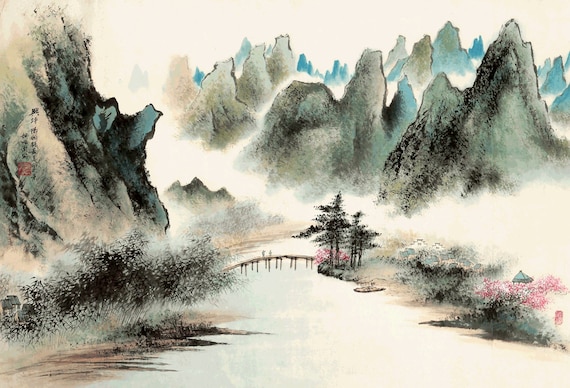
It is like the pictures in Chinese art. You see this style where there are great landscapes, symbolic of Nature and the Universe, and then somewhere in some little edge or corner, there is a person.


(note the tiny human figures, crossing the bridge, over the waters between the mountains)


When you try to put yourself at the center of the Universe, this naturally alienates you from reality, and from the physical, and from association with your body. Conversely, when you return your meditation to the body, you go within, and step out of the illusion of your own centrality. Paradoxically, only by doing so can you experience the vastness of the universal in a truthful way.

You do not need to be in the middle of this vastness; in fact, you can't be. You can't achieve that and create the appropriate place for the universe.

To Unite, you need to see your place in the enormous vastness of space/time that came before you and comes after you, that is beyond you and behind you.
That is to say, of your notion of you.

When you can be comfortable and fulfilled with just being a part of the big picture, even as a small figure on one edge of the canvas, then you can achieve Union.

Tuesday, February 27, 2018

Scaling Yongjia's Green Crag Mountain

Scaling Yongjia's Green Crag Mountain

(An I Ching poem, by Xie Lingyun, 4th century poet)


With provisions packed and a thin staff,
I walked a winding path, and scaled to a hidden place,
I went upstream and went beyond the trail.
I reached the peak, but had not yet found harmony.
The gentle rivulets frosted in winter beauty.
Strong bamboo glistened with frost.
The stream wound along, often losing its direction.
The forest was vast, the mountains deep.
I looked west anticipating the moonrise;
I glanced east, observing the light of sunset.
I walked on until night, having marched from dawn to dusk.
Even the most hidden places have become known to me.
The top line of Gu (#18): serve no king or prince.
The second line of Lu (#10): right pushing brings good luck.
A Hermit will always walk peacefully.
His great Virtue is incomparable.
How far is the distance from "yes" to "no"?
In stillness, I dedicate myself to Union.
As Harmony and Truth combine,
Only then can one begin to Repair.