Bagua

Bagua
Showing posts with label discipline. Show all posts

Monday, January 4, 2021

On the Significance of Yuan Heng Li Zhen

 The opening words of the I Ching's core text are "Yuan Heng Li Zhen", which is typically translated as "Sublime celestial forces in motion". 

When you think of the "celestial force" that is Time itself, you can understand immediately that this first line, the main text description of Hexagram #1, is also an apt description of what the entire I Ching is all about, and it has been treated that way by many scholars and adepts of the I Ching throughout history. As more commentary has been made of Hexagrams 1 & 2 than any of the others, it can also be said that more commentary has been made on those four words than any other words in the entire I Ching.

 These words do not appear on in Hexagram 1, however. They are also spread out, often in pairs (Yuan heng, or li zhen) throughout the I Ching core text.  Separately, "Yuan heng" means a broad or easy path, or also, a ritual or sacrificial rite. While "Li zhen" means a favorable auspice, clearly a common phrase in the context of divination. 
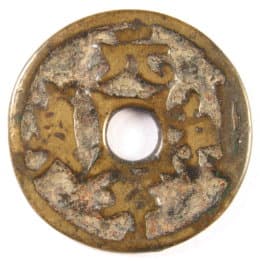

A Chinese coin-shaped talisman inscribed with Yuan Heng Li Zhen


In the Yi Fa teaching, a great deal of emphasis is put on those words as representative of the four facets of Virtue: Union/Love, Discipline, Justness/Harmony, and Truth/Reality. 

The description of Yuan Heng Li Zhen as being these four virtue facets originates with the Wenyan Commentary, which dates back to before the Han Dynasty. Here is a quote of that commentary from one translation:

 "What is called "the great and originating" (yuan 元) is [in man] the first and chief quality of goodness; what is called "the penetrating" (heng 亨) is the assemblage of excellences; what is called "the advantageous" (li 利) is the harmony of all that is right; and what is called "the correct and firm" (zhen 貞) is the faculty of action."

Here "goodness" is Love/Union, "the Assemblage of excellences" is the process of Discipline, Li is already translated here as Harmony, and the "Faculty of Action" is Truth or Reality, that is to say the perceptual faculty that allows us to take action.

Yuan Heng Li Zhen is also a reference to cycles:

Yuan - sublime, the head. The beginning. Spring
Heng accomplishment, prosperous. Summer
Li beneficence, harvest, autumn.
Zhen determination, endurance, winter

Thus Yuan symbolizes the beginning of all things, Heng their growth, Li their further development, and Zhen their maturity.  This concept of the four words connecting to the cycles of growth and the four seasons was particularly elaborated by Cheng Yi, the Song dynasty sage and friend of Shao Yong. 


These words are also used in some esoteric contexts as a mantra, and also as words of invocation for ritual purposes. In fact, just as the four words can be used to describe the pattern or process of natural or seasonal cycles, they can also be used to describe the STEPS of a ritual.

In this sense, "Yuan" symbolizes the invocation, calling down what is above, for the sake of Union.

"Heng" symbolizes the correct performance of the ritual, with Discipline.

"Li" means receiving a response from the forces you have called upon; that is to say, your ritual bringing you into Harmony with the universe.

And "Zhen" means applying that response or change in yourself, embodying Truth in the real world.




Friday, November 13, 2020

What is the Nature of the Superior Individual?

In the philosophy of the I Ching,  there is a basic truth that in every moment, we have a choice between manifesting the Superior Individual or the inferior person. 

Among those who practice cultivation, however, there may be some question as to just what the "Superior Individual" is.  In the course of cultivation, one might get a sense of the Superior Individual being some outside entity, the "higher self" sending them messages or guiding their life. 

So some have developed a conception where the Superior Individual is some kind of outside spiritual, angelic or divine entity.

But in fact, the Superior Individual is basic part of ourselves. It is not a separate being at all, it is us. The best of us. 

 This sense of differentness, of the Superior Individual seeming like another being with its own intelligence and communicating with us is a product of people's primary identification with the 'inferior person', which is also a part of us. Thus, we have become separate from the 'higher self'.


Why are we separated from our higher self?

We aren't, but it seems this way.

The issue is this: we are a species in the process of evolution. Our consciousness has multiple layers, which can be generally divided into two parts. In the context of I Ching studies (including the Yi Fa work) these are described as "World" and "Heaven". To Nietzche it was "last man" and "super-man". In others, it could be called "animal" and "divine".


The Chinese actually say that there are two parts to the human soul: Po and Hung. The Po is the part of us that is animal instinct plus conditioned behavior. The Hung is the part of us that is our fullest potential and true Individuality (as opposed to the 'persona' of our inferior po-soul).

We can, at every moment, choose to associate with one or the other. But on account of our intermediary condition and because of our social conditioning we tend to more directly identify ourselves as the "Inferior Person". So much so, that the Superior Individual can sometimes feel like it's a separate entity, some kind of guiding spirit.

You will find, if you engage with discipline in a sincere long-term course of spiritual cultivation, that over time, you will become more and more identified as one with the Superior Individual. At that point, the 'ideas' of the Superior Individual will be identical to your own, and the notions of the inferior person, which will still be present, will instead be the ones that appear to be foreign.

Tuesday, October 13, 2020

How to Master the I Ching

 In this latest video, I give you some guidelines as to how you should study the text and structure of the I Ching to maximize your ability to understand it!


Wednesday, April 1, 2020

Flaws in Virtue

The following is an excerpt from a Level 4 text of the Yi Fa Society:


If a practitioner tries to cultivate without Union, he will only be cultivating for himself. His successes might strengthen him, but only reinforce his narcissism. He will start to feel disconnected from the rest of reality around him, and will reinforce the petty interests of his Inferior Person as if these were significant. He will develop a sense of greatness he will not be able to apply to his actual surroundings. In this way, he will eventually subvert all his own progress.

If a practitioner tries to cultivate without Discipline, he will practice in starts and stops. He may at times seek to overcompensate, even practicing in unhealthy ways. He will fall into excuses for why his irregular practice is not a problem, or even how it is unnecessary for him to practice. He may hide in intellect or in emotion, making pretensions of great spiritual feelings or thoughts, while disdaining simple and basic practice. This will eventually mean that he loses all his momentum.

If a practitioner tries to cultivate without Harmony, he will be afraid of his weaknesses, and will put all his focus on his strengths. He will work with great effort at things he's already good at, while neglecting anything he is bad at. He will make a great show of his best qualities, while trying to deny existence of his worst qualities. In this way he will be unable to continue generating Virtue, or receive Gong.

If a practitioner tries to cultivate without Truth, he will delude himself with any fantasy. He may do the physical exercises, but they will exist in his own little bubble. He will interpret Virtue as anything he feels like. He will be unable to receive insight into how to manifest the Superior Individual. He will be unable to manifest Virtue in the world.


Sunday, October 13, 2019

Don't Over-Complicate Practice, Surrender Into It!


Qi Gong Practitioners often develop problems in their practice due to a predictable pattern of behavior. The root of this is placing very high expectations on your experience of practice.

High expectations tend to develop in one of two ways: the first is where you begin with a simple practice that has some powerful experiences and real results, and so want to maintain that intensity and try to do so by doing more: making more advanced practices, longer exercises, adding little details, etc. until you have overburdened your practice.

The second is where you are doing a practice and feel that it is not working well, so you decide to modify or add to it. This produces a positive result, which was really caused by making a change, but which you might interpret as having been due to adding complexity or greater effort. So you continue to add more complexity and detail in your practice to try to keep increasing your experience.

This focus on excessive complexity can lead to creating a false illusion of effectiveness, that only seems to be creating results for you as long as you keep trying to build it up and innovate in your practice. It is doomed to lead to a collapse.

So it's important not to over-complicate things, not to worry about meeting some kind of ever-growing quota of expectations.

This is often a sign you are in a cycle of creating a false reality (maybe of your success, or even of struggle), when you need to create ever increasing complexities to the work you're doing or to the results you expect; this is actually you trying to dedicate more and more of your own Qi to create a bubble of fictional reality around yourself. It's because there was something that you found useful, so you clung to it.

But in so doing, you lose what's actually useful (and often, good and enjoyable) about it.

So when you realize that this is what you're doing, you have to let the bubble deflate (before it outright pops), and return to the moment, and return to figuring out how to show up in the Active Consciousness to this moment, to this simple practice, to this pass-time, to this job, etc.

The key isn't about complexity, it's about being able to relax in your practice.

It's always about relaxing into it. So for a lot of people, relaxing feels like a really profound surrender because they're so resistant to the letting-go of control that relaxation entails.
Remember to breathe.

Tuesday, October 1, 2019

Video: Truth Seekers are (Mostly) Bunk!

Most people who emphasize on 'seeking' for truth (rather than finding and working on it) are actually dedicated to avoiding the truth before their very eyes at all cost.


Sunday, May 26, 2019

VIDEO: "Healing Magic" vs True Health


The following video is not on a topic I cover very often. Most perceptions of Qi Gong as being "for health" as a primary purpose are utterly wrong, and I don't want to encourage these perceptions. But then again, most people's perceptions of health and of what spiritual or alternative-medical practices are capable of doing for their health are totally wrong as well!

So, here I set the record straight: