Bagua

Bagua
Showing posts with label line positions. Show all posts

Saturday, August 22, 2020

I Ching Questions and Answers: Line 1 and Line 6

 I often receive questions about the I Ching, and how to read it more effectively. If you have a question post it in the comments below and I will try to answer it.


Meanwhile, here is one example of a question someone recently sent me, and my answer:


Q: what does it mean when only line 1 and line 6 are changing?


In an I Ching casting, you derive a six-line hexagram. In the casting, any number of those lines, from none at all to all six, could theoretically be changing lines. 

Any lines might or might not be changing. 

You cast the lines in order from the bottom to the top, so that the bottom line is considered "line 1", and the top line is considered "line 6".
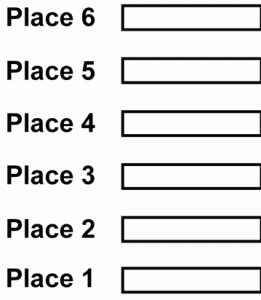


If more than one line is changing, it is important to determine what is the "central line", the part of the casting that is the most important. The way to do this is explained in The Magician's I Ching.

So if you get only two changing lines, and they are line 1 and line 6, of the two the central line of the reading is line 6. Line 1 needs to be read as a kind of prelude to the central line 6.
 

In an I Ching casting the position of each line has a general sense of importance. As each Hexagram represents a situation, the bottom 1st line represents the very beginning of the situation; often even what happens before the situation is really in action. Line two is often when things get going. Line three the most difficult part (the jump between the lower lines and the upper lines). Line four is when you're past the middle of the situation. Line 5 is usually the climax or peak of the situation, and Line 6 is when the situation is ending or even past due to end.

Since Line 1 usually signifies something taking place very early, and line 6 very late, there is a bigger distance between the two than if they were any other two lines. It can also mean with regard to the question that issues that happened at the beginning of the process are relevant to what is happening right now.

So in a casting where Line 1 and Line 6 are the two changing lines, you ought to think of Line 6 as what's most central right now, but there are things about how the current situation began that are having an important effect or consequence at the time of the situation ending.


Thursday, July 12, 2018

On the Origin of the I Ching's Lines


How did the lines of the I Ching get the text they did?

1. Often considerations have to do with the nature of the line, especially if its the only line of its type (yin or yang) in the hexagram.

2. The position of the line determines its overall role; so for example the first line is always about beginnings, the sixth about endings, in some sense.

3. In terms of the specific examples, they are often taken out of either common folk stories/sayings, or from events in the pre-zhouyi history (especially events relating to the royal lineage of Zhou, or sometimes of the Shang dynasty they eventually deposed).


But there is also an esoteric aspect that frequently emerges.

Look at a line and its text. Now consider this in the light of three different trigrams:
1. The trigam that line is found in.

2. The trigram that would result when that line changes.

3. The Nuclear trigram that rules it (generally the lower nuclear for lines 1-3 and upper nuclear for lines 4-6, but in the case of line 4 it can sometimes be either).


Studying the qualities that these trigrams have (the elements they are associated with, the qualities of nature they are associated with, and the qualities or spiritual concepts these represent), you will find that the line's text relates to aspects of those three trigrams.

Thursday, September 7, 2017

Tips on Interpreting the I Ching

The standard method of interpreting an I Ching casting is to cast the hexagram, read the main description of the hexagram you get, read the changing lines, and then read the resultant hexagram.  Many I Ching students put little thought into the matter beyond that.

But if you want to consider ways of reaching deeper understanding of the I Ching, there are more ways to work on it. 


Forgetting the resultant hexagrams for a moment, any given hexagram by itself has two means of interpretation: looking at each line in isolation, or looking at the lines as a 'story' being told, representing a progress of the overall theme dealt with in the hexagram. And as you study them, they can be 'read' in order, from one to six; where generally one is what happens even before the very start, two the real start, three the big challenge, four the further challenge, five the epic climax, and six is the denouement or epilogue.

So, when you bring in resultant hexagrams to the analysis it makes sense that both of those would also be applicable.


In actual casting, changing lines signify a couple of things. The overall number of changing lines represents the 'mutability' of the whole situation. A hexagram with many changing lines has a much more powerful "current" of change than one that has only one or two; that's why if you have four or more changing lines the diviner is advised to consider some part of the RESULTANT hexagram to be the 'central point' (ie. the present) of the casting; because it is incredibly difficult for the force of change to be overcome at that point.
Which specific lines are changing represent the points in the hexagram that are significant as 'mutable', things you can change, things you can do something about.

So what does this say in terms of understanding the six lines as a 'story'?
That they are a story in theory, in the way that a novel or a fairy tale is a story, one that is archetypal, neat and tidy, and almost never 'like that in real life'.
In a casting, you have to see a different story, a much messier one, composed of only those lines that are Changing.  So you can think of the six lines as a whole as a kind of 'big story' that cover all kinds of things that CAN happen related to theme; but in real life incidences only some of those parts actually DO happen as the story of the real events related to the question that was asked.

In any case, there's no question that the changes are all about Time.
However, another way to look at these resultant hexagrams is to think of them as being about Choices, because all of Time is just a product of cause & effect; and in an actual casting, the Changing Lines represent those flexible branching-off points in time where it is possible for some kind of choice to be made that affects the course of the future.

If you're interested in further conversations, teachings and insights on the I Ching, please check out the Magician's I Ching Facebook Group!

And if you are interested in a structured system of study, please get in touch about joining the Yi Fa Society.

Friday, October 2, 2015

The Significance of Line Positions in a Hexagram

I think that when it comes to the interpretation of line positions, there are clearly certain significant general rules. Yang is, on the whole, better than Yin; getting a solid line is usually more promising than getting a broken line. However, the lines of the hexagrams are affected by both their position on the hexagram (ie. a yin line in number 2 is more likely to be positive than a yin line in number 3 or 5), and the nature of the lines in other positions (ie. a yin line in number 2 is more likely to be positive if it is surrounded by strong yang lines; or if there is a solid yang line in number 5).

The overall positions of the lines seems to have more influence than the trigrams that compose the hexagram, when it comes to determining if any given line is auspicious or not; but the trigrams do still exert their influence. The overall image they create can affect the line concepts; and certain trigrams (like Kan, which symbolizes the lunar Moon force even though most English versions of the I Ching call it "Water"), tend to have stronger influences than others (Kan also represents "a pit", and so its seen as a serious malefic force unless its very well-dignified).