Bagua

Bagua
Showing posts with label Hexagrams. Show all posts

Saturday, August 22, 2020

I Ching Questions and Answers: Line 1 and Line 6

 I often receive questions about the I Ching, and how to read it more effectively. If you have a question post it in the comments below and I will try to answer it.


Meanwhile, here is one example of a question someone recently sent me, and my answer:


Q: what does it mean when only line 1 and line 6 are changing?


In an I Ching casting, you derive a six-line hexagram. In the casting, any number of those lines, from none at all to all six, could theoretically be changing lines. 

Any lines might or might not be changing. 

You cast the lines in order from the bottom to the top, so that the bottom line is considered "line 1", and the top line is considered "line 6".
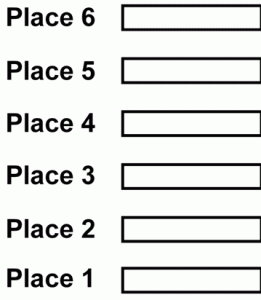


If more than one line is changing, it is important to determine what is the "central line", the part of the casting that is the most important. The way to do this is explained in The Magician's I Ching.

So if you get only two changing lines, and they are line 1 and line 6, of the two the central line of the reading is line 6. Line 1 needs to be read as a kind of prelude to the central line 6.
 

In an I Ching casting the position of each line has a general sense of importance. As each Hexagram represents a situation, the bottom 1st line represents the very beginning of the situation; often even what happens before the situation is really in action. Line two is often when things get going. Line three the most difficult part (the jump between the lower lines and the upper lines). Line four is when you're past the middle of the situation. Line 5 is usually the climax or peak of the situation, and Line 6 is when the situation is ending or even past due to end.

Since Line 1 usually signifies something taking place very early, and line 6 very late, there is a bigger distance between the two than if they were any other two lines. It can also mean with regard to the question that issues that happened at the beginning of the process are relevant to what is happening right now.

So in a casting where Line 1 and Line 6 are the two changing lines, you ought to think of Line 6 as what's most central right now, but there are things about how the current situation began that are having an important effect or consequence at the time of the situation ending.


Saturday, February 1, 2020

I Ching Hexagram Commentary #14 - Great Holdings

Here is the latest I Ching video. If you are interested in deeper teaching on the I Ching as part of an ongoing program of spiritual cultivation, please consider contacting me about applying to the Yi Fa Society.

Thursday, August 22, 2019

What Story is the I Ching Telling You?


There's really only one story that actually matters: the story of the journey of transformation.  All good stories are variations on it.

All hexagrams of the I Ching have within them a story of transformation. Each one tells its own little story. And when you combine them with other hexagrams in permutations, it's telling another story.
And when doing a casting its doing a very specific little story of transformation with regard to the one question you might have at this time.  While the whole King Wen sequence tells one great big story.


There were two schools in the period after the School of Yin and Yang, after Confucius, up to the Han Dynasty. These schools were rivals, I've spoken of them before. From that school of inner alchemy, there was a division into two forms of interpretation: Image and Number, and Meaning and Principle.


Image and Number focused on the line structures, trigrams, positions of things, mathematics of the I Ching, the elements, the cosmology. All of that was the focus of the School of Image and Number.
The school of Meaning and Principle looked at it a different way, saying that what mattered was the spiritual/philosophical teaching in the I Ching and that this was found by considering and interpreting the text, rather than the image or the mathematics/cosmology.

I've commented on the imperfection of both of those schools before.

Regardless, the value of what came out of the school of Meaning and Principle was a different approach to looking at groups of hexes, not based on their structure of lines and trigrams, but in terms of the text and grouping various hexagrams based on their common themes.  In other words, to look at the stories they tell.

If you do this in combination with the structural elements of the hexagrams, this is the best way to apply your studies in I Ching structure and cosmology to a more grounded and human element of connecting to that personal story of what one must do on a journey of transformation.

Thursday, July 12, 2018

On the Origin of the I Ching's Lines


How did the lines of the I Ching get the text they did?

1. Often considerations have to do with the nature of the line, especially if its the only line of its type (yin or yang) in the hexagram.

2. The position of the line determines its overall role; so for example the first line is always about beginnings, the sixth about endings, in some sense.

3. In terms of the specific examples, they are often taken out of either common folk stories/sayings, or from events in the pre-zhouyi history (especially events relating to the royal lineage of Zhou, or sometimes of the Shang dynasty they eventually deposed).


But there is also an esoteric aspect that frequently emerges.

Look at a line and its text. Now consider this in the light of three different trigrams:
1. The trigam that line is found in.

2. The trigram that would result when that line changes.

3. The Nuclear trigram that rules it (generally the lower nuclear for lines 1-3 and upper nuclear for lines 4-6, but in the case of line 4 it can sometimes be either).


Studying the qualities that these trigrams have (the elements they are associated with, the qualities of nature they are associated with, and the qualities or spiritual concepts these represent), you will find that the line's text relates to aspects of those three trigrams.

Thursday, October 27, 2016

New I Ching Video!

This is the new public commentary video on the I Ching's Hexagram #7, "the Army".


Note that members of the Yi Fa Society get access to additional videos and written materials on each hexagram. If you are interested in joining the society, please get in touch!

Friday, July 1, 2016

Another way of Looking at How the I Ching Hexagrams Explain Space & Time

Hexagram #1 and Hexagram #2 are the two extremes of Reality.  Hexagrams #63 and #64 are where those extremes meet.

Hexagram #1:


All other hexagrams have one of these four as their nuclear; or as the nuclear of their nuclear. #1 and #2 are both nuclears of themselves; hence they are two polar extremes. #63 and #64 are nuclears of each other; hence, they are the center-point where Time and Space collide.

Hexagram #2:


To understand the King Wen sequence (the regular sequence of Hexagrams as they appear in the I Ching) you must think of it as a U-shaped track. On one side are all the odd-numbered hexagrams, starting with Hexagram #1; on the other the even-numbered hexagrams, starting with Hexagram #2. The curve where the two lines meet is #63 and #64. So if you unfolded that track and made it into a straight line, you'd have #1 and #2 at opposite ends of each other, and #63 and #64 right in the middle of the line.

Otherwise you could also envision it as taking the form of a square angle (of 90 degrees, that is, one-fourth of a circle).  The Odd numbers would be the vertical and the Even numbers the horizontal. And #63 and #64 would be where they meet, in the center.

Hexagram #63:


Look at Hexagram #1 ("Creation"), and you will see that it is all about time.  Look at Hexagram #2 ("Passive") and you will see it is all about space. Where they intersect is the Now, but the now is eternal, and instant. It is so fast it cannot be depicted. The moment you say "it is now" you are no longer in the Now.

So instead, there is the flickering interplay between that vertical Time and horizontal Space, and it finds itself in the connection between Hexagram #63 ("After Ending") and Hexagram #64 ("Before Ending"): Before Ending, After Ending, Before Ending, After Ending.  Everything is a series of immediate flickering moments between what Is Changing and what has Not Yet Changed.

Hexagram #64:


Just like Hexagrams #1 and #2 are completely pure in their respective Yang and Yin, as ideal extremes, #63 and #64 are completely mixed; in that messiness of the incipient moment of the Now's explosive crash between Space and Time. #63 has everything in the proper place, #64 has nothing in its proper place. That's Reality.


Between Space, Time, and Now there is Space-Time, all the other situations that are represented by all those hexagrams that are in some way derived from these four hexagrams. They each and all have effects on how we can approach Reality and what we must do to manifest Virtue (which also has four aspects). The Superior Individual is he who chooses to take note of each situation as it is really happening in the Now, and manifest the right Virtue accordingly.  The Sage is someone who has been able to experience all of Space-Time and how it is both happening at once and not happening at all.
The Superior Individual has found the axis which forms a square; the Sage has found the Center-point.