Bagua

Bagua
Showing posts with label casting. Show all posts

Saturday, August 22, 2020

I Ching Questions and Answers: Line 1 and Line 6

 I often receive questions about the I Ching, and how to read it more effectively. If you have a question post it in the comments below and I will try to answer it.


Meanwhile, here is one example of a question someone recently sent me, and my answer:


Q: what does it mean when only line 1 and line 6 are changing?


In an I Ching casting, you derive a six-line hexagram. In the casting, any number of those lines, from none at all to all six, could theoretically be changing lines. 

Any lines might or might not be changing. 

You cast the lines in order from the bottom to the top, so that the bottom line is considered "line 1", and the top line is considered "line 6".
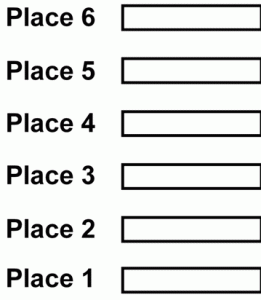


If more than one line is changing, it is important to determine what is the "central line", the part of the casting that is the most important. The way to do this is explained in The Magician's I Ching.

So if you get only two changing lines, and they are line 1 and line 6, of the two the central line of the reading is line 6. Line 1 needs to be read as a kind of prelude to the central line 6.
 

In an I Ching casting the position of each line has a general sense of importance. As each Hexagram represents a situation, the bottom 1st line represents the very beginning of the situation; often even what happens before the situation is really in action. Line two is often when things get going. Line three the most difficult part (the jump between the lower lines and the upper lines). Line four is when you're past the middle of the situation. Line 5 is usually the climax or peak of the situation, and Line 6 is when the situation is ending or even past due to end.

Since Line 1 usually signifies something taking place very early, and line 6 very late, there is a bigger distance between the two than if they were any other two lines. It can also mean with regard to the question that issues that happened at the beginning of the process are relevant to what is happening right now.

So in a casting where Line 1 and Line 6 are the two changing lines, you ought to think of Line 6 as what's most central right now, but there are things about how the current situation began that are having an important effect or consequence at the time of the situation ending.

Wednesday, July 10, 2019

The Time Travel of the I Ching


Enter the stream of the I Ching through its symbols.

The I Ching shows that time is like a forest, full of change.

The present is just the place you are at in the forest.

All the steps you took through this forest up until now have put you on this point in the path.

The direction they lead you in points toward where on the path you are heading; this is the future.


If you want to change the future, change it before it happens.

If you want to change the past, change your response to the choices you made in the past.

Saturday, January 5, 2019

Can You Use the I Ching for "Trivial Purposes"?

I have often had students ask me whether it's proper to use the I Ching for 'trivial' questions.

The question usually comes from the defining of certain types of questions as important, and others as unimportant. Sometimes it involves the notion that the I Ching should only be used for questions of Spiritual importance, or deep profound life-decision questions about one's purpose or higher self.

So I am asked, for example, if it is acceptable to ask about lost keys or some problem at work or how things will go at a football game, etc.


So my perspective is that this is absolutely acceptable to do; but I think what we need to define is the difference between something being "mundane" and something being actually "trivial", in the context of the I Ching.

The point isn't that the I Ching can't be used for everyday ordinary things. In fact, the I Ching can be greatly useful for mundane questions. You can use it for everyday subjects, even minor questions or doubts, or nearly-inconsequential problems.

However, where you can't use it is for something that's "trivial" in the sense of being a question you don't really care about.

That's true whether the question is about something very mundane or something of great cosmic, spiritual or life significance.

This is the secret of understanding whether a question is trivial or not: it's not about the subject matter but about whether you have anything actually invested in the subject matter.

 If you don't have a sense of the question actually mattering to you, then you should not do an I Ching casting about it.


Note: the idea that "you shouldn't do it" is not in the sense that it would somehow 'dishonor' the I Ching or that it is some kind of spiritual taboo or will cause bad karma or anything along those lines. It's simply that you shouldn't do it because if you don't have some kind of of sense of investment in the question beyond mere curiosity, the casting won't actually work for you.

You need to have some level of caring about the question asked beyond just mere curiosity. It has to matter to you a little more than that, whether it's at the level of something where you just have a strong feeling of wanting an answer even if the casting won't have any real consequence, all the way to "this casting is a matter of life and death". As long as you have investment, as long as there's skin in the game, regardless of the scale or whether the question is incredibly mundane or cosmically profound, the casting will be able to function.

Otherwise, the casting really will be "trivial".


Friday, May 18, 2018

Getting the Right Answer From the I Ching

I've had a number of people who have expressed difficulty with being able to get a coherent or useful answer out of their I Ching castings.

When I help them analyze their casting, it is quite often, certainly more than half the time, that the very first thing that becomes evident to me is that the caster did not take the time to formulate the ideal question.

This is the most important part of an I Ching casting, in the sense that it is the first thing you must figure out, and forms the ground for everything that comes after!

The nature and quality of your question will fundamentally determine the answer you receive.

The nature of your question speaks to the state of mind you have at the moment of making the casting: part of formulating the right question is not just a matter of the question itself, but of taking the time to contemplate and center yourself, to be in the right state to approach the casting.

So remember, first and foremost, when you are going to cast the I Ching, first give yourself a good while to work out what you want your question to be. Think about what it is you really need to know about the situation you want to cast about, and how you can phrase that in a way that will present you with the right sort of answers you can actually use.


Wednesday, September 20, 2017

An Explanation of The Generation of Changing Lines

In the system of the yarrow method of I Ching casting, when you have two small piles of yarrow and one large pile, that is a Yin line (the Yin being the 'small' piles), and when you have two large piles and one small pile, that is a Yang line (the Yang being the 'large' piles).

So some students of the I Ching have expressed confusion as why three small (yin) piles would be a Yang changing into Yin, or conversely three large (yang) piles would be a Yin changing into Yang.


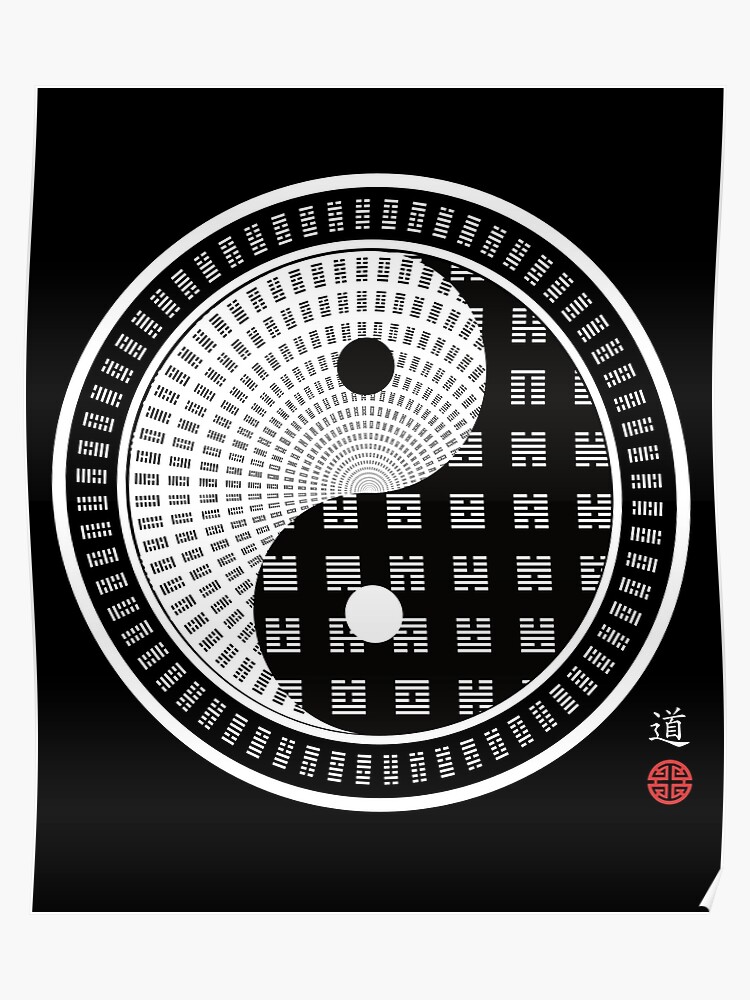
Imagine the image of the Taiji:


It is Yin and Yang, intermingling. Within the yin there is a centerpoint of yang; and within the yang a centerpoint of yin.

So at the very core of Yin is the most yin of anything possible; it is so overflowing with yin, that it takes on the nature of Yang.
Likewise at the very core of Yang is the most yang of anything possible; it is so overflowing with yang that it takes on the nature of Yin.

The former is in fact Yang that is inevitably transforming into Yin, that is the only direction it can go.
Likewise, the latter is Yin that is inevitably transforming into Yang.

So this is why in the casting, when you have three small (yin) piles, it is manifested as a Yang that is becoming a Yin.
And when you have three large (yang) piles, it is manifested as a Yin that is becoming a Yang.

That is the reason.
And the reason is reflected in the probabilities of the casting method, because these forces are not equal in nature; in nature Yin is more stable, so it is less common for Yin (the stable but weak) to become Yang (volatile but strong), than for Yang (strong, but volatile) to weaken into the more stable Yin.


"Weak but stable" are the valleys of space-time, "strong but unstable" are the peaks.

Wednesday, April 26, 2017

Video: An Example of an I Ching Casting in Process

This is a video showing the performance of a casting, for reference purposes.


If you are interested in learning more about the I Ching and a whole system of spiritual cultivation, please contact me regarding the Yi Fa Society.

Thursday, March 9, 2017

What to Know Before You do an I Ching Casting


The I Ching can be used to for divination about literally any subject. It is said that it covers all possibilities within the "world of 10000 things" (the manifested reality in which we exist).   So it's not just for thinking about very profound or advanced 'spiritual' questions. It's also not just for thinking about very mundane and ordinary subjects (romance, relationships, family, money, business, etc).  It can be equally effective for any of these things!

And yet, some I Ching castings end up working 'better' for the caster than others.  Why is that?
First, of course, is the level of training and understanding one has in working with and interpreting the I Ching.  The more you study it, and the more you consider its form, its text, its whole system, the better you'll get at using it. That part is pretty obvious (even though for some reason, many people never bother to go beyond the most basic level of understanding with it, even if they use it a lot; I've met some people who have used the I Ching fairly regularly for years and never even actually read the whole text!).

But whatever your level of training and understanding with the I Ching, there is also the fact that sometimes you will do castings that will seem to 'work' really well, providing you clear understanding of the question you are asking, and at other times, it will seem like the answer you get doesn't 'work' for you at all (in the sense that you aren't able to get a clear answer, or that what you get in the casting doesn't seem to be right).

Here are things you need to keep in mind when you are considering doing an I Ching casting about a question:

1. What is the level of Necessity for the casting? Is this something that you do not have a clear idea about without casting for it? Is there a strong emotional sense of intensity to seek out the answer?

2. Do you have the sense that there is something you may be missing, that you hope the I Ching could clarify?

3. How likely are you to interpret the casting objectively?

4. How open will you be to proceeding with the advice the I Ching may present to you?


None of these are points that should necessarily be taken as reasons not to do a casting. But they should give you an idea of whether you're really at the right spot to do the casting or not, and sometimes they may lead you to change your attitude about the casting you are about to perform, before you engage in it. 

The more intense the necessity is for a casting, the more likely that it will be fruitful.

The more clear you are about what it is you are needing from the casting, the more accurate the casting is likely to be.

The more you prepare yourself to be objective in your analysis of the casting, the more likely that you will not mislead yourself in your interpretation.

And the more serious you are about following through with the advice given by the I Ching, the more likely that the casting will provide concrete, direct and meaningful advice.


Friday, May 27, 2016

The Working Tools

The working tools of an I Ching practitioner are the yarrow or staves, the paper, the pen or stylus and ink, and the book itself.   The yarrow or staves are used to cast the oracle, paper is used to record the oracle on, the pen to draw the lines of yin and yang, and the book is used to study and analyze the hexagram and consider its implications.


However, in the Yi Fa Society we are not just fortune-tellers but cultivators, so we apply these tools to the development of enlightenment. 

In that sense, the staves or yarrow stalks represent Time and the nature of Change. 

The paper represents the vast potential of Space.

The pen represents the noting of confluence of these forces, manifesting in the specific measurement of Change in this one point in space-time.

And the book represents the wisdom of the Sage in comprehending the significance of this measurement, in order to know how to manifest the Superior Individual in any point in time and space, in any circumstance of change.


Thursday, February 11, 2016

More on the I Ching, Macrocosm and Microcosm

This is a follow up to the previous entry, where I touched on the difference between Macrocosmic and Microcosmic perspectives of the I Ching.

Some people wanted more clarification on this subject, which is not often touched upon in writings.

The type of divination you do when you cast the I Ching with the yarrow stalks, staves, or coins, etc. is a 'microcosmic' divination.  It is a casting influenced by two factors, on account of this: the first factor is the objective reading of Time in this present point in space. The second factor is the role of your place in that measurement, with regards to the specific question you are asking.


So this is why you could ask different questions, on different subjects, within the same time frame; it is also why you should not keep trying to ask the same question about the same subject; although in some specific situations, you might want to ask a follow-up question or something that results from the first casting.  In the case of getting Hexagram #8 as a result, the I Ching is explicitly ordering you to do so!  Conversely, if you get Hexagram #4, it suggests that your 'follow-up' questions are really being motivated by a desire to get a different answer than the one you got, and you absolutely should stop consulting on this subject.

This is the difference between ordinary casting and the Plum Blossom Numerology system; the latter is 'macrocosmic', it doesn't do a reading of your personal place regarding a situation, but of an objective measurement of time.  Your own place is not included in the casting, only the governing measurement of the point in time you are making a calculation for.

So when you use the Plum Blossom method you are getting a reading relating to the auspiciousness or inauspiciousness of a particular moment in time, which applies to all matters connected to that particular moment.

Understanding this difference can help you understand what situations are better suited to a 'regular' I Ching Casting, and which are better suited to the numerological system of the Plum Blossom method.

Monday, December 21, 2015

Postponed

Today's blog entry is postponed on account of being busy providing Holiday I Ching castings for Yi Fa Society students.

Please contact me if you are interested in membership in the Yi Fa Society.

Wednesday, October 21, 2015

Determining the "Present" in an I Ching Casting

An excerpt from The Magician's I Ching:

In I Ching tradition, the number of changing lines you have affects what should be read.  Depending on the number of changing lines, the "present" or "central incipiency" of a casting varies.  Everything that comes before that "present" is a reflection of previous developments (that are still influencing the present moment), and everything that comes after are "incipiencies" that have not yet manifested, that is, later developments.


Determine the changing lines you have:


-No Changing Lines:  the Main Hexagram Text is central, and should be the only part read.

-1 Changing Line: the single changing line is the "present".  The Main text and the main text of the resulting hexagram are broad themes of the prior and later developments.

-2 Changing Lines: the UPPER of the two changing lines is the "present".


-3 Changing Lines: the MIDDLE changing line is the "present".

-4 Changing Lines: in this case you should read the main text of the hexagram, the four changing lines of that hexagram AND the two unchanging lines of the resulting hexagram (so if you have a hexagram with lines 1-4 being 'changing lines'; you should read those four, plus lines 5 and 6 of the new hexagram).  Of these, the LOWER of the two resulting hexagram lines is the "present".


-5 Changing Lines: As above, read the main text, all 5 changing lines, and the single line of the resulting hexagram that was not changed.  The single unchanging line from the resulting hexagram is the "present".

-6 Changing lines: read the main text, all six moving lines, and the resulting text.  The resulting hexagram text is the "present".

Thursday, October 8, 2015

How to Interpret an I Ching Casting: Part 2

In I Ching tradition, the number of changing lines you have affects what should be read, and allows you to determine which particular part of the overall reading represents the “centre”, that part of the casting that marks the present or the most urgent thing to attend to (with all that comes before that “centre” being previous developments, and all that comes after being later developments).

In the reading, if you have: Then read:
-No Moving Lines: then read the Main Hexagram Text only.
-1 Moving Line: then read the Main Hexagram Text, the Moving Line, and the Future Hexagram Text, and the Moving Line is the “centre”.
-2 Moving Lines: then read the Main Hexagram Text, both Moving Lines, and the Future Hexagram Text; and the UPPER Moving Line is the “centre”.
-3 Moving Lines: then read the Main Hexagram Text, all three Moving Lines, and the Future Hexagram Text; and the MIDDLE Moving Line is the “centre”.
-4 Moving Lines: then read the Main Hexagram Text, the four Moving Lines, the Future Hexagram Text and the two lines from the Future Hexagram that were unmoving (for example, if you get a hexagram with lines 1-4 moving; then you will read lines 5 and 6 of the Future Hexagram). Of these, the LOWER Future Hexagram Line is the “centre”.
-5 Moving Lines: then read the Main Hexagram Text, all five Moving Lines, the Future Hexagram Text, and the unmoving Future Hexagram Line; and the single unmoving Future Hexagram Line is the “centre”.
6 Moving Lines: then read the Main Hexagram Text, all six Moving Lines, and the Future Hexagram Text; and the Future Hexagram Text is the “centre”.

Naturally, all of the above describes the basic way you would read an I Ching casting, and it is how you begin. However, as you develop there are other aspects you are doing to want to look at, but it is not good to overburden yourself at the beginning. Make certain that you have a firm grasp of the fundamental method before delving into other details. Later on, you may want to look at and contemplate the structure of the hexagrams you cast: look at the lines, which line is where, understand why that makes certain things good or bad. Look at and contemplate the image evoked by the component trigrams (both the “official” one described in the book and other ways you could imagine those two elements combining to create an image). You will also want to look at the Nuclear Hexagrams involved, as well as the opposite, overturned and reversed hexagrams; there may be more information on this later.

If you want more information and guidance to performing an I Ching casting, please consider purchasing the book "The Magician's I Ching". 

Wednesday, October 7, 2015

How To Interpret an I Ching Casting: Part I

Once you have generated a hexagram with a casting (whether its by the yarrow stalk, three coins, my own 'four staves' or some other method) you must then interpret the casting.

The way to do this is first, look up the hexagram generated in the I Ching (most I Ching books have a master table that lets you easily look up the hexagram number based on its component Trigrams).

Once you have looked it up, read FIRST the general main description of the Hexagram.

Second, read any "changing lines" that were generated by your casting.  Read only those lines, do not read the oracles for the lines that were not changing lines.
In terms of interpretation, as a rule of thumb, if the changing line/lines seem to contradict the oracle in the main text use the oracle of the lines.  The lines deal with the specifics of your particular moment in the process of that hexagram, while the main text deals with the bigger "panoramic" view of the hexagram's theme.

You can also read, if you are using a translation that has them, the image description and Confucian commentaries for that hexagram.

Then, after that, take all the changing lines and change those lines into their opposite: so any broken changing lines become solid lines, and any changing solid lines become broken lines.  This generates a brand new hexagram, the "future hexagram".  Look it up, and read only the main text description.  This provides you with an oracle as to what the present situation is in the process of evolving into.

These are only very basic simple instructions.  Later on, I'll try to write more detailed instructions as to how to interpret a casting.

Tuesday, September 29, 2015

I Ching: The Four Staves Casting Method

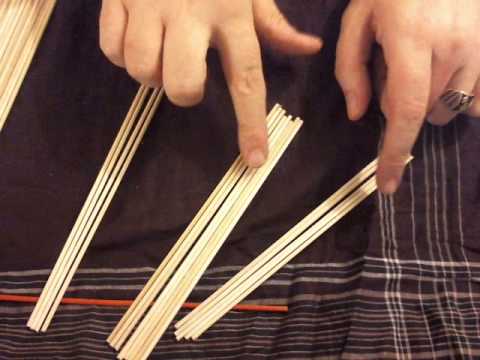
This is a new method I have devised for myself, after having felt dissatisfaction with the imperfect mirroring of change from the more popular “three coin” method, while at the same time finding the complexities of the traditional counting method using 50 yarrow stalks to be often too impractical. While it is called “four staves” and my own preference is to use four wooden sticks, you could in fact use any four two-sided objects; these can be coins, or flat sticks, or anything else, where the two sides are distinguishable from one another (coins with a "head" and "tail", for example, or sticks that have a mark on one side). In my own case, I use four carpenter's pencils (which are two-sided) and have marked one side of each with a black line to delineate the “Yang” side.


To perform a reading, begin with the ritual procedure delineated in the Magician's I Ching.

You should be prepared with paper and pen, to note the results, and then you toss the devices. For simplicity's sake, assume one side of the device is the “yang” side, and the other is the “yin” side; If you are using something other than coins, its a good idea to mark only one side to allow for quick and easy distinction as to which side is which.

When you throw the devices, you have to see how they each came up:

If all four come up Yin, the result is a broken changing line. Draw a split line and put a mark or an “x” next to it, to note it is a changing line.

If three come up Yin (and one yang): the result is a broken line. Draw a split line.

If they are tied (2 and 2) you have to look at the one that fell furthest to your left:
if that one is a Yin: the result is a broken line (draw a split line)
if that one is a Yang: the result is a solid changing line (draw it and put a mark or an “x” next to it, to note that it is a changing line)

If three come up Yang (and one Yin), OR if all four come up Yang: the result is a solid line. Draw a straight line on your page.

As usual, you do this six times to generate the hexagram.


The reason this method is preferable to the “three coin method” is that in that latter method there is an equal chance of getting a solid or broken line; and an equal (lesser) chance of getting a solid changing or broken changing line. But in the “Four Staves” method it is most rare to get a broken changing line (1/16 chance); slightly less rare to get a solid changing line (3/16); less rare still to get a solid line (5/16), and most common of all to get a broken line (7/16).

These odds match those of the oldest method of I Ching divination, the complicated counting method of 50 yarrow stalks. The odds with that method are almost exactly the same as in this method. And it is important because this method more accurately reflects the probabilities of Change. It is more probable in reality that something be in a state of weakness than in a state of strength; and more probable that something strong will weakening, than something weak strengthening.

This is the nature of reality; so by using this method you get the most accurate approximation of the laws of nature.