A video today, explaining our relationship to the universe, and the path to Union.
Bagua

Showing posts with label Macrocosm. Show all posts
Showing posts with label Macrocosm. Show all posts
Friday, March 29, 2019
You Don't Matter and That's The Only Way To Matter
A video today, explaining our relationship to the universe, and the path to Union.

Wednesday, December 5, 2018
On the Nature of Nuclear Hexagrams
Nuclear Hexagrams are a frequently-misunderstood mystery of the I Ching. In The Magician's I Ching I attempted to give a brief explanation of how to understand them. They can be understood as "nuclear hexagrams" because they are the hexagram the exists inside the "nucleus" of a hexagram: the lower trigram of a nuclear hexagram consists of lines 2, 3 and 4 of the original hexagram, and the upper trigram consists of lines 3, 4 and 5 of the original hexagram.
So for example, Hexagram #19:
 has as its nuclear Hexagram #24:
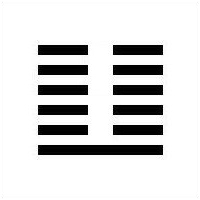 I have seen some people mistakenly look at nuclear hexagrams in an I Ching casting as if it was some additional part of the divination process on its own, as if there was some random element to it which contributed to the 'fortune telling' itself. But the nuclear hexagram is static, every hexagram only has a single nuclear (though in the cases of Hexagram #1 and Hexagram #2, they are their own nuclear).
In fact, Nuclear Hexagrams are part of a system of clusters or connections between hexagrams. On the cover of The Magician's I Ching, you can see this pattern depicted artistically:

The nuclears show you groups of common hexagrams which can be understood to interact in special ways. Their main practical use is for the purpose of contemplating the mysteries and deepening one's understanding of the I Ching as a whole and of the individual hexagrams. The relationship of the hexagrams connected by their nuclear provides important insights.
Let's look, for example, at the hexagrams that have Hexagram #23 as their nuclear:

Hexagram #23 is "Shedding".
In this set of four hexagrams with #23 as their nuclear, for example, you can see the pattern that starts first with the effort of beginning, with Hexagram #3, "challenge":

Then as you build up, it leads to bringing things together, with Hexagram #8 "Union":
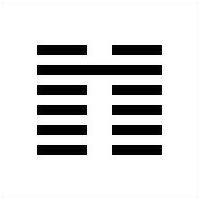
After this, you move to reaching beyond the level of the foundations to be able to discover the greater mastery that is more than the sum of its parts, with Hexagram #20 "Contemplating":

And finally, to the state of making advance to a new level, with Hexagram #42 "Gaining":

So to put it another way, looking at it (for example) in the context of Cultivation: first the initial enthusiasm in the face of a vast undertaking, then the hard work of mastering the basic forms of the exercise, then when that is mastered of understanding what lies beyond the mere technical practice and exploring the essence, and then the genuine growth.
This needs to begin with Shedding (#23); you can almost imagine the "landslide" of Shedding, and following that landslide the tiny sprout of #3 breaking out of the shifted ground, then the hard work of growth, then the bearing fruit, and finally the harvest.
But it is also true that the nuclear governs at each step; as you move from one step to the next there needs to always be a process of shedding off some of what you are doing to make room for the next stage of growth.
In your own I Ching studies, first you need to study and learn the basic meanings of each hexagram by itself. But once you're ready to go deeper, studying the nuclears and the connections between the hexagrams and their nuclears will be of great use for developing a larger understanding of the greater mysteries of the I Ching.
So for example, Hexagram #19:
In fact, Nuclear Hexagrams are part of a system of clusters or connections between hexagrams. On the cover of The Magician's I Ching, you can see this pattern depicted artistically:

The nuclears show you groups of common hexagrams which can be understood to interact in special ways. Their main practical use is for the purpose of contemplating the mysteries and deepening one's understanding of the I Ching as a whole and of the individual hexagrams. The relationship of the hexagrams connected by their nuclear provides important insights.
Let's look, for example, at the hexagrams that have Hexagram #23 as their nuclear:
Hexagram #23 is "Shedding".
In this set of four hexagrams with #23 as their nuclear, for example, you can see the pattern that starts first with the effort of beginning, with Hexagram #3, "challenge":
Then as you build up, it leads to bringing things together, with Hexagram #8 "Union":
After this, you move to reaching beyond the level of the foundations to be able to discover the greater mastery that is more than the sum of its parts, with Hexagram #20 "Contemplating":
And finally, to the state of making advance to a new level, with Hexagram #42 "Gaining":
So to put it another way, looking at it (for example) in the context of Cultivation: first the initial enthusiasm in the face of a vast undertaking, then the hard work of mastering the basic forms of the exercise, then when that is mastered of understanding what lies beyond the mere technical practice and exploring the essence, and then the genuine growth.
This needs to begin with Shedding (#23); you can almost imagine the "landslide" of Shedding, and following that landslide the tiny sprout of #3 breaking out of the shifted ground, then the hard work of growth, then the bearing fruit, and finally the harvest.
But it is also true that the nuclear governs at each step; as you move from one step to the next there needs to always be a process of shedding off some of what you are doing to make room for the next stage of growth.
In your own I Ching studies, first you need to study and learn the basic meanings of each hexagram by itself. But once you're ready to go deeper, studying the nuclears and the connections between the hexagrams and their nuclears will be of great use for developing a larger understanding of the greater mysteries of the I Ching.
Wednesday, July 26, 2017
The Yi Fa Cosmology
Some people have asked about the cosmology of the Yi Fa curriculum.
In fact, the cosmology of Yi Fa is directly drawn from the teachings of the I Ching.
There are more details of the cosmology in the teachings of levels 2 and 3 of the Yi Fa curriculum.
What follows is only an explanation in brief.
There is the whole, first off (you could call it the Taiji or the Tao if you like, the absolute sum of all that actually exists).
Then there are certain primal forces (Yin and Yang, the four fundamental forces of existence, the eight elements) which all have archetypal existence. Some of them may appear to have personalities but that's really our way of being able to comprehend them.
Then there's the manifested world, "the World of 10000 Things" as the Chinese poetically put it. It contains all of of those things I mentioned above WITHIN it. Those things are the building blocks of the manifested world, what you find when you look at reality on both the cosmic scale, and by going deep within.
So those elements and primal forces and positive and negative (yang and yin) all exist within us. They take shape to make each of us a unique expression of reality.
Human beings are unique (as far as we currently know) in that we are capable of conscious awareness of these forces. We have Will. Even if most of us never actually use it.
We can use this Will to become conscious operators of those forces, not just reactive operators the way other things in the world of 10000 things are. But that consciousness also creates in us an illusion of separateness from reality. We mistake being Unique for being Apart. And this illusion can be called the Persona.
Since it is an illusion, and we cannot ever actually be apart, it creates a conflict within us between the part of us that is Real and the part of us that is fabricated, the Individual and the Person. In Chinese mysticism, these are two separate parts of the human soul, called the Hung and the Po. The Hung is eternal, the Po is temporal and dissolves after death. The Hung is the Superior Individual, the Po is the Inferior Person.
Thus, the cosmology of the Yi Fa curriculum establishes the cause of our human alienation, and also shows the path toward resolving it, by manifesting the Superior Individual.
Thursday, June 29, 2017
The Great Work, Healing, and Growth
Is personal 'healing', physical or emotional, a part of the Great Work?
The Great Work has many levels at which it operates.
In the Microcosmic, it has to do with growth, expanding consciousness, the achievement of the Superior Individual, and Enlightenment.
In the Macrocosmic, it has to do with the spiritual evolution of humanity. There's much more teaching on this subject in Levels 2 and 3 of the curriculum.
As to 'healing' think of it like this: imagine there's a complex knot tied in a string, and that knot is in a tiny box (say, 2 inches by 2 inches). The perspective most people have on "healing" is like trying to untie that knot in that tiny little box, because the knot occupies almost all of the space in the box.
Growth is where you expand that box, so the space is now 2 feet by 2 feet; or 2 yards by 2 yards, or 2 miles by 2 miles. So now, that knot that seemed so huge occupies just a tiny little space in the box. At that point, if it was necessary, the knot would be much easier to untie; but you might find that the knot is now so small that it won't really need to be untied at all, it can just be there, as one tiny part of the large space.
The Great Work has many levels at which it operates.
In the Microcosmic, it has to do with growth, expanding consciousness, the achievement of the Superior Individual, and Enlightenment.
In the Macrocosmic, it has to do with the spiritual evolution of humanity. There's much more teaching on this subject in Levels 2 and 3 of the curriculum.
As to 'healing' think of it like this: imagine there's a complex knot tied in a string, and that knot is in a tiny box (say, 2 inches by 2 inches). The perspective most people have on "healing" is like trying to untie that knot in that tiny little box, because the knot occupies almost all of the space in the box.
Growth is where you expand that box, so the space is now 2 feet by 2 feet; or 2 yards by 2 yards, or 2 miles by 2 miles. So now, that knot that seemed so huge occupies just a tiny little space in the box. At that point, if it was necessary, the knot would be much easier to untie; but you might find that the knot is now so small that it won't really need to be untied at all, it can just be there, as one tiny part of the large space.
Wednesday, August 17, 2016
The Relationship Between "Spritual" and "Reality"
There is a great spiritual difference between spiritual teachings and religions that place the unmanifested above the manifested, and those that do not. Just as there are materialistic philosophies which deny anything 'spiritual', there are also anti-materialist belief systems that deny the material in favor of something they choose to imagine as 'spiritual', separate from the material.
In ancient China, all three concepts existed. There were strictly materialist philosophies that denied anything but the manifest, the "Yi-fa". There were likewise many movements that wanted to envision the universe as a universe of immaterial 'spirit' and that the manifested world was either an illusion or a corruption, something inferior to the pure and unsullied 'spiritual world'.
But if you study the I Ching and the teachings of the great Sages, it becomes evident that neither of these are a correct reflection of reality.
This same conflict existed in many other places and times, with other names; certain "gnostic" sects in the west claimed that our world was nothing but an illusion. The institutional forms of Buddhism made similar claims, many of them ascribing a higher position to some 'spiritual' world that the Buddha himself denied.
In The Magician's I Ching, I have detailed the story of the debate between Zhang Shi and Zhu Xi, and Zhu Xi's quest to achieve enlightenment as to the true nature of reality, and how to reconcile the difference between the unmanifested (Wei Fa) and the manifested (Yi Fa). It is unsurprising that after coming to realization, Zhu Xi would strongly advocate the study and practice of the I Ching, because within it, it uncovers the truth of this relationship.
Some would-be mystics want to conceive of the nature of reality as a kind of top-down hierarchy where the lowest and least important level of reality is the manifested world. But consider the I Ching: a hexagram contains, within it, the trigrams. Trigrams contain, within them, the Yin and the Yang. Within Yin and Yang are found the Taiji (the undivided polarity). Within the Taiji is the the Wuji (the boundless), and within that boundlessness is Wu (emptiness).
Without trying to confuse scientific concepts with mystical ones, this can't help but bring to mind the nature of physical reality as we understand it today: how within objects there are molecules, those are composed of atoms, atoms are composed of protons and electrons, within those there are quantum particles, and inside all of this is empty space. Reality is not top-down, it is a whole, and that whole has layers, more fundamental and basic layers, and more complex outer layers.
This is the functioning of reality, and it is essential to understand if you are going to practice a real system of cultivation (because any spiritual practice not based on reality will not get you very far)! The Manifested (Yi Fa) and the Unmanifested (Wei Fa) must of necessity both exist, they are both real, but the only place where the unmanifested can possibly exist is within the Manifested. Wei Fa is not 'outside' or 'beyond' Yi Fa, it is only real within Yi Fa.
This is important to spiritual practice, because it means that Wei Fa, for the practitioner, can only be reached through the Yi Fa. You can't reject the body, reject the world, reject reality, and go off into some spiritual wonderland that is somehow beyond all that, because there is nothing to connect to there. You cannot find the Unity of all things by rejecting any thing. You have no tools to connect to the truly 'spiritual' if you ignore your body, your mind, your world, and your interactions with the world. This place, this world, our bodies, our awareness, all the things that exist in the manifested reality are the alchemical laboratory of our self-transformation. Without them, you can go nowhere.
In ancient China, all three concepts existed. There were strictly materialist philosophies that denied anything but the manifest, the "Yi-fa". There were likewise many movements that wanted to envision the universe as a universe of immaterial 'spirit' and that the manifested world was either an illusion or a corruption, something inferior to the pure and unsullied 'spiritual world'.
But if you study the I Ching and the teachings of the great Sages, it becomes evident that neither of these are a correct reflection of reality.
This same conflict existed in many other places and times, with other names; certain "gnostic" sects in the west claimed that our world was nothing but an illusion. The institutional forms of Buddhism made similar claims, many of them ascribing a higher position to some 'spiritual' world that the Buddha himself denied.
In The Magician's I Ching, I have detailed the story of the debate between Zhang Shi and Zhu Xi, and Zhu Xi's quest to achieve enlightenment as to the true nature of reality, and how to reconcile the difference between the unmanifested (Wei Fa) and the manifested (Yi Fa). It is unsurprising that after coming to realization, Zhu Xi would strongly advocate the study and practice of the I Ching, because within it, it uncovers the truth of this relationship.
Some would-be mystics want to conceive of the nature of reality as a kind of top-down hierarchy where the lowest and least important level of reality is the manifested world. But consider the I Ching: a hexagram contains, within it, the trigrams. Trigrams contain, within them, the Yin and the Yang. Within Yin and Yang are found the Taiji (the undivided polarity). Within the Taiji is the the Wuji (the boundless), and within that boundlessness is Wu (emptiness).
Without trying to confuse scientific concepts with mystical ones, this can't help but bring to mind the nature of physical reality as we understand it today: how within objects there are molecules, those are composed of atoms, atoms are composed of protons and electrons, within those there are quantum particles, and inside all of this is empty space. Reality is not top-down, it is a whole, and that whole has layers, more fundamental and basic layers, and more complex outer layers.
This is the functioning of reality, and it is essential to understand if you are going to practice a real system of cultivation (because any spiritual practice not based on reality will not get you very far)! The Manifested (Yi Fa) and the Unmanifested (Wei Fa) must of necessity both exist, they are both real, but the only place where the unmanifested can possibly exist is within the Manifested. Wei Fa is not 'outside' or 'beyond' Yi Fa, it is only real within Yi Fa.
This is important to spiritual practice, because it means that Wei Fa, for the practitioner, can only be reached through the Yi Fa. You can't reject the body, reject the world, reject reality, and go off into some spiritual wonderland that is somehow beyond all that, because there is nothing to connect to there. You cannot find the Unity of all things by rejecting any thing. You have no tools to connect to the truly 'spiritual' if you ignore your body, your mind, your world, and your interactions with the world. This place, this world, our bodies, our awareness, all the things that exist in the manifested reality are the alchemical laboratory of our self-transformation. Without them, you can go nowhere.
Thursday, February 11, 2016
More on the I Ching, Macrocosm and Microcosm
This is a follow up to the previous entry, where I touched on the difference between Macrocosmic and Microcosmic perspectives of the I Ching.
Some people wanted more clarification on this subject, which is not often touched upon in writings.
The type of divination you do when you cast the I Ching with the yarrow stalks, staves, or coins, etc. is a 'microcosmic' divination. It is a casting influenced by two factors, on account of this: the first factor is the objective reading of Time in this present point in space. The second factor is the role of your place in that measurement, with regards to the specific question you are asking.
So this is why you could ask different questions, on different subjects, within the same time frame; it is also why you should not keep trying to ask the same question about the same subject; although in some specific situations, you might want to ask a follow-up question or something that results from the first casting. In the case of getting Hexagram #8 as a result, the I Ching is explicitly ordering you to do so! Conversely, if you get Hexagram #4, it suggests that your 'follow-up' questions are really being motivated by a desire to get a different answer than the one you got, and you absolutely should stop consulting on this subject.
This is the difference between ordinary casting and the Plum Blossom Numerology system; the latter is 'macrocosmic', it doesn't do a reading of your personal place regarding a situation, but of an objective measurement of time. Your own place is not included in the casting, only the governing measurement of the point in time you are making a calculation for.
So when you use the Plum Blossom method you are getting a reading relating to the auspiciousness or inauspiciousness of a particular moment in time, which applies to all matters connected to that particular moment.
Understanding this difference can help you understand what situations are better suited to a 'regular' I Ching Casting, and which are better suited to the numerological system of the Plum Blossom method.
Some people wanted more clarification on this subject, which is not often touched upon in writings.
The type of divination you do when you cast the I Ching with the yarrow stalks, staves, or coins, etc. is a 'microcosmic' divination. It is a casting influenced by two factors, on account of this: the first factor is the objective reading of Time in this present point in space. The second factor is the role of your place in that measurement, with regards to the specific question you are asking.
So this is why you could ask different questions, on different subjects, within the same time frame; it is also why you should not keep trying to ask the same question about the same subject; although in some specific situations, you might want to ask a follow-up question or something that results from the first casting. In the case of getting Hexagram #8 as a result, the I Ching is explicitly ordering you to do so! Conversely, if you get Hexagram #4, it suggests that your 'follow-up' questions are really being motivated by a desire to get a different answer than the one you got, and you absolutely should stop consulting on this subject.
This is the difference between ordinary casting and the Plum Blossom Numerology system; the latter is 'macrocosmic', it doesn't do a reading of your personal place regarding a situation, but of an objective measurement of time. Your own place is not included in the casting, only the governing measurement of the point in time you are making a calculation for.
So when you use the Plum Blossom method you are getting a reading relating to the auspiciousness or inauspiciousness of a particular moment in time, which applies to all matters connected to that particular moment.
Understanding this difference can help you understand what situations are better suited to a 'regular' I Ching Casting, and which are better suited to the numerological system of the Plum Blossom method.
Subscribe to:
Posts (Atom)