Bagua

Bagua
Showing posts with label Superior Individual. Show all posts

Friday, November 13, 2020

What is the Nature of the Superior Individual?

In the philosophy of the I Ching,  there is a basic truth that in every moment, we have a choice between manifesting the Superior Individual or the inferior person. 

Among those who practice cultivation, however, there may be some question as to just what the "Superior Individual" is.  In the course of cultivation, one might get a sense of the Superior Individual being some outside entity, the "higher self" sending them messages or guiding their life. 

So some have developed a conception where the Superior Individual is some kind of outside spiritual, angelic or divine entity.

But in fact, the Superior Individual is basic part of ourselves. It is not a separate being at all, it is us. The best of us. 

 This sense of differentness, of the Superior Individual seeming like another being with its own intelligence and communicating with us is a product of people's primary identification with the 'inferior person', which is also a part of us. Thus, we have become separate from the 'higher self'.


Why are we separated from our higher self?

We aren't, but it seems this way.

The issue is this: we are a species in the process of evolution. Our consciousness has multiple layers, which can be generally divided into two parts. In the context of I Ching studies (including the Yi Fa work) these are described as "World" and "Heaven". To Nietzche it was "last man" and "super-man". In others, it could be called "animal" and "divine".


The Chinese actually say that there are two parts to the human soul: Po and Hung. The Po is the part of us that is animal instinct plus conditioned behavior. The Hung is the part of us that is our fullest potential and true Individuality (as opposed to the 'persona' of our inferior po-soul).

We can, at every moment, choose to associate with one or the other. But on account of our intermediary condition and because of our social conditioning we tend to more directly identify ourselves as the "Inferior Person". So much so, that the Superior Individual can sometimes feel like it's a separate entity, some kind of guiding spirit.

You will find, if you engage with discipline in a sincere long-term course of spiritual cultivation, that over time, you will become more and more identified as one with the Superior Individual. At that point, the 'ideas' of the Superior Individual will be identical to your own, and the notions of the inferior person, which will still be present, will instead be the ones that appear to be foreign.

Thursday, October 22, 2020

The Steps of Human Consciousness

 There's a teaching in Chinese mysticism that there are two levels of our consciousness. They're associated with the concepts in the I Ching of the "inferior person" and "superior individual". 

At every moment in space and time we have a choice of which of the two we associate with in our active consciousness, but most people in general associate with the inferior person. The inferior person is a collection of influences and conditionings based on your physical nature, your environment, and the influences of your past and present choices and people in your life.

The Superior Individual is your true nature, what is real about you behind all those things. But in point of fact most people are so disconnected from their true and essential nature that it feels like it is another person. In many rituals used to "communicate" with the Superior Individual, that division is so notable that it feels like the Superior individual is some totally different entity from "ourselves", which is why in western symbolism its called the "Holy Guardian Angel". 

This is also why when one is trying to shift the association of their consciousness from the inferior person to the Superior Individual it feels like dying, like the very essence of who were until now (or rather, who you thought you were) has to be destroyed for you to get to that true self. In a lot of cases, people's motives for getting to that true state involve desires OF the inferior person, so they realize that to get to what's real, they'll have to give up the fantasies of the false person they were, and that's very hard.

This internal conflict is mirrored externally by the struggle between (the inferior person) wanting to imagine one's self the center of the universe, and wanting to have a power that acts on the universe and get to impose its desires on the universe, and the (Superior Individual's) understanding that we are one non-divisible part of reality and are not the central actor but one small part of a very big picture in the vastness of Space and Time, and how this is not something that can just be reasoned out, but has to be experienced through meditative practice and the application of virtue to restore that Union with the Taiji (what in modern English we could call the "Singularity").


So in fact while most of these sorts of studies and articles and ordinary perceptions on the subject of "enlightenment" talk about a two-option process (unconsciousness / enlightenment), the work of spiritual Cultivation is actually a multi-step process of initial glimpses of waking up, initiation, developing discipline, achieving communication with the Superior Individual (in western magick called the "True Will"), working to change one's life and environment to better fit one's efforts at attainment and union, making the shift from general association with the inferior person to general association with the Superior Individual, engaging in teaching or other forms of applying Virtue in the world, attaining states of Union to reality, and finally manifesting that Union fully and becoming the Sage (Enlightenment). There are steps Beyond Enlightenment as well but these are generally not spoken of in lay contexts.

Of the above stages, the big three are:

- Initiation: the beginning of awareness of one's Enlightenment quality, and the start of serious spiritual cultivation.

-Adepthood: the shift into association with the Superior Individual

-Enlightenment: uniting to nature or space-time as a whole (which is to say, overcoming this false notion of separation between self and other, and the self-referencing nature of "thinking you're in the middle of the picture").


Finally, I'll note that the very notion that Enlightenment is some kind of separation from the World or one's humanity is ridiculous and disgusting. That's essentially either nihilism or solipsism, the heresies of the gnostics. You can't become "one with everything" by being less human, or less engaged. 

Anyone claiming to be Enlightened while pretending that they don't care about things, or feel things, or that there are certain normal human things that they just don't experience (be it anger, sadness, physical pain, or basic physical needs) are both arguing for Enlightenment being a kind of sub-humanity, and blatant liars.

Enlightenment requires, as my own teacher once said, that you Be More Human.

It's not about separating yourself, it's about Showing Up, being present in the active consciousness.
It's not about feeling less or caring less, it's about Totality. Becoming one part of the big picture, without trying to run away from that big picture, or trying to be right in the middle of that big picture, or trying to control that big picture. It's about being 100% of yourself in the here and now.


Wednesday, February 26, 2020

Cultivating the True Will and Superior Individual

What you have to understand is that achieving the True Will (what in I Ching terms is called the Superior Individual) requires three basic ingredients:

The first is self-inquiry. That is to say, growing in your understanding of your self, and what you are really capable of, and developing a way of tapping in, at every given moment and each given decision, to what is the best choice you can make to manifest that true will. Both meditation (Qi breathing) and the study of the I Ching helps with this; the former because it connects body and consciousness, the latter because it guides you in the situations where you can come to frame your choices in time and space. The I Ching is used for divination, but in the context of the Great Work it is a lot more than that; sometimes you will need to cast the I Ching to get answers to difficult situations, but as you grow in practice and if you've spent enough time in contemplating and considering the meaning of the I Ching you will eventually develop an ability to understand what to do by an "observation of nature" (that is, by paying attention to where you are in time and space, and being able to manifest the best possible self in your choices at that moment).

The second is developing in Virtue. The term Virtue is a very specific thing in the context of Yi Fa work; it means working on improving your dedication to the four core concepts inherent in "Yuan Heng Li Zhen": Union/Love, Discipline, Harmony/Justness, and Truth/Sincerity.


It isn't enough to just think about or study these concepts; you have to work on trying to embody them in everything you do in your everyday life. This takes a lot of work, it's like an exercise regime: you'll get better at it the more often you do it. The practice of self-inquiry mentioned above is very important in this regard because as you get better at being able to overcome the passions and impulses of the Inferior Person (the opposite of your True Will, your conditionings) the easier it will be to remember to manifest these qualities.

And the third part is the exercises of Yi Fa Qi Gong. These exercise are a kind of internal alchemy; they gradually transform your body and consciousness at the same time. First off by giving you the opportunity to accumulate Qi (life force) within yourself, that is then transformed within your body to a force that breaks down the attachments you have to activities of the Inferior Person (relating to what in modern lingo could be called the mind/body connection). Beyond that, the regular practice of the exercises helps to generate Virtue, which you can then apply as mentioned above in your everyday life.


As you become more advanced in the Qi Gong practice, it will unlock new levels of your consciousness which will grant you the ability to increasingly directly manifest the Superior Individual.

Of course, all of this depends on you practicing the Work with sincerity and dedication. It takes time, but the longer you do it the more cumulative and lasting the benefits become.

Thursday, October 31, 2019

Who is the Inferior Person?

In the I Ching, we are presented with a division between two levels of the self: the self as the "inferior person", and the self as the "Superior Individual". One of the most fundamental teachings of the I Ching is that in every moment, we are constantly facing a choice between embodying the inferior person, or embodying the Superior Individual.
 
But if the Superior Individual is our true nature, our consciousness applied to totality, when we are 100% engaged and united to reality... then what is the inferior person? What are you when you are being the inferior person?  And what is the real 'problem' of the inferior person?

First, the inferior person is who you usually imagine yourself to be. In fact, it is a groundless mishmash of transitory influences, from influences of our childhood and past, of our environment, of the influences people and ideas and media have made over our notions of reality and who we are, until we wear it all like a false patchwork skin.Wearing this skin gives us a false sense of security and significance, where we "know who we are" and "what we want", and yet ironically it is the real source of our most crippling insecurities and insignificance.


Yourself as the inferior person is really nothing at all; it's a tiny little man, in a very restricted world.

You make yourself small by shutting yourself into your limiting perspective.

You make yourself a world that's small, by only referring to reality through your own centered lens.

And when you're that small, that you affect only your own little controlled world, then what you do doesn't really matter.

It is fleeting, because it is so limited.

It creates a momentary effect, that all too often crashes against a larger reality it tries to defy, and sooner or later your efforts, that you imagined to be so very great, come to nothing.


So the problem of the inferior person is that they are a 'shut-in'. Instead of showing up, letting themselves be part of reality as it is, they are locked into their tiny fantasy universe, seeing only glimpses of heavily-altered reality through that lens of all their desires and fears and programmed beliefs. This means that they are not able to be effective in the world.

Whereas when you don't insist on being only in the center, when you act in Union and accordance with the whole force of the universe, even very small efforts can move along that flow of reality to make huge changes to yourself and to the world.

Thursday, November 8, 2018

Hexagram #12 and the Mulberry Buds

After posting the video commentary to Hexagram #12, where I had recited the text of the hexagram as it appears in The Magician's I Ching, someone presented me with an interesting question:

"What happened to the roots of the mulberry tree in line 5? Anyway, I am surprised that your version is so much different from the original text, that's all."

I felt that it was important to present an answer to this, for those who are students of the Yi Fa Society or readers of my book.


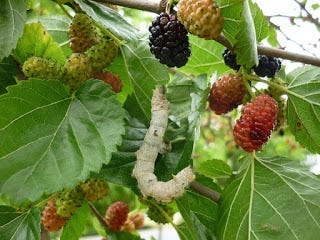
For a start, line five, in the original text, doesn't refer to any 'roots'. It refers to the flower-buds of the Mulberry tree. This is a reference to fortune, patience, and constancy.

So for those who know what the reference to the mulberry tree means, the meaning is in the line I quoted. For those who don't know what the reference to the mulberry tree means, the meaning is in the line I quoted.

"Bao" refers to the calyx or bud of a flower. Xi in this case (to tie) refers to a silkworm, which will make its cocoon next to the flower bud of a mulberry tree.


In other words, it is a stuckness that must be done, to follow one's true will. When the flower bud unsticks, naturally, in the flowering moment, then the silkworm's cocoon opens as well, and the silkmoth will be freed. The Superior individual must remind himself constantly, to create constancy and patience, to bring an end to corruption.


As far as the absence of the analogy in the text, the questioner actually gives a perfect example of why I kept it out. Trying to explain this analogy which is so out of western culture would have required too much room for this type of text, and leaving it as it was for some kind of academic precision in the blind dumb service of sinology would only have created something impractical for actual use for most readers.

Again, those who UNDERSTAND the meaning of the mulberry in this line would understand the line as I wrote it. Those who don't know the existence of the symbol would receive the meaning without the symbol present, and avoid confusion. The only ones who would be distressed by the line as I presented it are people who know, but do not understand.

Friday, March 24, 2017

On the Scope of the Great Work


On a personal level, the Great Work involves each individual's progress to manifesting the Superior Individual, and attaining to the level of the Sage (Enlightenment).

But on a greater scale, the Great Work involves the spiritual evolution of humanity as a whole.
In that greater scale, the work you do applying Virtue in the world is not meant to change the world at this present time, but to lay down currents of Change that will change the world over the course of cosmic Time. 

Presidencies, nations and whole civilizations will come and go while we perform the Great Work.
Things happening in the world now are the ripple-effect of things Initiates did 300 years ago.

The things we do with consciousness now will ripple forward to change the entire world 300 years from now.
The Great Work on this scale is done not for one's own gratification, because it is not anything any of us will live to see.


It is work to change the future.

Tuesday, July 5, 2016

Dealing With Reluctance to Practice


We ALL have moments where we hunker down and become reluctant to engage in our daily practice of Qi Gong and meditation. The question, and the difference, is what we do after that.  There's two (not incompatible) ways of handling this. The first is to try to reconnect to the joy of doing the practice.  The practice can't feel great ALL the time, but we should in general be able to find things that feel good about practicing.

So one step is to focus on the parts or the ways the practice feels good.  When we're very ill, for example, it's good to do as much as we can of the practice while ill, but not too much more than it could either harm us or sour us to the practice.

When we are for non-physical reasons in a state of malaise, it can be good to figure out and remember those things we like most about practicing, and give ourselves permission to just do those for a few days, to focus on improving those parts. To ignore or de-emphasize the parts we think we don't care for and spend more time focusing on the parts we do.

You could say that's the Yin way.


The second way is to focus on Discipline, and push ourselves forward to practice. To defy our own Inferior Person and take our practice as an act of our own Will to defy what we might happen to be feeling at the given moment. Doing that first, we can start to turn around and find value in our practicing, and then reconnect to the joy of practicing.

You could say that's the Yang way.


The ideal is to be clear on which way to deal with the barriers to our practice at this given time.


Monday, January 25, 2016

Zhu Xi's 8 Points of Cultivation Training


Zhu Xi was one of the greatest teachers of Yi Fa, and responsible for its fullest elaboration in Chinese Philosophy.  He was a strong advocate of cultivation practice in an age where it was not generally approved of by the intelligentsia. His fellow scholars tried to claim that the I Ching should only be studied as a philosophical text, and not actually used; and many of them dismissed Qi Gong and meditation entirely as merely 'mystical' activities that were unnecessary. They believed that a sage only needed to memorize and repeat the classic teachings, or speculate on intellectual matters.

Thus, Zhu Xi had to restore conditions in Cultivation practice that were in a strong state of disrepair. He brought back significance and legitimacy to the active practice of cultivation work, and explained how this was vital to the process of self-transformation.

He had eight key points that he considered essential to being effective at self-cultivation:


Zhu Xi's 8 Points of Cultivation Training

1. Zhujing: maintain a state of composure.  In other words, step 1 is to remember to relax and be present.

2. Zhen-tu: Attention in solitude.  The practice of Showing Up to reality, letting yourself become attentive and sensitive to the sensations of your body and consciousness to detect the "weifa" (unmanifested reality) within the "yi fa" (reality).

3. Xing-cha: self-inquiry.  You must seek to understand the nature of your own being and the sources of your qualities in the past.

4. Cun-yang: "Preserve and nourish".  You must hold to your original nature. Find the most natural way of your being and help it be nourished. The 'most natural' here does not mean the easiest or your baser impulse, but rather your higher nature, the Superior Individual.

5. Ke-ji: "conquering the self". Overcome your own tendencies and outside influences to maintain discipline in practice and develop Virtue.

6. Jing-zuo: quiet contemplation. Collect your thoughts, nourish your consciousness.

7. Ke-wu zhih-zhih: "grasping the whole pattern (of events and phenomena)".  Observe beyond the merely visible, by making use of your mind, intuition and consciousness, within and without you. Thus you will achieve "guandong", usually translated as "interpenetration": the state of seeing the connections in all things.

8. Xing: "practice".  Ceaselessly continue in your practice, ceaselessly apply what you have practiced to your life.


Monday, January 11, 2016

How Different Levels of Divination Technologies Work

Someone had commented once, on the issue of challenges to the I Ching, specifically that the I Ching is really not different from using a Magic 8-Ball.
The thing is, the way a lot of people use it, the I Ching isn't any better than a magic 8-ball!


There are different forms of divination; you have the Simple Oracle, at the lowest level. This is where you can just flip a coin, shake a magic 8-ball, open a book to a random page. In terms of the Technology of Divination, this is something that works only on the basis of being just an aid (a catalyst, really) for your own intuition. Divination through coin-flipping or bibliomancy or baseball cards for that matter would all be based purely on your intuitive reaction to what is being done, it adds nothing by itself, and so really the method you use is interchangeable with any other in that case.


The thing is, more sophisticated divination technologies are often used by people as though they were Simple Oracles. Anyone who says they're an "intuitive reader" of the tarot cards, and just draws a bunch of cards, has no previous study of their structure or symbolism, and only 'reads' them by looking at the pictures and asking themselves what they think it means, are just using the Tarot as a Simple Oracle. If you do the same with the I Ching, again you are using it only as a simple oracle (though being a textual rather than purely visual divination system, it has some safeguards against that). If you use Tarot or I Ching in this way, it is LITERALLY NO DIFFERENT than using a magic 8-ball.


The next higher level are divination systems that have some form of metaphysic; that is, a set of symbols that are meant to reflect a model of reality. The Tarot, Runes, and I Ching all have this, as does Western, Indian and Chinese Astrology; but so do many other simpler systems (if you got four cards and said "these are earth, air fire and water", that would already be a metaphysical divination system). These depend on you actually having some kind of knowledge of what that symbolism is; so if you use Tarot or Runes or I Ching but do no study at all of the symbolism of its component parts, you are still in fact using these as if they were simple oracles (though you can argue that the inherent 'collective unconcsious' impact of the symbols themselves, even if you don't understand them at all, might still make them slightly better at being simple oracles than if you tried to divine with baseball cards or bottle caps).


They differ from simple oracles in that when you use them you are now doing TWO things: you are still tapping into your personal intuition, but you are now ALSO tapping into the archetypal symbolism of the metaphysics being used in the system. This allows you to receive insights into the nature of reality that come out of something other than your own self.


The highest level of divination technology are systems that have not only a metaphysical but also a Transcendental element to them. These systems not only show you a model of reality, they also contain a framework (either inherent or evolved out of the symbolism) that puts your divination work in the context of what western magick calls "The Great Work"; or what in the east is sometimes referred to as the Buddha Path. That is, the work of self-transformation, not just to make the right decision but to seek to transcend one's own self/ego and attain permanent states of higher consciousness. You are using the system not just in isolation as a thing you do, but as a part of a bigger set of spiritual disciplines intended to bring about transcendence.  Only some of the Metaphysical Systems are also Transcendental Systems of divination. The Tarot and the I Ching are both examples of this; the Tarot being a system that depicts a journey (through the Major Arcana) from Initiation to Enlightenment, and the I Ching having the potential (from the addition of the Confucian commentaries onward) to understand every oracle as a guide to embodying the Superior Individual; that is, going from the "inferior man" to the "superior man".


Since the transcendental systems are almost always the same as the metaphysical systems (that is, not all metaphysical systems can be transcendental, but all transcendental systems also have a metaphysical aspect), the real difference in them is in how you are using them. If you are using a divination tool only as an aid to your own intuition, then you are using a simple oracle; if you are using a divination tool to tap into something bigger than yourself in order to get an answer that would be beyond you, you are using a metaphysical oracle. If you are doing the above within the framework of a full spiritual discipline, of spiritual practice meant to expand your consciousness and lead to self-transformation, and you are interpreting the oracle in the context not of "what answer will most benefit me materially/emotionally/etc.?" but in the context of "what answer will be the best choice for that path of enlightenment?" (or in I Ching, we could say "how can I embody the Superior Individual?"), then you are using a transcendental oracle. 


And because each by definition encompasses the previous, we can understand each level of divination to be more effective than the prior one.

It is better to use an oracle AND seek to understand its system, than just to use it intuitively. It is better to use an oracle system as a process of engaging the symbolism to aid in your self-transformation than to use it only in isolation.

Saturday, January 2, 2016

What is Involved in Applying for Yi Fa Society Membership, and the Benefits of Membership

The application process for becoming a Yi Fa Society member is just filling out a short questionnaire. Most of the questions in this form are used to understand the background and previous experience of the applicant, and their reasons for wanting to join.

There's usually only three reasons why someone wouldn't be accepted: if they didn't seem to have a serious interest in actually working the system, if they're interested in learning the system for totally wrong reasons, or if they were in a situation in their current moment where they wouldn't be able to have enough very basic stability in their life to fulfill the necessities of what it takes to practice effectively.

If you are a member of the Yi Fa Society, you get access to a secret group, where you will be taught additional material not available on this public blog or the Yi Fa Society Youtube Playlist. This includes more elaborate guidance to how to practice Yi Fa Qi Gong, secrets of the I Ching, guidance for meditations, other special techniques, and lots of files of teaching to help you in your advancement.

The group also provides you with the opportunity to interact with other members, and to  present your questions and experiences to me for help and advice. Members of the Yi Fa Society can write me any time (and are encouraged to do so AT LEAST once a month as a minimum) to let me know how they're doing and to keep them guided and motivated in their advancement.

This is at level 1.  There are 8 levels in total in the Yi Fa Society, and you have to fulfill certain work in order to move up to the next level each time (no one gets to go up just based on time served or special friendship or donations, or anything like that; this isn't about getting fancy titles, it's about learning how to master yourself and your inner being and outer world).

While level 1 is mainly about improving on the core and basic Yi Fa practices, from level 2 and up you get all kinds of new material including new and secret Qi Gong practices and I Ching secrets not available to the public.  You also receive training in techniques of advanced meditations (and what could be called 'magick') for working with your Qi, De and Gong (the three types of spiritual/alchemical forces you use in the Yi Fa system).  Each level works progressively in guiding you to self-transformation, an alchemical process to manifest your "Superior Individual" (as the I Ching calls it), or true nature.

In the Yi Fa society you work at your own pace, you can take it fast or slow, but the goal is to develop a regular and daily practice that can fit into your life and that serves as a foundation to more advanced work.  You are expected to be trying to keep working on this, and developing your discipline and virtue.

Membership in the Yi Fa Society requires that you give a monthly donation; the amount is your own choice, based on your own means and level of value you find in the work.

If you are interested in membership in the Yi Fa Society please contact me via private message on Facebook or G+.

Friday, November 6, 2015

Fake Qi Gong and People Responsible For It

Here's a great example of totally fake Qi Gong:


The old fraud in this video claims he's using Qi to move everyday objects. In fact, as subsequent investigation found out, the table he was putting all the objects on was rigged with a machine that moved them.

This was a particularly obvious example of fakery, but there are many other supposed "Qi Gong Masters" out there who engage in slightly more clever frauds.  None of them are very clever, however.  For the most part, common sense should allow one to discern fraudulence.

But why are there all these frauds?  Who is really responsible for them?  Of course, on the one hand people like this faker are responsible for the choice to engage in fraud; but the question remains as to why they feel driven to do so in the first place?

There is an old saying: "the reason there are so many fake teachers is because there are so many fake students".  The people who engage in this kind of trickery do so because there are great number of people willing to give them fame, fortune, unmerited respectability, and other benefits for their falsehood.  In turn, these people give this over to the frauds because they in turn desperately want to believe in gaining the types of powers these teachers claim to have. They want to have answers, to fix their problems, to gain fame and be respected as "spiritual people", so they will buy into what these snakeoil salesmen are selling.

If you are drawn to Qi Gong, or to other mystical teachings, it is important to look within to understand the reasons why.  You will likely find that you do have some of these reasons listed above. You may also find that you have a deeper reason: to want to transform yourself, to overcome your own limitations and develop your consciousness.

It isn't that there are just "fake students" and "real students"; this is a question of the Inferior Person and the Superior Individual taught about in the I Ching.  We all have our lower motives and our higher motives: the lower ones lead us, through fantasies and lust of result, to fool ourselves and let ourselves be fooled by otherwise obvious fakes.  The higher ones let us break free and liberate our being.

Wednesday, September 30, 2015

The "Point" of the I Ching

One of our members asked:

"the complete "point' of the i ching ( i mean in a Very Broad sense) is to bring us where or what state finally? It is an ancient tool and gift from Masters, could take lifetimes of study and still get new things... but what is the 'culmination' persay when it comes to lifetimes of learning to live with and use and appreciate the i ching as practicers and devotees (and i am of the least of those) then what is our Release... "

What I would say is this: the I Ching is first and foremost a tool to help us live our lives in the present; and to understand reality better. It lets us understand our reality at this physical level (of what you could call our "daily lives") and to understand the flow of Time and Space in relative dimensions that exist below the surface of that.

So as you grow in understanding of that, you gain in Awareness, your perceptions expand, your consciousness grows. And the I Ching does this through a system that isn't about trying to abandon or ignore our surface reality. This is a very important point. I will write more about this here, probably, and I talk about it explicitly in the book I'm working on; it is based on a spiritual concept called "yi-fa", which could be called "the Law of Change". It says that the best way to understand our "unmanifested reality" is by engaging in the manifested world.

--There's a similar teaching to this in the Book of the Law, when it states "The Khabs is in the Khu, not the Khu in the Khabs" (AL I:8)--

But the teaching of the I Ching (and the concept of Yi-Fa) also has an instruction that works on the personal rather than the universal level. This is the concept of the "Superior Individual". So the I Ching provides a framework of lessons for how to go from being a disconnected person into becoming someone who "embodies Heaven", who is Connected to this Reality. In each hexagram of the I Ching there is a hidden lesson about what we call the "Great Work", about how to develop what the I Ching calls "Virtue", which is not the standard term of that word as something like 'good behaviour', but rather the development of spiritual qualities within you that give you a kind of magical power, the power to Connect with "Heaven" (that is, with fundamental reality).

But in terms of an end-point, there really isn't one. The I Ching, like other profound mystical teachings, ultimately expresses reality as a "Spiral"; there really isn't an end to anything as such, there's no point where suddenly you say "I'm done now, I'm perfect". But it's not just a circle either; it's not that you don't change, and there are important stages along the way. You grow, you end up fulfilling more of your potential, your birthright as a human being.  In any case, if there is an end, I have not found it nor seen any hint of it. Lots of things end, including us (our lives end, stages in our lives end) but there's no big final state where Change stops.

That's the fundamental teaching of the I Ching: it is named "The Book of Changes" because it explains that the fundamental truth of reality is Change.