The official public blog of the Yi Fa Society, a mystical order dedicated to the teaching and practice of self-transformation through the study of long-hidden practices of internal alchemy.
Bagua
Showing posts with label change. Show all posts
Tuesday, September 17, 2019
The Greatest Changes You Make are the Ones You'll Never See
One of the things that the I Ching teaches you, when you get really deep into it, is to see certain things in really big scales of time.
This also brings with it the realization that all the truly big things, the really meaningful things you can do with your life, are things you will never live to see the end results of.
The key to making intentional change in something, according to the I Ching, is to do it before it starts.
To have a vision of the future, to know how to make change in something before it even starts, requires that you must be able to very clearly observe the present.
So if the future is really Incipiencies existing as 'seeds' in the present, changing the future is all about planting the right seeds.
Wednesday, July 10, 2019
The Time Travel of the I Ching
Enter the stream of the I Ching through its symbols.
The I Ching shows that time is like a forest, full of change.
The present is just the place you are at in the forest.
All the steps you took through this forest up until now have put you on this point in the path.
The direction they lead you in points toward where on the path you are heading; this is the future.
If you want to change the future, change it before it happens.
If you want to change the past, change your response to the choices you made in the past.
Tuesday, April 9, 2019
Unfolding the Nature of Truth
Truth is a more complicated concept than we tend to understand it to be. It is also a fundamental pillar of the practice of Cultivation and the development of Virtue. In particular, in the western world, there has been a kind of crisis over the nature of truth that has developed over the last several decades; in our society, certain philosophies have tried to advocate the idea that there is really no such thing as truth, or that truth is an entirely subjective personal affair (which is effectively the same as suggesting there's no such thing as truth), or that "truth" is really just some kind of collective notion where if enough people believe in something that makes it true (which is just a delusion of collective solipsism rather than individual solipsism).
This is in stark contrast to certain other paradigms that suggest that truth is starkly and plainly absolute, a thing is either true or it isn't. This latter concept may be more accurate in the sense that Truth is an absolute feature of reality, but it is not really much more productive because it fails to consider the human element of how we relate to Truth, of the process of understanding Truth.
There is absolute and objective Truth. However, what is true at any given time is not immune to the nature of Change, which the I Ching clearly demonstrates is the fundamental nature of all of reality, to which Truth is not immune. The most absolute Truth is change itself. In all other levels, Truth is only absolute in the context of Space-Time. That is, in certain places or in certain times, something can be true.
If, for example, it is raining where you are right now, that it rains is Truth, when and where you are. There's no relativity to that Truth, no amount of believing differently changes the fact that it is raining, and thus we see that it is objectively true; but we also know that it was not raining before, nor will it be raining later, so it is also a truth that is affected by Change. Saying "it is raining" is true only while it rains. With other, much vaster things, the time-span of how long something is true can be orders of magnitude greater, but it is just as affected by Change.
Our awareness as a whole, which includes elements like senses, our ability to reason, and our conscience, allow us to process and attempt to determine Truth. Because we are imperfect, and because the nature of what is true can change over time and place, the process of understanding Truth is a constant and ongoing process. We must continually unfold truth from our inner awareness and our observation of reality.
How do we do this, in practical Cultivation terms? As always, the process must begin within ourselves.
The first step to unfolding truth is found in our own choice to make the attempt to pursue truth, over what is not true. This can be defined as "sincerity". It also requires Discipline, to have not only a sincere dedication to seeking truth within and without your own being but to do what is necessary to embody this process in the world. Sincerity is important on a rational basis because if you are deluding yourself it is bound to impede your ability to see what is true about nature and reality; in a more esoteric sense, one could say that it is the nurturing of Truth within your own being that can allow you to connect to Truth in the macrocosm beyond you.
This leads you to the second step, of being able to examine the nature of Reality on a regular basis; through both rational study and the development of learning, and meditation and the development of consciousness.
This observation allows the third step, where you can determine what are right actions, truthful actions, within reality at any given place and time. This allows you to operate in Harmony within yourself, and with your surroundings.
Finally, there is a fourth element to this process, which is the question of how you relate Truth to your responsibility for humanity, how to apply truth to benefit humanity through contributing to its spiritual evolution (what can be called the Great Work). Being sincere and harmonious within ourselves develops within us a quality of fairness, where we wish for the world to be a fair place, for ourselves to be treated justly and for others to be treated justly. Our observation of the interconnection between all things in the tapestry of Space-Time makes it clear to us that this is necessary, because our well-being depends on the well being of others, and vice-versa. Similarly, any claim we have over any natural rights depends on others having the same natural rights.
At the same time, it is only through observation of Truth, and the degree to which we are able to accurately observe Truth, that we can consciously apply this sense of justice. We must be capable of being able to pragmatically manifest concepts like justice, rights, and well-being, in the degree to which is possible in the time and place we are located.
It is only through that degree of understanding what is true that we can manage to enact beneficial change (for ourselves and others, in the short term and building up into the long-term) that can actually work as intended, harmoniously with the reality of what is functional.
Thursday, October 4, 2018
The I Ching, Reality and Rules For Living
There is no one formula for what to do in life.
But there is a path to work out what to do in each moment.
Tuesday, September 18, 2018
How Do You Develop Wisdom?
There is a common misconception that age brings with it wisdom. That is not true. Even experiences are useless to wisdom, without consciousness. There are great many people in the world who are no wiser at 80 than they were at 18.
Someone who lives an unexamined life is a child forever.
So what does develop wisdom?
It is true that Time brings wisdom. But this requires not just to go through time without any consideration. You have to understand and consider time.
Considering the nature of time and one's place in it and going through it is one part of the process to develop wisdom. This is part of what is developed through the study of the I Ching.
But this alone is not enough.
There are three other factors that are essential to the development of wisdom:
The first is an attention and awareness of your Self. Most importantly, recognizing your own imperfections. It is through time that we can measure these imperfections, so that we can work on them, and through time track our improvement.
The second is the Will. Will is the raw determination to change yourself. Self-inquiry is useless if you consider yourself but make no effort to transform yourself.
The third is concentration, Attention. This is only available through disciplined training. If you practice discipline in developing your ability to be actively conscious, the Will can then be accurately applied.
Without an understanding of time, you cannot measure the self.
Without the will, you cannot take action to transform.
Without concentration, you cannot apply the will effectively.
If you have all of these, you can know how and where to work on yourself, and take note of your ability to change. This is how you develop wisdom.
Friday, March 24, 2017
On the Scope of the Great Work
On a personal level, the Great Work involves each individual's progress to manifesting the Superior Individual, and attaining to the level of the Sage (Enlightenment).
But on a greater scale, the Great Work involves the spiritual evolution of humanity as a whole.
In that greater scale, the work you do applying Virtue in the world is not meant to change the world at this present time, but to lay down currents of Change that will change the world over the course of cosmic Time.
Presidencies, nations and whole civilizations will come and go while we perform the Great Work.
Things happening in the world now are the ripple-effect of things Initiates did 300 years ago.
The things we do with consciousness now will ripple forward to change the entire world 300 years from now.
The Great Work on this scale is done not for one's own gratification, because it is not anything any of us will live to see.
It is work to change the future.
Tuesday, August 30, 2016
The Process of Integrating Truth
The process of spiritual learning requires something more than the standard method by which we are taught to learn. The Sufis have said that in spiritual training, first "you must learn how to learn".
This is because we are used to processing knowledge by simply attempting to absorb knowledge as abstract fact. For most forms of learning, this is adequate: we can memorize facts, learn formulas for things from mathematics to kitchen recipes, intellectually analyze stories and songs and art.
But for spiritual learning it is not enough to simply 'know' something in that intellectual sense. We have to integrate spiritual knowledge as Truth, and this can only be done when we unite to that knowledge in our own consciousness.
If you simply study a spiritual system, like the I Ching, through intellectual analysis, this learning will continue to remain superficial, second-hand. But the power of symbols is that they do not operate solely on the level of intellect, but also on the level of consciousness. Any given set of spiritual symbols, like those of the I Ching, can certainly be studied and comprehended through the level of the intellect; but to actually use them in cultivation practice (and not just theoretical study), the symbol itself must be integrated into the individual's consciousness. Unity between object and subject must be achieved, through the vehicle of Symbol.
The standard process of study separates subject from object; in fact, standard academia tends to venerate the quality of 'objectivity' in some forms of study, of keeping a certain amount of clinical distance from the topic of study.
But in spiritual learning, this is the process:
1. The object (of study) exists outside of the subject (the self).
2. On being examined experientially, the object has an effect on the subject.
3. The Symbol (that is, the concept/image/essence) of the object, is made present IN the subject's consciousness.
To "Learn", therefore, the student must repeat steps 1-3 over and over again. This is an understanding by immersion, rather than deduction. Every time the process is repeated the integration has an effect on the student, as the symbol becomes more true in the consciousness of the student, and thus it not only becomes more understood, but also changes the student in the process.
Rather than separate subject and object, you must bring them together to attain understanding.
The ability to integrate symbol also depends on your level of attainment. As you proceed in meditation practice, in spiritual discipline, the development of Virtue, and also grow in knowledge and maturity through life experiences, you change as an Individual, and this allows you to change the extent to which you integrate symbol and the levels to which you can integrate (comprehend and be changed by) symbols. This is why spiritual teachings (including 'sacred' texts like the I Ching, as well as many others) can be read over and over again across different points in one's life, and seem very different from one reading to another, particularly if in the intervening period between one reading and the next you have grown through cultivation.
Friday, July 1, 2016
Another way of Looking at How the I Ching Hexagrams Explain Space & Time
Hexagram #1 and Hexagram #2 are the two extremes of Reality. Hexagrams #63 and #64 are where those extremes meet.
Hexagram #1:
All other hexagrams have one of these four as their nuclear; or as the nuclear of their nuclear. #1 and #2 are both nuclears of themselves; hence they are two polar extremes. #63 and #64 are nuclears of each other; hence, they are the center-point where Time and Space collide.
Hexagram #2:
To understand the King Wen sequence (the regular sequence of Hexagrams as they appear in the I Ching) you must think of it as a U-shaped track. On one side are all the odd-numbered hexagrams, starting with Hexagram #1; on the other the even-numbered hexagrams, starting with Hexagram #2. The curve where the two lines meet is #63 and #64. So if you unfolded that track and made it into a straight line, you'd have #1 and #2 at opposite ends of each other, and #63 and #64 right in the middle of the line.
Otherwise you could also envision it as taking the form of a square angle (of 90 degrees, that is, one-fourth of a circle). The Odd numbers would be the vertical and the Even numbers the horizontal. And #63 and #64 would be where they meet, in the center.
Hexagram #63:
Look at Hexagram #1 ("Creation"), and you will see that it is all about time. Look at Hexagram #2 ("Passive") and you will see it is all about space. Where they intersect is the Now, but the now is eternal, and instant. It is so fast it cannot be depicted. The moment you say "it is now" you are no longer in the Now.
So instead, there is the flickering interplay between that vertical Time and horizontal Space, and it finds itself in the connection between Hexagram #63 ("After Ending") and Hexagram #64 ("Before Ending"): Before Ending, After Ending, Before Ending, After Ending. Everything is a series of immediate flickering moments between what Is Changing and what has Not Yet Changed.
Hexagram #64:
Just like Hexagrams #1 and #2 are completely pure in their respective Yang and Yin, as ideal extremes, #63 and #64 are completely mixed; in that messiness of the incipient moment of the Now's explosive crash between Space and Time. #63 has everything in the proper place, #64 has nothing in its proper place. That's Reality.
Between Space, Time, and Now there is Space-Time, all the other situations that are represented by all those hexagrams that are in some way derived from these four hexagrams. They each and all have effects on how we can approach Reality and what we must do to manifest Virtue (which also has four aspects). The Superior Individual is he who chooses to take note of each situation as it is really happening in the Now, and manifest the right Virtue accordingly. The Sage is someone who has been able to experience all of Space-Time and how it is both happening at once and not happening at all.
The Superior Individual has found the axis which forms a square; the Sage has found the Center-point.
Hexagram #1:
All other hexagrams have one of these four as their nuclear; or as the nuclear of their nuclear. #1 and #2 are both nuclears of themselves; hence they are two polar extremes. #63 and #64 are nuclears of each other; hence, they are the center-point where Time and Space collide.
Hexagram #2:
To understand the King Wen sequence (the regular sequence of Hexagrams as they appear in the I Ching) you must think of it as a U-shaped track. On one side are all the odd-numbered hexagrams, starting with Hexagram #1; on the other the even-numbered hexagrams, starting with Hexagram #2. The curve where the two lines meet is #63 and #64. So if you unfolded that track and made it into a straight line, you'd have #1 and #2 at opposite ends of each other, and #63 and #64 right in the middle of the line.
Otherwise you could also envision it as taking the form of a square angle (of 90 degrees, that is, one-fourth of a circle). The Odd numbers would be the vertical and the Even numbers the horizontal. And #63 and #64 would be where they meet, in the center.
Hexagram #63:
Look at Hexagram #1 ("Creation"), and you will see that it is all about time. Look at Hexagram #2 ("Passive") and you will see it is all about space. Where they intersect is the Now, but the now is eternal, and instant. It is so fast it cannot be depicted. The moment you say "it is now" you are no longer in the Now.
So instead, there is the flickering interplay between that vertical Time and horizontal Space, and it finds itself in the connection between Hexagram #63 ("After Ending") and Hexagram #64 ("Before Ending"): Before Ending, After Ending, Before Ending, After Ending. Everything is a series of immediate flickering moments between what Is Changing and what has Not Yet Changed.
Hexagram #64:
Just like Hexagrams #1 and #2 are completely pure in their respective Yang and Yin, as ideal extremes, #63 and #64 are completely mixed; in that messiness of the incipient moment of the Now's explosive crash between Space and Time. #63 has everything in the proper place, #64 has nothing in its proper place. That's Reality.
Between Space, Time, and Now there is Space-Time, all the other situations that are represented by all those hexagrams that are in some way derived from these four hexagrams. They each and all have effects on how we can approach Reality and what we must do to manifest Virtue (which also has four aspects). The Superior Individual is he who chooses to take note of each situation as it is really happening in the Now, and manifest the right Virtue accordingly. The Sage is someone who has been able to experience all of Space-Time and how it is both happening at once and not happening at all.
The Superior Individual has found the axis which forms a square; the Sage has found the Center-point.
Tuesday, May 3, 2016
Explaining the Value of the Yarrow Method Probabilities
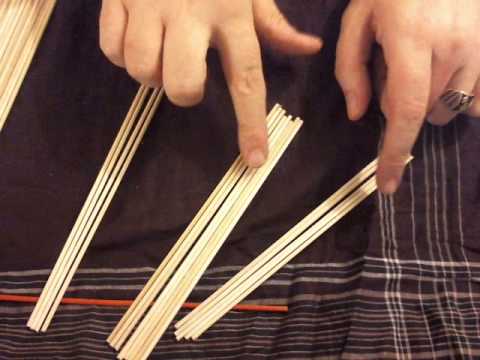
In the Yi Fa Society, we advocate the use of two methods for I Ching casting (aside from various non-casting practices, like the Plum Blossom method). These are the "Four Staves" method I designed and explain in The Magician's I Ching, and the Yarrow Stalk method that has long been used in tradition for casting the I Ching. Here is a video explaining a simple way to use this method:
The other common method, the "3 coin" method, is not recommended. That is because the probabilities of that method are different from those of the Yarrow Method, or from the Four Staves method (which uses the same probabilities as the Yarrow, but with a simpler faster process).
Some advocates of the '3 coin' method actually suggest that the probabilities in this method are 'more balanced', because there is an equal chance of getting a stable Yin or Yang, or a changing Yin or Yang, whereas in the Yarrow Method (or Four Staves) there's a 1/16 chance of getting a Yin changing to Yang, a 3/16 chance of a Yang changing to Yin, a 5/16 chance of a stable Yang, and a 7/16 chance of getting a stable Yin.
However, these probabilities mean that not only is the Yarrow method in fact balanced, it also better reflects the nature of Change in the Universe. It is a more accurate method.
In the Yarrow method, you have a 50/50 chance of either a solid (Yang) or a broken (Yin) line. What changes, however, is that it is more likely that the solid line will be a changing line, and more likely that the broken line will be stable.
Why?
Yin is the "weak" or "soft" force.
Yang the "hard" or "strong" force.
Now, it is more likely for something soft or weak to be STABLE.
It is more likely for something strong or hard to be unstable.
That which is strong is likely to weaken.
That which is soft is likely to endure.
It is more common in Time and Space for things that are strong to become things that are weak, and less likely for things that are weak to become strong.
That is the nature of entropy.
All of this put together creates the perfect balance of the fully accurate perspective on the nature of the probabilities of change.
On a final note: this is not to say that the 3 coin method, or indeed other methods, are completely 'wrong' or not usable. The I Ching is a system of measurement (to measure Change according to Space and Time). You can measure something with a meter stick, or a measuring tape, or a GPS-assisted program. What varies is the overall degree of accuracy of the measurement.
The other common method, the "3 coin" method, is not recommended. That is because the probabilities of that method are different from those of the Yarrow Method, or from the Four Staves method (which uses the same probabilities as the Yarrow, but with a simpler faster process).
Some advocates of the '3 coin' method actually suggest that the probabilities in this method are 'more balanced', because there is an equal chance of getting a stable Yin or Yang, or a changing Yin or Yang, whereas in the Yarrow Method (or Four Staves) there's a 1/16 chance of getting a Yin changing to Yang, a 3/16 chance of a Yang changing to Yin, a 5/16 chance of a stable Yang, and a 7/16 chance of getting a stable Yin.
However, these probabilities mean that not only is the Yarrow method in fact balanced, it also better reflects the nature of Change in the Universe. It is a more accurate method.
In the Yarrow method, you have a 50/50 chance of either a solid (Yang) or a broken (Yin) line. What changes, however, is that it is more likely that the solid line will be a changing line, and more likely that the broken line will be stable.
Why?
Yin is the "weak" or "soft" force.
Yang the "hard" or "strong" force.
Now, it is more likely for something soft or weak to be STABLE.
It is more likely for something strong or hard to be unstable.
That which is strong is likely to weaken.
That which is soft is likely to endure.
It is more common in Time and Space for things that are strong to become things that are weak, and less likely for things that are weak to become strong.
That is the nature of entropy.
All of this put together creates the perfect balance of the fully accurate perspective on the nature of the probabilities of change.
On a final note: this is not to say that the 3 coin method, or indeed other methods, are completely 'wrong' or not usable. The I Ching is a system of measurement (to measure Change according to Space and Time). You can measure something with a meter stick, or a measuring tape, or a GPS-assisted program. What varies is the overall degree of accuracy of the measurement.
Subscribe to:
Posts (Atom)