Members of the Yi Fa Society get access to additional I Ching video and text commentaries that go into more depth on the symbolism and divination uses of the I Ching's Hexagrams. If you are interested in joining the Yi Fa Society, please get in touch.
Bagua

Thursday, November 16, 2017
I Ching Commentary - Hexagram #10 "Stepping"
Here is the youtube video for the newest in my commentaries on the I Ching, on the subject of the 10th Hexagram, "Stepping".
Members of the Yi Fa Society get access to additional I Ching video and text commentaries that go into more depth on the symbolism and divination uses of the I Ching's Hexagrams. If you are interested in joining the Yi Fa Society, please get in touch.
Members of the Yi Fa Society get access to additional I Ching video and text commentaries that go into more depth on the symbolism and divination uses of the I Ching's Hexagrams. If you are interested in joining the Yi Fa Society, please get in touch.

Wednesday, October 11, 2017
The I Ching Teaches us That Reality is a "Doing"
The I Ching's cosmology suggests a reality that isn't a structure of 'things'. It is not a universe of things 'being', it is always a universe of things 'doing', of the interaction of elements.
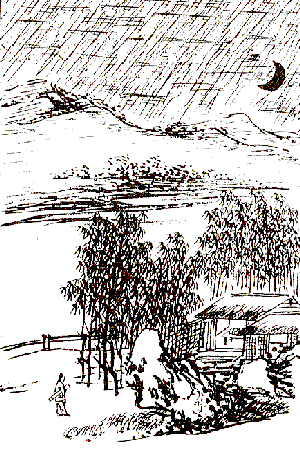
In the West people tend to imagine that Reality is a noun, rather than a verb. That may be because of the self-referencing perspective; if something is a static object, rather than a moving process, it is easier to define, and to control.
Something static can be more easily controlled. You put a solid cube in one corner of the room, it will stay there. It won't move on its own at least. You can turn it on one side, it'll stay on that side.
On the other hand, it takes a lot of work (energy) to break that cube, or burn it, to make it move or to shape it into something other than a cube.
Static things are easy to control, hard to manipulate.
On the other hand, if you understand reality as a "doing", a constant interplay of the 8 elements that make up the world of 10000 things, then it is much EASIER to manipulate.
Creating change is much less difficult than the illusion of solidity makes it look.
But it is much HARDER to control, than our notion of a static reality leads us to think.
You can alter the course of the river, but you can't just force it into a fixed route forever, make it stop flowing forever, or much less make it change the direction of its flow.
Wednesday, September 20, 2017
An Explanation of The Generation of Changing Lines
So some students of the I Ching have expressed confusion as why three small (yin) piles would be a Yang changing into Yin, or conversely three large (yang) piles would be a Yin changing into Yang.
Imagine the image of the Taiji:

It is Yin and Yang, intermingling. Within the yin there is a centerpoint of yang; and within the yang a centerpoint of yin.
So at the very core of Yin is the most yin of anything possible; it is so overflowing with yin, that it takes on the nature of Yang.
Likewise at the very core of Yang is the most yang of anything possible; it is so overflowing with yang that it takes on the nature of Yin.
The former is in fact Yang that is inevitably transforming into Yin, that is the only direction it can go.
Likewise, the latter is Yin that is inevitably transforming into Yang.
So this is why in the casting, when you have three small (yin) piles, it is manifested as a Yang that is becoming a Yin.
And when you have three large (yang) piles, it is manifested as a Yin that is becoming a Yang.
That is the reason.
And the reason is reflected in the probabilities of the casting method, because these forces are not equal in nature; in nature Yin is more stable, so it is less common for Yin (the stable but weak) to become Yang (volatile but strong), than for Yang (strong, but volatile) to weaken into the more stable Yin.
"Weak but stable" are the valleys of space-time, "strong but unstable" are the peaks.
Thursday, September 7, 2017
Tips on Interpreting the I Ching
The standard method of interpreting an I Ching casting is to cast the hexagram, read the main description of the hexagram you get, read the changing lines, and then read the resultant hexagram. Many I Ching students put little thought into the matter beyond that.
But if you want to consider ways of reaching deeper understanding of the I Ching, there are more ways to work on it.

Forgetting the resultant hexagrams for a moment, any given hexagram by itself has two means of interpretation: looking at each line in isolation, or looking at the lines as a 'story' being told, representing a progress of the overall theme dealt with in the hexagram. And as you study them, they can be 'read' in order, from one to six; where generally one is what happens even before the very start, two the real start, three the big challenge, four the further challenge, five the epic climax, and six is the denouement or epilogue.
So, when you bring in resultant hexagrams to the analysis it makes sense that both of those would also be applicable.
In actual casting, changing lines signify a couple of things. The overall number of changing lines represents the 'mutability' of the whole situation. A hexagram with many changing lines has a much more powerful "current" of change than one that has only one or two; that's why if you have four or more changing lines the diviner is advised to consider some part of the RESULTANT hexagram to be the 'central point' (ie. the present) of the casting; because it is incredibly difficult for the force of change to be overcome at that point.
Which specific lines are changing represent the points in the hexagram that are significant as 'mutable', things you can change, things you can do something about.
So what does this say in terms of understanding the six lines as a 'story'?
That they are a story in theory, in the way that a novel or a fairy tale is a story, one that is archetypal, neat and tidy, and almost never 'like that in real life'.
In a casting, you have to see a different story, a much messier one, composed of only those lines that are Changing. So you can think of the six lines as a whole as a kind of 'big story' that cover all kinds of things that CAN happen related to theme; but in real life incidences only some of those parts actually DO happen as the story of the real events related to the question that was asked.
In any case, there's no question that the changes are all about Time.
However, another way to look at these resultant hexagrams is to think of them as being about Choices, because all of Time is just a product of cause & effect; and in an actual casting, the Changing Lines represent those flexible branching-off points in time where it is possible for some kind of choice to be made that affects the course of the future.
If you're interested in further conversations, teachings and insights on the I Ching, please check out the Magician's I Ching Facebook Group!
And if you are interested in a structured system of study, please get in touch about joining the Yi Fa Society.
But if you want to consider ways of reaching deeper understanding of the I Ching, there are more ways to work on it.
Forgetting the resultant hexagrams for a moment, any given hexagram by itself has two means of interpretation: looking at each line in isolation, or looking at the lines as a 'story' being told, representing a progress of the overall theme dealt with in the hexagram. And as you study them, they can be 'read' in order, from one to six; where generally one is what happens even before the very start, two the real start, three the big challenge, four the further challenge, five the epic climax, and six is the denouement or epilogue.
So, when you bring in resultant hexagrams to the analysis it makes sense that both of those would also be applicable.
In actual casting, changing lines signify a couple of things. The overall number of changing lines represents the 'mutability' of the whole situation. A hexagram with many changing lines has a much more powerful "current" of change than one that has only one or two; that's why if you have four or more changing lines the diviner is advised to consider some part of the RESULTANT hexagram to be the 'central point' (ie. the present) of the casting; because it is incredibly difficult for the force of change to be overcome at that point.
Which specific lines are changing represent the points in the hexagram that are significant as 'mutable', things you can change, things you can do something about.
So what does this say in terms of understanding the six lines as a 'story'?
That they are a story in theory, in the way that a novel or a fairy tale is a story, one that is archetypal, neat and tidy, and almost never 'like that in real life'.
In a casting, you have to see a different story, a much messier one, composed of only those lines that are Changing. So you can think of the six lines as a whole as a kind of 'big story' that cover all kinds of things that CAN happen related to theme; but in real life incidences only some of those parts actually DO happen as the story of the real events related to the question that was asked.
In any case, there's no question that the changes are all about Time.
However, another way to look at these resultant hexagrams is to think of them as being about Choices, because all of Time is just a product of cause & effect; and in an actual casting, the Changing Lines represent those flexible branching-off points in time where it is possible for some kind of choice to be made that affects the course of the future.
If you're interested in further conversations, teachings and insights on the I Ching, please check out the Magician's I Ching Facebook Group!
And if you are interested in a structured system of study, please get in touch about joining the Yi Fa Society.
Thursday, August 31, 2017
Video From Toronto Workshop
This is a video with some details and tips on Qi Breathing practice, presented to people who participated in the Toronto workshop:
If you are interested in more advanced teachings and working in a curriculum of spiritual development, please contact me about joining the Yi Fa Society.
Wednesday, July 26, 2017
The Yi Fa Cosmology
Some people have asked about the cosmology of the Yi Fa curriculum.
In fact, the cosmology of Yi Fa is directly drawn from the teachings of the I Ching.
There are more details of the cosmology in the teachings of levels 2 and 3 of the Yi Fa curriculum.
What follows is only an explanation in brief.
There is the whole, first off (you could call it the Taiji or the Tao if you like, the absolute sum of all that actually exists).
Then there are certain primal forces (Yin and Yang, the four fundamental forces of existence, the eight elements) which all have archetypal existence. Some of them may appear to have personalities but that's really our way of being able to comprehend them.
Then there's the manifested world, "the World of 10000 Things" as the Chinese poetically put it. It contains all of of those things I mentioned above WITHIN it. Those things are the building blocks of the manifested world, what you find when you look at reality on both the cosmic scale, and by going deep within.
So those elements and primal forces and positive and negative (yang and yin) all exist within us. They take shape to make each of us a unique expression of reality.
Human beings are unique (as far as we currently know) in that we are capable of conscious awareness of these forces. We have Will. Even if most of us never actually use it.
We can use this Will to become conscious operators of those forces, not just reactive operators the way other things in the world of 10000 things are. But that consciousness also creates in us an illusion of separateness from reality. We mistake being Unique for being Apart. And this illusion can be called the Persona.
Since it is an illusion, and we cannot ever actually be apart, it creates a conflict within us between the part of us that is Real and the part of us that is fabricated, the Individual and the Person. In Chinese mysticism, these are two separate parts of the human soul, called the Hung and the Po. The Hung is eternal, the Po is temporal and dissolves after death. The Hung is the Superior Individual, the Po is the Inferior Person.
Thus, the cosmology of the Yi Fa curriculum establishes the cause of our human alienation, and also shows the path toward resolving it, by manifesting the Superior Individual.
Tuesday, July 11, 2017
The Magician's I Ching Facebook Group Has Over 2100 members!
The Facebook group created in honor of The Magician's I Ching, but which is a general discussion group for all I Ching related subjects, has now reached just over 2100 members!

So if you haven't already joined the Magician's I Ching Facebook Group, please consider joining! It's free, and filled with interesting conversation and material related to the I Ching and I Ching studies. It's open to people coming from western or eastern traditions. It's very welcoming to newcomers to the I Ching, and you can get questions answered or useful advice. But it also has many very learned and highly experienced advanced students of the I Ching, and if you are one of those people you'll find some excellent higher level discussion about some of the finer points of I Ching study.
While you're at it, please consider joining the Yi Fa Society. Members of the Yi Fa Society also have a (secret) discussion group, and benefit from a complete and detailed training program for studying Yi Fa Qi Gong and the I Ching. Members of the Yi Fa Society are taught additional Qi Gong and I Ching secrets that are not available anywhere public.
At higher levels of membership, the advanced exercises of Yi Fa Qi Gong are taught, and students are provided large numbers of instructional materials (whole books, like "Secret Techniques of the I Ching", "Universal Yi Fa", "The Yi Dao", and "the Great Book of Yi Fa", among others) on how to deepen their work with Qi Gong and I Ching for self-transformation and the work of enlightenment.
Members of the Yi Fa Society can work personally with me to keep up their practice, to resolve problems in their practice, and to develop discipline and structure in their spiritual path. Members also have the opportunity to have monthly Skype meetings with me for the same purpose.
Yi Fa Society membership is not free, but basic membership is on a monthly donation basis set by each student.
If you are interested in joining the Magician's I Ching Facebook group, just click on the link and join, and start reading and sharing with us!
If you are interested in joining the Yi Fa Society, please contact me, here or on Facebook.
Subscribe to:
Posts (Atom)