The video commentary on hexagram #18. Members of the Yi Fa Society have access to a second video with more advanced insights.
Bagua

Monday, March 28, 2022

Monday, December 13, 2021
Spontaneous Body Activity During Qi Gong Practice
On more than one occasion, people have asked me about something that has happened to them during Qi Gong practice, and how to deal with it. They have told how during practice, their body might spontaneously make slight movements, not like involuntary twitches but rather what seems to be a natural adjustment, a shift in stance or readjustment of positions of the arms, legs, head or back, but one they had not consciously thought to do. Similarly, some practitioners have asked about spontaneous unexpected body activity that happens during Qi Gong, like suddenly starting to repeatedly yawn, belch, or cough; or to have some kind of welling up of a strong emotion in mid-practice that seems not to arise from one's conscious thoughts or feelings.
What you're experiencing with these phenomena are spontaneous body-adjustments during Qi Gong practice. In some cases, they are 'corrections' to things like your posture or the position of your arms.
Subtle muscular adjustments are a very common form of body adjustment.
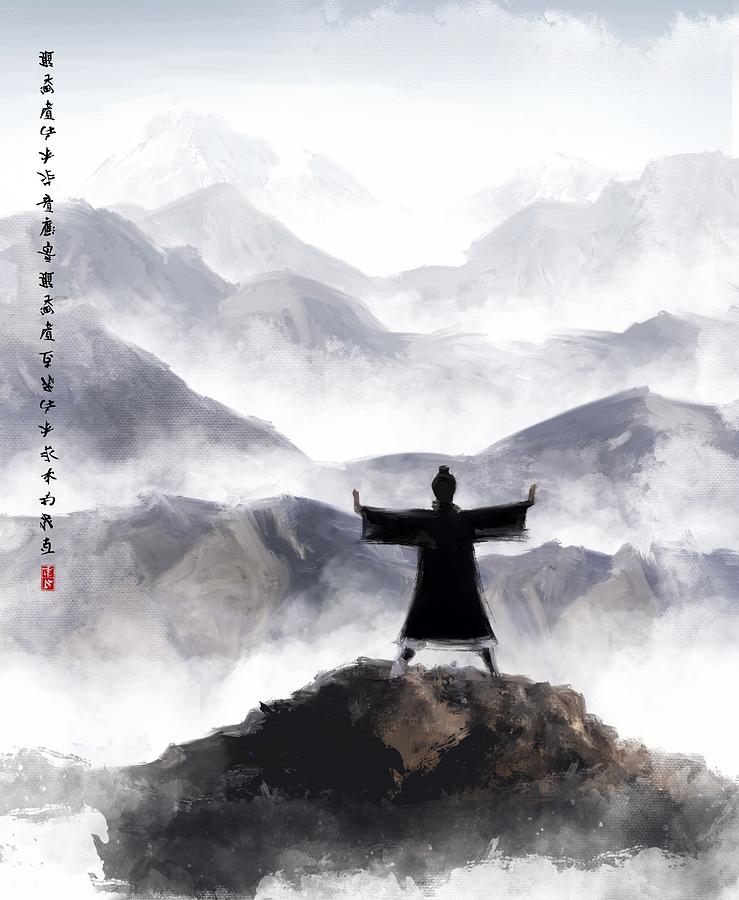
Yawning is a very common side-effect of the releasing of blocks that impair the circulation of Qi, they're a good thing (unless they're happening because you're very tired).
Coughing is a less common adjustment, but it's not too unusual either, particularly if in regular circumstances you are breathing too tightly, perhaps due to stress, and this is a reaction to the relaxation of your breathing. Belching can happen as a result of relaxing the body as well.
Emotional experiences are part of the mind-body connection, as you relax and release tensions in the body this in turn releases certain emotional tensions you might not even have been aware of.
Generally, these are all OK, and are a sign that you are improving at Qi Gong practice, as long as you do not radically alter your Qi Gong form (small adjustments are fine and good, but for example wanting to stretch out the back is something you should do in between exercises).
The emotional effects are alright too, but the key is that you should let them happen while at the same time not being carried away by them. Let them pass and don't resist them, but don't feed them.
Friday, July 23, 2021
Confucius On Cultivation
The following is attributed to Confucius, as recorded by his grandson, from the Zhong Yong:

Truth is the way of Heaven.
Developing Sincerity is the way of Humanity.
If you can be effortlessly Sincere, without lust of result, and walk embracing the Middle Pillar, then you have become a Sage.
If you are practicing at becoming Sincere, you must find your Virtue and cleave to it.
You must study it generally, investigate its particulars, contemplate it with care, perceive it with clarity, and practice it at all levels.
When there is a gap in your understanding, or you haven't yet reached the point in your practice where it is really effective, don't just abandon it.
When there is something you have investigated, but not yet fully understood, don't just abandon it.
When there is something you have not yet been able to perceive, or can perceive but not with clarity, don't just abandon it.
When there is something you have not yet practiced, or not yet practiced to a certain level, don't just abandon it.
If someone else can get it in a single try, I will try it a hundred times.
If someone else gets it in ten tries, I will try a thousand times.
If you can persist in following this Path, even if you are stupid, you will become Enlightened. Even if you are weak, you will achieve Power.
Thursday, July 1, 2021
Thursday, April 29, 2021
"Stale Qi" Part II
The previous post on this blog, regarding the matter of "stale Qi", had a number of comments on social media from ordinary practitioners as well as serious Qi Gong practitioners or alleged teachers.
Among these comments, some were in agreement, others strongly disagreed and tried to argue that "stale qi" or other "varieties" of Qi are a real phenomenon.
However, the most interesting comments came from people who suggested that whether or not the phenomenon itself was real, my statement about it wasn't relevant because it doesn't really matter in terms of effects. In other words, even if "stale" Qi (or any of the many other types of descriptors of Qi, including things like "scattered qi", stolen qi, sinking qi, rising qi, boiling qi, small qi, long qi, weak qi, strong qi, still qi, hard qi, etc.) wasn't actually real and Qi is just Qi, the description of these things as 'types' of Qi can be helpful for a student to understand what they're working through and it can potentially help them to engage with Qi Gong practice.
Now, first of all, if you think about all those statements being attributed to Qi, you can see that they're not really talking about Qi itself at all, but rather about how YOU process Qi.
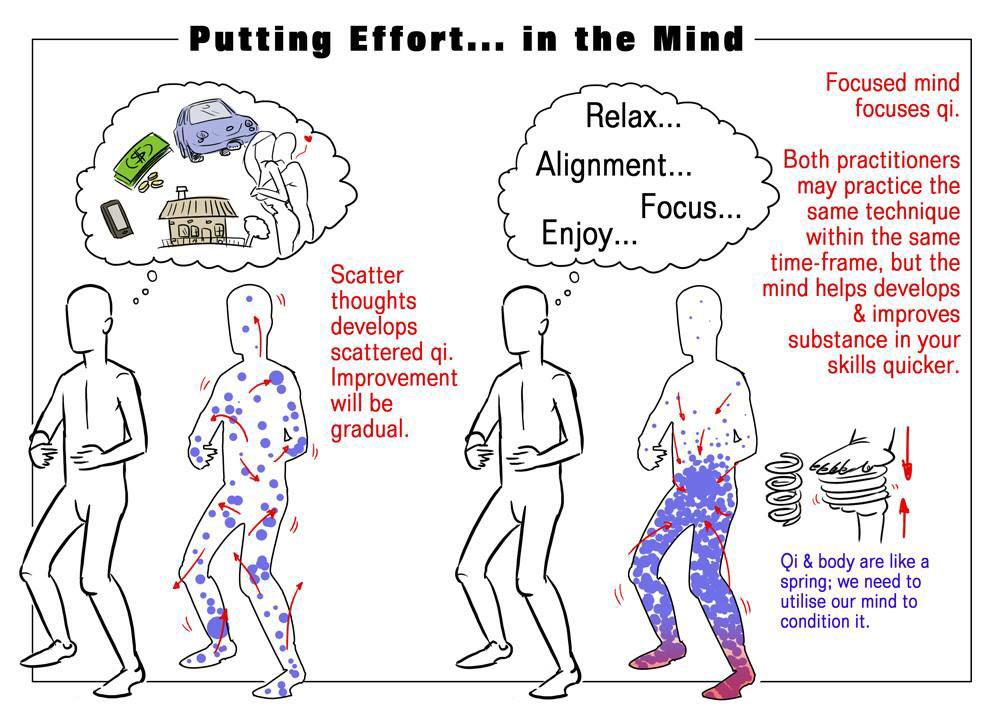
(It's not the Qi that's scattered, it's you)
It is technically correct, that from a 'practical' point of view, it doesn't immediately matter whether it's the Qi that's "bad" or your body that is "bad" due to your failure of cultivation and/or lack of Virtue.
However, in the bigger picture, there is an important difference!
If people believe it's the Qi that's bad, they can go looking for magic potions and quick fixes and fake Wu or plastic new-age "taoists" who will do "energy cleanses" that will "fix their Bad Qi".
On the other hand, if they realize Qi is Qi, and the problem is THEMSELVES, they might understand that the only way to fix the problems are by their own discipline and virtue.
So that's a HUGE difference.
Sunday, March 21, 2021
Can Qi Really go "Stale"?
Qi is really just Qi. But at times it is useful in speaking about Qi, in the context of things like Qi Gong, cultivation practice, esoteric studies or traditional healing to describe particular interactions of Qi with our body or our consciousness through the use of metaphorical conditions. However, this has led over the years to different systems or teachings in esoteric schools to end up using a variety of terms, like "positive qi", "negative qi", "Yin Qi" or "Yang Qi", "Natal Qi", "Active Qi" or "Stale Qi"; but all of these gradually came to be thought of as different "types" of Qi, which is inaccurate.
As an example, let's consider the example of "stale Qi":
There are two ways to understand Qi in any way that Qi could be said to be 'stale'. The term is a deceptive because it implies that it is the Qi that is bad or corrupted or in some sense different from normal Qi.
The first is in the sense of physical well-being, where if someone has failed to be natural for a long time, developing harmful physical habits that lead to physical tension, a failure to breathe naturally, tightness/restriction of the body in varied ways, then the circulation of Qi through the body is not open and fluid, and so Qi will tend to accumulate only in certain areas of the body and not others, leading to physical disharmony. Notice that it is not in fact a problem with Qi, or that Qi is any different, it is a problem with the body and its ability to be open and receptive and fluid in relation to Qi.
The second is in the sense of understanding Qi not only as life-force but as Will. Our will is directed to certain things. We put our will into certain things. This includes things that must be done in the immediate sense, like very ordinary things, and also things that we are trying to achieve in a bigger sense, but it also means anything we've intentionally or unintentionally invested ourselves in. This investment means that some of our will, our Qi, will be directed in certain ways, and normally this isn't a problem, it's perfectly normal. But if we have invested our will into things that we cannot resolve, into things that are unreal, or things that are no longer real, our attention and our emotions (fear or desire) and our mind and our pain clinging to those things in spite of their unreality, then the Qi gets locked in to being invested in that. Part of our will is stuck there.
That manifests also in the body, as tension (tension here meaning anything from physical rigidity to posture, to breathing, to other symptoms like sleeplessness or intestinal troubles, to serious disease). The Qi there is 'stale' because it is stuck clinging to something unresolved and that cannot ever be resolved in the usual way. Once again note that the problem is not with Qi, or that the Qi is different, but rather a problem that our mind is locking-in our Qi, limiting its fluidity because of our obsessions.
So the ways to resolve these sorts of problem are either by physical practice (Qi breathing) or by Virtue (through self-inquiry). The former uses the body to loosen the bonds of the mind, the latter uses awareness to loosen these bonds. Typically, a combination of both is best.
Monday, March 8, 2021
Sunday, March 7, 2021
Psychedelics and Spiritual Cultivation
I have often been asked whether there is any utility or value in the use of psychedelic drugs while engaging in spiritual practices, and specifically cultivation practice like that found in Yi Fa Qi Gong and other authentic Qi Gong cultivation systems.
My answer has always been that one has to be very cautious and prudent in how to approach the question of psychedelics. And in fact, people who are already engaging in or have previously used psychedelics will probably have very little benefit, and potentially drawbacks, from any attempt to use them in the context of cultivation practice.
Not because "drugs are bad" or anything like that, but because in the context of just WHAT they're useful for in terms of spiritual development. Psychedelic drugs need to be used ideally only at very carefully selected moments and in very specially selected contexts. The ancient shamanic cultures throughout the world understood this, as did some of the hermetics and some of the eastern sects.
The central feature of the psychedelic experience is twofold: it temporarily breaks down the ego, and it opens the doors of perception (to paraphrase Huxley).
The latter means that suddenly you're having a sensory experience different to anything you experienced before.
This is what leads to the effect of breaking down the ego: the mind's ability to lock-in to personality is based largely on imprinted behaviors from memory... what you could call "conditioning". Basically, ways you've programmed yourself, some of which is essential for daily living but a lot of which is also highly limiting, including in the spiritual context.
When you use a psychedelic for the first time, it makes your brain unable to refer back to any past experience that was sufficiently similar to allow the ego to assert itself (in the sense of "I know what's happening here, I know what to do") and so you have the potential to have an experience that can break some barriers the Ego has created that could be very hard to break otherwise. It is the inability to put what you're experiencing into some comfortable box of context that makes the experience so potentially charged with the opportunity to make serious Change.
But by the second time you use a psychedelic, you already have a context by which the brain can compare it to in memory; namely, the first time you used it! So even just the second use of a psychedelic will be, spiritually speaking, enormously less useful than the first time.
I would say that generally speaking, the real spiritual utility of psychedelics for transformation (in cultivation practice) is limited to the first two or at most three times you use a drug. Any use after that will, at best, only be useful for attaining a kind of trance state (but that can be done in a lot of ways, including meditation). It's no longer useful as an ego-overwhelming tool. It is just re-creating a former experience.
That means that if you had wasted the first time you used a psychedelic (say, at a party or something), you would wasted a big potential tool that you could never use again.
So you want to think carefully about when you use psychedelics. If you do use them, it should be at a carefully planned moment and in a carefully prepared context so as to make the best use of the power of the ego-overwhelming experience.
Friday, January 22, 2021
I Ching Hexagram Commentary #16 - Certainty
Here is the latest in the I Ching public video series.
Members of the Yi Fa Society get access to private videos and written teachings that elaborate further on each hexagram covered in this series. If you are interested in applying to the Yi Fa Society please get in touch.
Monday, January 4, 2021
On the Significance of Yuan Heng Li Zhen
The opening words of the I Ching's core text are "Yuan Heng Li Zhen", which is typically translated as "Sublime celestial forces in motion".
When you think of the "celestial force" that is Time itself, you can understand immediately that this first line, the main text description of Hexagram #1, is also an apt description of what the entire I Ching is all about, and it has been treated that way by many scholars and adepts of the I Ching throughout history. As more commentary has been made of Hexagrams 1 & 2 than any of the others, it can also be said that more commentary has been made on those four words than any other words in the entire I Ching.
These words do not appear on in Hexagram 1, however. They are also spread out, often in pairs (Yuan heng, or li zhen) throughout the I Ching core text. Separately, "Yuan heng" means a broad or easy path, or also, a ritual or sacrificial rite. While "Li zhen" means a favorable auspice, clearly a common phrase in the context of divination.
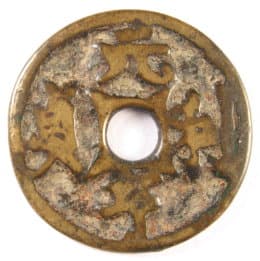
A Chinese coin-shaped talisman inscribed with Yuan Heng Li Zhen
In the Yi Fa teaching, a great deal of emphasis is put on those words as representative of the four facets of Virtue: Union/Love, Discipline, Justness/Harmony, and Truth/Reality.
The description of Yuan Heng Li Zhen as being these four virtue facets originates with the Wenyan Commentary, which dates back to before the Han Dynasty. Here is a quote of that commentary from one translation:
"What is called "the great and originating" (yuan 元) is [in man] the first and chief quality of goodness; what is called "the penetrating" (heng 亨) is the assemblage of excellences; what is called "the advantageous" (li 利) is the harmony of all that is right; and what is called "the correct and firm" (zhen 貞) is the faculty of action."
Here "goodness" is Love/Union, "the Assemblage of excellences" is the process of Discipline, Li is already translated here as Harmony, and the "Faculty of Action" is Truth or Reality, that is to say the perceptual faculty that allows us to take action.
Yuan Heng Li Zhen is also a reference to cycles:
Yuan - sublime, the head. The beginning. Spring
Heng accomplishment, prosperous. Summer
Li beneficence, harvest, autumn.
Zhen determination, endurance, winter
Thus Yuan symbolizes the beginning of all things, Heng their growth, Li their further development, and Zhen their maturity. This concept of the four words connecting to the cycles of growth and the four seasons was particularly elaborated by Cheng Yi, the Song dynasty sage and friend of Shao Yong.

These words are also used in some esoteric contexts as a mantra, and also as words of invocation for ritual purposes. In fact, just as the four words can be used to describe the pattern or process of natural or seasonal cycles, they can also be used to describe the STEPS of a ritual.
In this sense, "Yuan" symbolizes the invocation, calling down what is above, for the sake of Union.
"Heng" symbolizes the correct performance of the ritual, with Discipline.
"Li" means receiving a response from the forces you have called upon; that is to say, your ritual bringing you into Harmony with the universe.
And "Zhen" means applying that response or change in yourself, embodying Truth in the real world.
Friday, December 11, 2020
What Does Active Consciousness Feel Like?
In Yi Fa Qi Gong, a great emphasis is placed on being in the Active Consciousness. What this means is that while you're doing the exercises it is very important to be present, to "Show Up" to the practice; to be situated in your body and in the moment, attentive to what you are doing. You can't be distracted in your mind; and to avoid this you must pay attention to the sense of your body.
But some students have asked what this experience feels like; how one can know what the Active Consciousness is like?
When you're REALLY in the "zone" of the Active Consciousness you will feel like you're completely present, sort of like you're right at the front of your body.
Your breathing will be Qi Breathing, effortlessly centered in the lower dantien point (the spot just below your belly button), and you'll be experiencing the whole of your body as one whole thing.

You will feel much more solid and real than usual. You will not be in the head, though you'll still hear your thoughts, they won't feel like where you are and what you're doing, they'll feel like something in the background, like it was a radio playing on a shelf behind you.
You will feel very powerful and your practices will feel very powerful and intuitive.
These are the signs that you are effectively present in the Active Consciousness.
Friday, November 13, 2020
What is the Nature of the Superior Individual?
In the philosophy of the I Ching, there is a basic truth that in every moment, we have a choice between manifesting the Superior Individual or the inferior person.
Among those who practice cultivation, however, there may be some question as to just what the "Superior Individual" is. In the course of cultivation, one might get a sense of the Superior Individual being some outside entity, the "higher self" sending them messages or guiding their life.
So some have developed a conception where the Superior Individual is some kind of outside spiritual, angelic or divine entity.
But in fact, the Superior Individual is basic part of ourselves. It is not a separate being at all, it is us. The best of us.
This sense of differentness, of the Superior Individual seeming like another being with its own intelligence and communicating with us is a product of people's primary identification with the 'inferior person', which is also a part of us. Thus, we have become separate from the 'higher self'.
Why are we separated from our higher self?
We aren't, but it seems this way.
The issue is this: we are a species in the process of evolution. Our consciousness has multiple layers, which can be generally divided into two parts. In the context of I Ching studies (including the Yi Fa work) these are described as "World" and "Heaven". To Nietzche it was "last man" and "super-man". In others, it could be called "animal" and "divine".
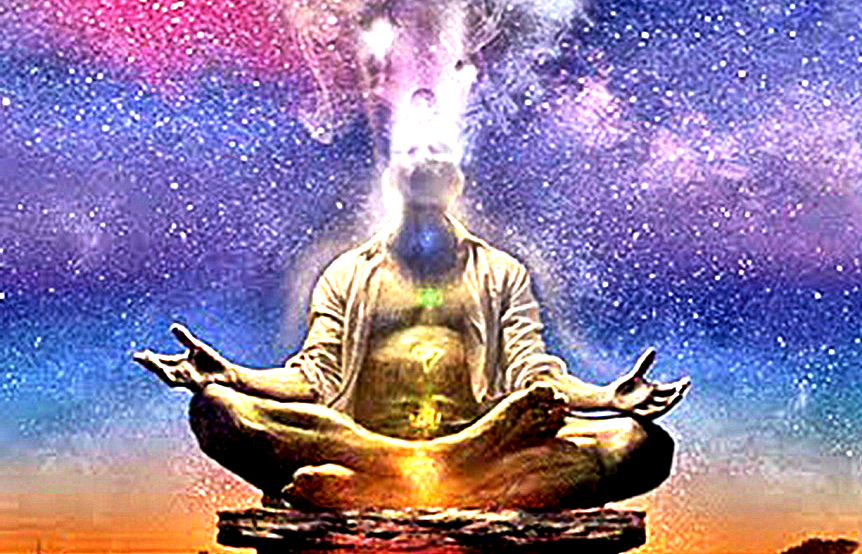
The Chinese actually say that there are two parts to the human soul: Po and Hung. The Po is the part of us that is animal instinct plus conditioned behavior. The Hung is the part of us that is our fullest potential and true Individuality (as opposed to the 'persona' of our inferior po-soul).
We can, at every moment, choose to associate with one or the other. But on account of our intermediary condition and because of our social conditioning we tend to more directly identify ourselves as the "Inferior Person". So much so, that the Superior Individual can sometimes feel like it's a separate entity, some kind of guiding spirit.
You will find, if you engage with discipline in a sincere long-term course of spiritual cultivation, that over time, you will become more and more identified as one with the Superior Individual. At that point, the 'ideas' of the Superior Individual will be identical to your own, and the notions of the inferior person, which will still be present, will instead be the ones that appear to be foreign.
Thursday, October 22, 2020
The Steps of Human Consciousness
There's a teaching in Chinese mysticism that there are two levels of our consciousness. They're associated with the concepts in the I Ching of the "inferior person" and "superior individual".
At every moment in space and time we have a choice of which of the two we associate with in our active consciousness, but most people in general associate with the inferior person. The inferior person is a collection of influences and conditionings based on your physical nature, your environment, and the influences of your past and present choices and people in your life.
The Superior Individual is your true nature, what is real about you behind all those things. But in point of fact most people are so disconnected from their true and essential nature that it feels like it is another person. In many rituals used to "communicate" with the Superior Individual, that division is so notable that it feels like the Superior individual is some totally different entity from "ourselves", which is why in western symbolism its called the "Holy Guardian Angel".
This is also why when one is trying to shift the association of their consciousness from the inferior person to the Superior Individual it feels like dying, like the very essence of who were until now (or rather, who you thought you were) has to be destroyed for you to get to that true self. In a lot of cases, people's motives for getting to that true state involve desires OF the inferior person, so they realize that to get to what's real, they'll have to give up the fantasies of the false person they were, and that's very hard.
This internal conflict is mirrored externally by the struggle between (the inferior person) wanting to imagine one's self the center of the universe, and wanting to have a power that acts on the universe and get to impose its desires on the universe, and the (Superior Individual's) understanding that we are one non-divisible part of reality and are not the central actor but one small part of a very big picture in the vastness of Space and Time, and how this is not something that can just be reasoned out, but has to be experienced through meditative practice and the application of virtue to restore that Union with the Taiji (what in modern English we could call the "Singularity").
So in fact while most of these sorts of studies and articles and ordinary perceptions on the subject of "enlightenment" talk about a two-option process (unconsciousness / enlightenment), the work of spiritual Cultivation is actually a multi-step process of initial glimpses of waking up, initiation, developing discipline, achieving communication with the Superior Individual (in western magick called the "True Will"), working to change one's life and environment to better fit one's efforts at attainment and union, making the shift from general association with the inferior person to general association with the Superior Individual, engaging in teaching or other forms of applying Virtue in the world, attaining states of Union to reality, and finally manifesting that Union fully and becoming the Sage (Enlightenment). There are steps Beyond Enlightenment as well but these are generally not spoken of in lay contexts.
Of the above stages, the big three are:
- Initiation: the beginning of awareness of one's Enlightenment quality, and the start of serious spiritual cultivation.
-Adepthood: the shift into association with the Superior Individual
-Enlightenment: uniting to nature or space-time as a whole (which is to say, overcoming this false notion of separation between self and other, and the self-referencing nature of "thinking you're in the middle of the picture").

Finally, I'll note that the very notion that Enlightenment is some kind of separation from the World or one's humanity is ridiculous and disgusting. That's essentially either nihilism or solipsism, the heresies of the gnostics. You can't become "one with everything" by being less human, or less engaged.
Anyone claiming to be Enlightened while pretending that they don't care about things, or feel things, or that there are certain normal human things that they just don't experience (be it anger, sadness, physical pain, or basic physical needs) are both arguing for Enlightenment being a kind of sub-humanity, and blatant liars.
Enlightenment requires, as my own teacher once said, that you Be More Human.
It's not about separating yourself, it's about Showing Up, being present in the active consciousness.
It's not about feeling less or caring less, it's about Totality. Becoming one part of the big picture, without trying to run away from that big picture, or trying to be right in the middle of that big picture, or trying to control that big picture. It's about being 100% of yourself in the here and now.
Tuesday, October 13, 2020
How to Master the I Ching
In this latest video, I give you some guidelines as to how you should study the text and structure of the I Ching to maximize your ability to understand it!
Tuesday, September 22, 2020
The Magician's I Ching Facebook Group now has Over 3000 Members!
The Facebook group created in honor of The Magician's I Ching, but which is a general discussion group for all I Ching related subjects, has now reached 3000 members!

So if you haven't already joined the Magician's I Ching Facebook Group, please consider joining! It's free, and filled with interesting conversation and material related to the I Ching and I Ching studies. It's open to people coming from western or eastern traditions. It's very welcoming to newcomers to the I Ching, and you can get questions answered or useful advice. But it also has many very learned and highly experienced advanced students of the I Ching, and if you are one of those people you'll find some excellent higher level discussion about some of the finer points of I Ching study.
While you're at it, please consider joining the Yi Fa Society. Members of the Yi Fa Society also have a (secret) discussion group, and benefit from a complete and detailed training program for studying Yi Fa Qi Gong and the I Ching. Members of the Yi Fa Society are taught additional Qi Gong and I Ching secrets that are not available anywhere public.
At higher levels of membership, the advanced exercises of Yi Fa Qi Gong are taught, and students are provided large numbers of instructional materials (whole books, like "Secret Techniques of the I Ching", "Universal Yi Fa", "The Yi Dao", and "the Great Book of Yi Fa", among others) on how to deepen their work with Qi Gong and I Ching for self-transformation and the work of enlightenment.
Members of the Yi Fa Society can work personally with me to keep up their practice, to resolve problems in their practice, and to develop discipline and structure in their spiritual path. Members also have the opportunity to have monthly Skype meetings with me for the same purpose.
Yi Fa Society membership is not free, but basic membership is on a monthly donation basis set by each student.
If you are interested in joining the Magician's I Ching Facebook group, just click on the link and join, and start reading and sharing with us!
If you are interested in joining the Yi Fa Society, please contact me, here or on Facebook.
Saturday, August 22, 2020
I Ching Questions and Answers: Line 1 and Line 6
I often receive questions about the I Ching, and how to read it more effectively. If you have a question post it in the comments below and I will try to answer it.
Meanwhile, here is one example of a question someone recently sent me, and my answer:
Q: what does it mean when only line 1 and line 6 are changing?
In an I Ching casting, you derive a six-line hexagram. In the casting, any number of those lines, from none at all to all six, could theoretically be changing lines.
Any lines might or might not be changing.
You cast the lines in order from the bottom to the top, so that the bottom line is considered "line 1", and the top line is considered "line 6".
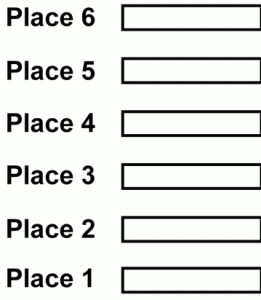
If more than one line is changing, it is important to determine what is the "central line", the part of the casting that is the most important. The way to do this is explained in The Magician's I Ching.
So if you get only two changing lines, and they are line 1 and line 6, of the two the central line of the reading is line 6. Line 1 needs to be read as a kind of prelude to the central line 6.
In an I Ching casting the position of each line has a general sense of importance. As each Hexagram represents a situation, the bottom 1st line represents the very beginning of the situation; often even what happens before the situation is really in action. Line two is often when things get going. Line three the most difficult part (the jump between the lower lines and the upper lines). Line four is when you're past the middle of the situation. Line 5 is usually the climax or peak of the situation, and Line 6 is when the situation is ending or even past due to end.
Since Line 1 usually signifies something taking place very early, and line 6 very late, there is a bigger distance between the two than if they were any other two lines. It can also mean with regard to the question that issues that happened at the beginning of the process are relevant to what is happening right now.
So in a casting where Line 1 and Line 6 are the two changing lines, you ought to think of Line 6 as what's most central right now, but there are things about how the current situation began that are having an important effect or consequence at the time of the situation ending.
Wednesday, July 15, 2020
Spiritual Cultivation is Not Just "Follow Your Passion"
One of my students had a question regarding a new-age author who suggested the following advice, not uncommon in our modern culture:
"He says that if in your work you are being distracted with something else, then maybe you should do what you are being distracted with, i.e. follow your passion. Which is common sense of course."
Note that this was even noted as "common sense".

But in fact, this is terribly bad advice to give people; as 'distraction' and 'passion' are not the same thing.
Most people don't have any idea what their passion is.
If they do know, and follow it, they will find that there are all kinds of "distractions" that try to drive them AWAY from those passions, because it turns out that following one's passion requires enormous discipline and very hard and often boring work and many sacrifices and lots of other things that aren't fun.
And your passion requires CHANGE.
It requires that you be almost a completely different person when you come out of the process than when you started, and if you are not willing to make that kind of change, the no-longer-being your existing conception of self, then many of the 'distractions' are likely to be things that are also tempting to you precisely in order to try to get you to keep being who you are right now.
They're saying "look, you find this really interesting, right? Come follow this wild goose chase of things you find interesting instead of that one really hard thing you're trying to do".
And before you know it, years have gone by and you've started ten thousand things and finished none of them.
You need to find out what you actually love (as in, what is your actual will), not the lies that you tell yourself about the type of person you'd like to be because you hope other people will see you that way, or because someone else told you its what you have to be like, but what you are actually want to accomplish, above all else. As precisely as possible.
And then you have to follow that thing you love no matter how hard it is or how much struggle and suffering and sacrifice you go through in it, until it kills you.
Monday, June 22, 2020
The I Ching: Hexagram 15 - Humility
An analysis of the 15th hexagram of the I Ching, in the latest video in the I Ching series:
If you want more teachings on the deeper mysteries of the I Ching, as part of a program of cultivation and spiritual self-development including meditation and Qi Gong practices, please consider applying to the Yi Fa Society!
If you want more teachings on the deeper mysteries of the I Ching, as part of a program of cultivation and spiritual self-development including meditation and Qi Gong practices, please consider applying to the Yi Fa Society!
Thursday, May 21, 2020
Why Do People Hide In Their Own Fake Realities?
Q: why do people try to stay in the center of their own little universes?
We stay in little universes, that we can pretend we're in the center of. At first glance, this might seem to be a way to get something, to gain some fantasies we have. But it's more about trying not to lose.
We fear being vulnerable, so we shut ourselves up in our own little universes, separating ourselves from reality, as a way to create the illusion of greater control in our lives. If we can be at the center of things that means that we are in control and can avoid dangers and can justify anything we do; of course that's all just delusion, but that's how we imagine it'll work. Instead of accomplishing what you want it to, you become trapped in your own tiny box.

Making yourself NOT the center of your own universe means Losing Control, and having to trust: first of all, to trust yourself, that you won't fail without total control. Most people don't believe in their own abilities, so they create this tiny little box-world where they can feel like the big fish of it (what Reich called the "little man").
Second, trust other people.
And third, trust reality itself.
And those are very hard because what we want is not to be harmed and of course all those things WILL harm us. We will fail (sometimes), we will be hurt by people (sometimes) and life will definitely kill us, eventually.
But the expansion of our fears of those things happening, our failure to go ahead and trust anyways and therefore have a chance of creating purpose for our lives, leads us instead to hide away in that fantasy of self-referencing where ultimately all the things we fear will happen anyways, and on top of that we will have failed to have purpose.
And absolutely, through cultivating Virtue, we grow to understand the pointlessness of trying to put ourselves in the center of our own little universe instead of diving into our corner of the great big one and getting to be one precious part of that.
Thursday, May 14, 2020
"Positive Affirmations" are the Opposite of Real Spiritual Positivity
In this video, I talk about how the notion of trying to force the Tao to give you what you think you desire or magically make you who you imagine you want to be is not real "positive affirmation", but the opposite of true positive spiritual perspective!
Subscribe to:
Posts (Atom)